

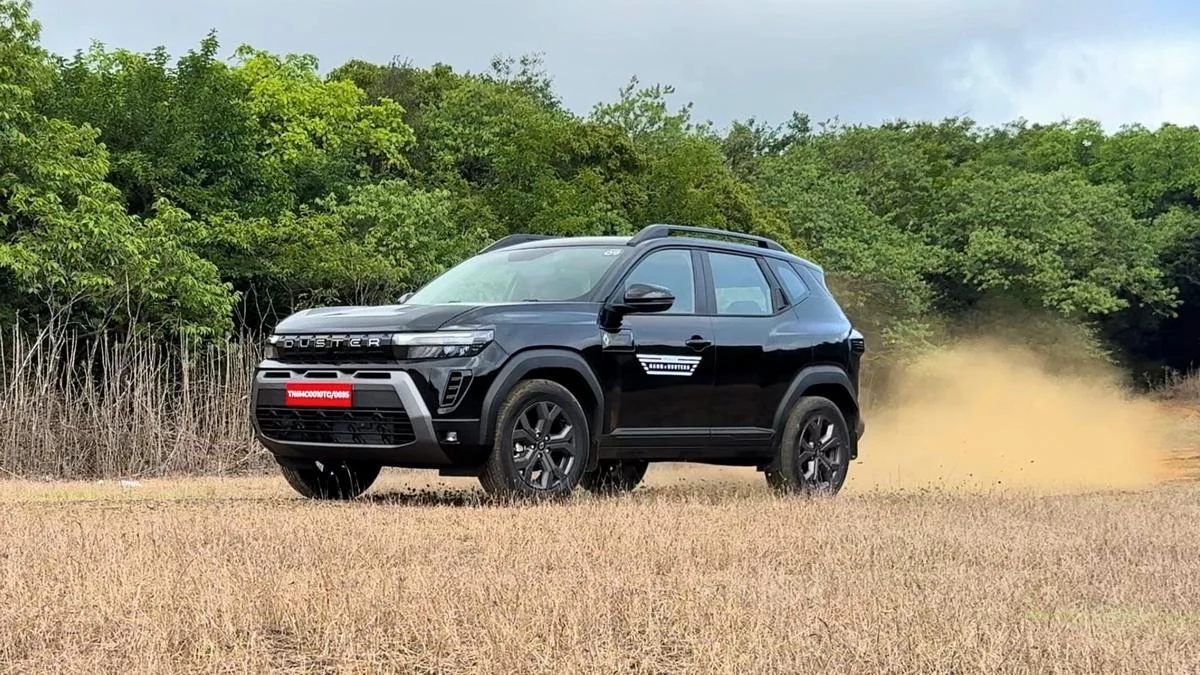
In an automotive landscape increasingly dominated by specification sheets and "bigger is better" marketing, the Renault Duster TCe 100 arrives as a sophisticated rebuttal to conventional wisdom. For years, the Indian car buyer has harbored a lingering skepticism toward small-capacity engines, particularly when tasked with hauling the bulk of a C-segment SUV. The prevailing assumption—that a 1.0-litre engine is inherently "underpowered" for a vehicle of the Duster’s stature—is a hurdle Renault has chosen to tackle head-on.
The Duster TCe 100 is not merely a budget-friendly entry point into the lineup; it is a masterclass in powertrain calibration. By leveraging turbocharging technology and precise gear-ratio matching, Renault has produced a vehicle that challenges the psychological barrier of engine displacement, proving that the quality of engineering often outweighs the quantity of cubic centimeters.
Main Facts: Breaking the 1,000cc Stigma
At the heart of this discussion is the Renault-Nissan-Mitsubishi Alliance’s 999cc, three-cylinder turbocharged petrol engine. On paper, the figures—100PS of power and 166Nm of torque—might seem modest compared to the high-output 1.3-litre turbo units found elsewhere in the segment. However, the raw data fails to capture the "tractability" of the motor.
The TCe 100 variant, priced between ₹10.49 lakh and ₹13.49 lakh, positions itself as a high-value alternative to both sub-compact SUVs and more expensive mid-size rivals. While it shares its basic architecture with the engine found in the Renault Kiger, the Duster’s iteration has undergone significant re-engineering. This is not a "plug-and-play" swap; the ECU mapping, cooling circuits, and transmission pairings have been specifically tailored to handle the Duster’s higher curb weight and more demanding driving cycles.
Key highlights of the package include:

- A "Big Engine" Feel: The engine delivers its peak torque at a low 2,000rpm, providing a surge of momentum that mimics a much larger naturally aspirated unit.
- Refined Transmission: A slick six-speed manual gearbox ensures the engine stays within its power band, offering a more engaging experience than the typical five-speed units found in entry-level crossovers.
- Chassis Excellence: The Duster retains its legendary suspension tuning, offering a ride quality that remains the benchmark for the segment.
Chronology: The Evolution of a Legend
To understand the significance of the TCe 100, one must look at the Duster’s journey in the Indian market. Launched originally in 2012, the Duster single-handedly created the compact SUV segment in India. Its success was built on the back of the 1.5-litre K9K diesel engine—a motor famed for its "go-anywhere" torque and bulletproof reliability.
However, the shift toward Bharat Stage VI (BS6) emission norms and a global pivot away from diesel forced a strategic reinvention. Renault’s response was a focus on downsizing and turbocharging.
- The Diesel Era (2012–2020): The Duster dominated via its rugged diesel powertrain and available AWD system.
- The Turbo Transition (2020–Present): Renault introduced the 1.3-litre HR13 turbo-petrol engine, co-developed with Daimler. While powerful, it left a gap for a more fuel-efficient, accessible turbo option.
- The TCe 100 Integration: The 1.0-litre turbo was introduced to bridge the gap between the entry-level 1.5-litre naturally aspirated engines of the past and the high-performance 1.3-litre units of the present.
The current TCe 100 represents the culmination of this evolution, applying the lessons learned from the Kiger and Magnite to a larger, more sophisticated platform.
Supporting Data: Technical Proficiency and Interior Sophistication
Powertrain Dynamics
The technical achievement of the TCe 100 lies in its torque-to-weight efficiency. While 166Nm may not sound revolutionary, the way it is delivered via the six-speed manual gearbox is critical. The first three gear ratios are relatively short, allowing the Duster to get off the line with surprising urgency. By the time the driver shifts into fourth or fifth, the turbo is fully spooled, providing a linear pull that makes highway overtaking a stress-free affair.
During testing, the vehicle demonstrated remarkable flexibility, pulling cleanly from 25 km/h in third gear. This "anti-stall" character is vital for urban Indian driving conditions, where frequent speed fluctuations usually demand constant gear changes.

Ride, Handling, and NVH
Renault has addressed the typical "thrum" of a three-cylinder engine through extensive use of sound-deadening materials and hydraulic engine mounts. While a slight vibration is perceptible at idle, it disappears entirely once the tachometer crosses the 1,500rpm mark.
The suspension remains the Duster’s "ace in the hole." Using a MacPherson strut front and a torsion beam rear (calibrated for firmness), the vehicle manages to iron out sharp ruts while maintaining excellent body control. Unlike many modern SUVs that feel "floaty" at high speeds, the Duster remains planted, thanks in part to its communicative steering setup which offers genuine feedback—a rarity in an era of overly assisted electric power steering.
Interior and Technology
Renault has moved away from the utilitarian "hard plastic" interiors of the past. The Techno variant features:
- Sophisticated Palette: A dual-tone cabin with brown accents and extensive fabric upholstery on the door pads and center console.
- Infotainment: A responsive touchscreen featuring wireless Apple CarPlay and Android Auto, integrated into a dashboard that prioritizes ergonomics.
- Safety and Hardware: 17-inch alloy wheels, all-wheel disc brakes (a significant safety upgrade), and a sunroof to cater to modern consumer preferences.
Official Responses and Expert Analysis: A Strategic Re-Engineering
While Renault has not released a detailed public white paper on the TCe 100’s development, technical experts from the Alliance indicate that the "re-engineering" mentioned in the drive experience is centered on the thermal management of the turbocharger.
Engineers noted that a 1.0-litre engine in a larger SUV body generates more heat under load than it would in a smaller hatchback. Consequently, the Duster TCe 100 features an optimized intercooler setup and a more robust clutch assembly to handle the increased rotational inertia.

Industry analysts suggest that Renault’s decision to stick with a manual transmission for the TCe 100 (initially) was a deliberate move to maximize the engine’s output. "By allowing the driver to control the shift points, Renault ensures the 1.0-litre motor is never caught ‘off-boost’ by an indecisive automatic gearbox," says one automotive consultant. "It’s a configuration that respects the driver’s intelligence."
Implications: Changing the Consumer Narrative
The success of the Duster TCe 100 has broader implications for the Indian automotive market, specifically regarding "displacement bias."
1. The Death of the "Big Engine" Requirement
As the Duster proves it can climb mountain passes and cruise at 120 km/h with just 999cc, it paves the way for other manufacturers to downsize without fear of consumer rejection. It shifts the conversation from "How big is the engine?" to "How wide is the torque curve?"
2. Challenging the European Hegemony
Traditionally, buyers looking for a "solid" driving feel—the heavy door thunk and the precise handling associated with European engineering—had to look toward the Volkswagen Taigun or the Skoda Kushaq. The Duster TCe 100 positions itself as a direct rival to these vehicles. It offers a similar "European" flavor but with a more rugged suspension setup that is arguably better suited for rural or broken Indian roads.
3. Value-Based Premiumization
At ₹13.49 lakh for the top-spec Techno trim, Renault is offering a "sweet spot" in pricing. It provides the safety of all-wheel disc brakes and the premium feel of a well-appointed cabin at a price point that often only gets buyers a mid-spec or base-spec version of its competitors. However, the lack of ventilated seats and electric seat adjustment remains a minor "miss" in a market that is increasingly obsessed with luxury features.

Conclusion: The New Benchmark for Balance
The Renault Duster TCe 100 is a reminder that excellence in automotive design is found in the balance of parts rather than the scale of specifications. It succeeds because it does not try to be a race car; instead, it tries to be the most competent version of a family SUV.
By delivering a powertrain that feels "eager" rather than "strained," and a chassis that feels "connected" rather than "isolated," Renault has revitalized the Duster brand. For the majority of SUV buyers who spend their time navigating city traffic and occasional weekend getaways, the TCe 100 isn’t just a viable option—it is arguably the most logical one. It proves that in the modern era, 1.0 litre is more than enough to carry the weight of a legend.
Renault Duster TCe 100 Price Range: ₹10.49 lakh – ₹13.49 lakh
Motorscribes, in association with The Hindu, brings you the latest in cars and bikes. Follow them on Instagram @motorscribes
