

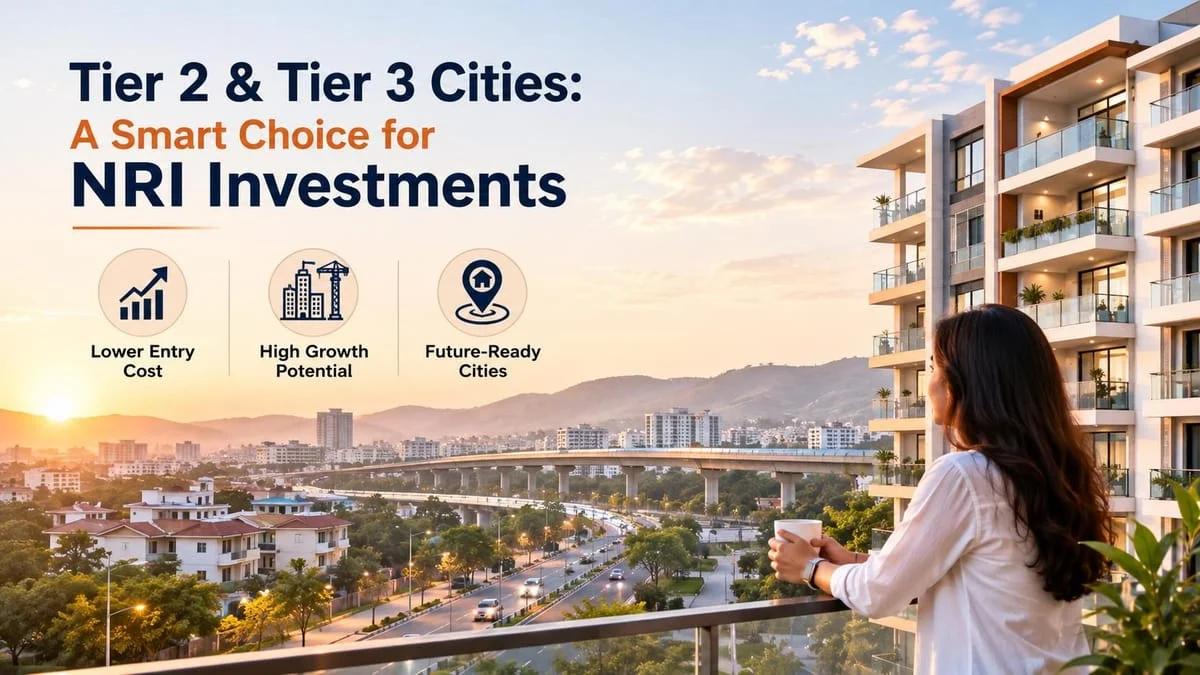
Executive Summary: A Paradigm Shift in Global Indian Investment
For decades, the narrative of Non-Resident Indian (NRI) investment in domestic real estate was anchored to the skyline of India’s "Big Three": Mumbai, Bengaluru, and the Delhi-National Capital Region (NCR). These metros offered the promise of liquidity, prestige, and reliable capital appreciation. However, as we move into the mid-2020s, a profound structural shift is underway. Driven by astronomical entry costs in Tier 1 cities, the saturation of urban infrastructure, and the rise of remote work, the NRI diaspora is increasingly looking toward India’s emerging urban centers.
Data from the 2024–2026 investment cycles suggests that Tier 2 and Tier 3 cities—once considered "sentimental" investments for those returning to their ancestral roots—have now transformed into high-yield strategic assets. From the tech-adjacent corridors of Hosur to the infrastructure-heavy landscape of Lucknow, the "peripheral" market is becoming the new mainstream.
1. Defining the New Urban Hierarchy: Tier 2 vs. Tier 3
To understand the investment migration, one must first understand how these cities are categorized. While the Reserve Bank of India (RBI) and various government agencies use population-based metrics, the real estate industry defines tiers based on commercial maturity and infrastructure readiness.
Tier 2: The High-Growth Mid-Sized Hubs
Tier 2 cities are the rising stars of the Indian economy. These are mid-sized urban centers characterized by rapid industrialization, the presence of regional IT hubs, and burgeoning secondary airports.
- Key Characteristics: Maturing infrastructure (Metros, Ring Roads), expanding job markets, and a growing "mall culture."
- Primary Examples: Chandigarh, Coimbatore, Indore, Jaipur, Kochi, Nagpur, and Lucknow.
- The NRI Draw: These cities offer a "metropolitan lifestyle" at a 30% to 50% discount compared to Mumbai or Bengaluru.
Tier 3: The Emerging Frontiers
Tier 3 cities are one level lower in terms of current development but offer the highest potential for "ground-floor" capital appreciation.
- Key Characteristics: Lower population density, developing civic amenities, and significantly lower land prices.
- Primary Examples: Alwar, Bathinda, Mathura, Hosur, Udipi, Junagadh, and Zirakpur.
- The NRI Draw: These are often "play" investments where the entry price is low enough to allow for the purchase of large land parcels or luxury independent villas that would be unaffordable in Tier 1 or Tier 2 zones.
2. Chronology of the Shift: From Metros to the Hinterland (2010–2026)
The transition of NRI capital from the "Big Three" to smaller cities did not happen overnight. It is the result of a fifteen-year evolution in India’s economic fabric.
- 2010–2016: The Era of Metro Obsession. NRIs focused almost exclusively on luxury high-rises in Gurgaon, South Mumbai, and Whitefield. Tier 2 cities were largely ignored due to a lack of transparency and the presence of unorganized local developers.
- 2017: The RERA Turning Point. The introduction of the Real Estate (Regulation and Development) Act (RERA) provided the legal framework necessary for NRIs to trust developers in smaller cities. Transparency became a national standard, not just a metro luxury.
- 2020–2022: The Pandemic Catalyst. COVID-19 changed the "Why" of investment. Many NRIs sought "homes away from home" in less congested cities. The rise of remote work meant that IT professionals (a large segment of the NRI pool) no longer needed to be physically present in Bengaluru or Pune, boosting the rental demand in Tier 2 cities.
- 2023–2026: The Infrastructure Explosion. The completion of massive projects like the Delhi-Mumbai Expressway, the expansion of the UDAN scheme (regional airport connectivity), and the proliferation of Metro Rail projects in cities like Kochi and Lucknow have solidified Tier 2 and 3 cities as viable commercial hubs.
3. Supporting Data: The Economics of the "Smaller" Market
The move to Tier 2 and Tier 3 cities is backed by compelling financial metrics that outperform the stagnant yields of many Tier 1 luxury segments.
Snapshot of Key Investment Hubs (2026 Projections)
| City | Tier | Primary Growth Driver | Price Advantage vs. Tier 1 | Annual Appreciation Trend |
|---|---|---|---|---|
| Kochi | 2 | Port expansion, Tourism, NRI repatriation | 35–40% Cheaper | 7–10% |
| Lucknow | 2 | New Metro corridors, IT Parks, Political focus | 45% Cheaper | 8–12% |
| Hosur | 3 | Proximity to Bengaluru’s Electronic City, New Metro | 60% Cheaper | 9–15% |
| Bharuch | 3 | Port expansion, Industrial Freight Corridor | 65% Cheaper | 6–9% |
The Price-to-Value Ratio
In a Tier 1 city like Mumbai, an NRI might spend ₹5 Crores ($600,000+) for a 3-bedroom apartment. In a Tier 2 city like Chandigarh or Indore, that same investment can secure a sprawling independent bungalow or two premium luxury apartments. This "lifestyle arbitrage" is a significant psychological driver for the diaspora.
4. Official Framework: The Legal and Regulatory Landscape
For NRIs and Overseas Citizens of India (OCIs), the legal framework for investing in Tier 2 and Tier 3 cities is governed by the Foreign Exchange Management Act (FEMA).
Ownership Rights
NRIs have the same rights as resident Indians when it comes to purchasing residential and commercial property. There is no limit on the number of properties an NRI can own. However, a critical restriction remains: Agricultural land, farmhouses, and plantation properties cannot be purchased directly. These can only be acquired through inheritance or, in specific cases, as a gift from a resident Indian, subject to FEMA compliance.
Financial Protocols
To ensure the legality of the transaction and ease of future repatriation, all payments must be channeled through:

- NRE (Non-Resident External) Accounts
- NRO (Non-Resident Ordinary) Accounts
- FCNR (Foreign Currency Non-Resident) Accounts
Direct transfers from overseas are permitted, but cash transactions, foreign currency notes, or traveler’s checks are strictly prohibited and can lead to severe penalties under anti-money laundering laws.
5. Official Industry Responses: What the Experts Say
Market analysts and developers are increasingly bullish on the "Rurbanization" (Rural-Urbanization) of India.
The Developer Perspective:
Large national developers (such as Godrej Properties, DLF, and Tata Housing) who previously only operated in metros are now launching massive townships in Tier 2 cities. "We are following the infrastructure," says a senior executive at a leading real estate firm. "When the government builds a 12-lane expressway to a city like Jaipur or Alwar, the real estate value follows immediately. NRIs recognize this ‘first-mover’ advantage."
The Economic Analyst Perspective:
Economists note that the "Reverse Brain Drain" is fueling this trend. As high-achieving NRIs plan for eventual retirement or look to provide better housing for their aging parents in their hometowns, they are demanding Tier 1 amenities (gated communities, clubhouses, 24/7 security) in Tier 2 locations. This has forced local developers to upgrade their construction quality to international standards.
6. Critical Implications: Risk vs. Reward
While the allure of Tier 2 and 3 cities is strong, seasoned investors must weigh the inherent risks.
The Infrastructure Gamble
The single greatest risk in Tier 3 investment is the "Promise vs. Reality" gap. Appreciation in these markets is almost entirely dependent on proposed infrastructure. If a promised Metro line or Industrial Park is delayed by five years, the capital appreciation of the surrounding residential projects will stall. Unlike Tier 1 cities, which have "organic" demand, Tier 3 cities rely on "induced" demand from government projects.
Liquidity Concerns
Tier 2 markets have established resale markets, making it relatively easy to exit an investment. However, Tier 3 markets can be "illiquid." An NRI might find that while their property value has technically doubled on paper, finding a buyer at that price point in a smaller town may take significantly longer than in a city like Mumbai.
The Maturity Factor
- Tier 2: Offers a balance of moderate risk and steady growth. The market is mature enough to support a rental economy.
- Tier 3: High-risk, high-reward. These are long-term plays (10+ years) where the investor is essentially betting on the city’s transformation into a Tier 2 hub.
Final Thoughts: The Strategy for 2026 and Beyond
The trend of NRI investment in Tier 2 and Tier 3 cities represents the "democratization" of Indian real estate. It is no longer a market reserved for the elite in the metros. However, the shift requires a higher level of due diligence.
For the modern NRI investor, the strategy is no longer just about "buying home." It is about identifying the specific corridors where government spending meets private sector job creation. Whether it is the IT-driven growth of Hosur or the infrastructure-led rise of Lucknow, the smart money is moving away from the crowded skylines of the metros and toward the expansive horizons of India’s emerging heartland.
The bottom line: In the next decade, the most significant wealth in Indian real estate will likely be created not in the cities we already know, but in the ones we are just beginning to discover.
