

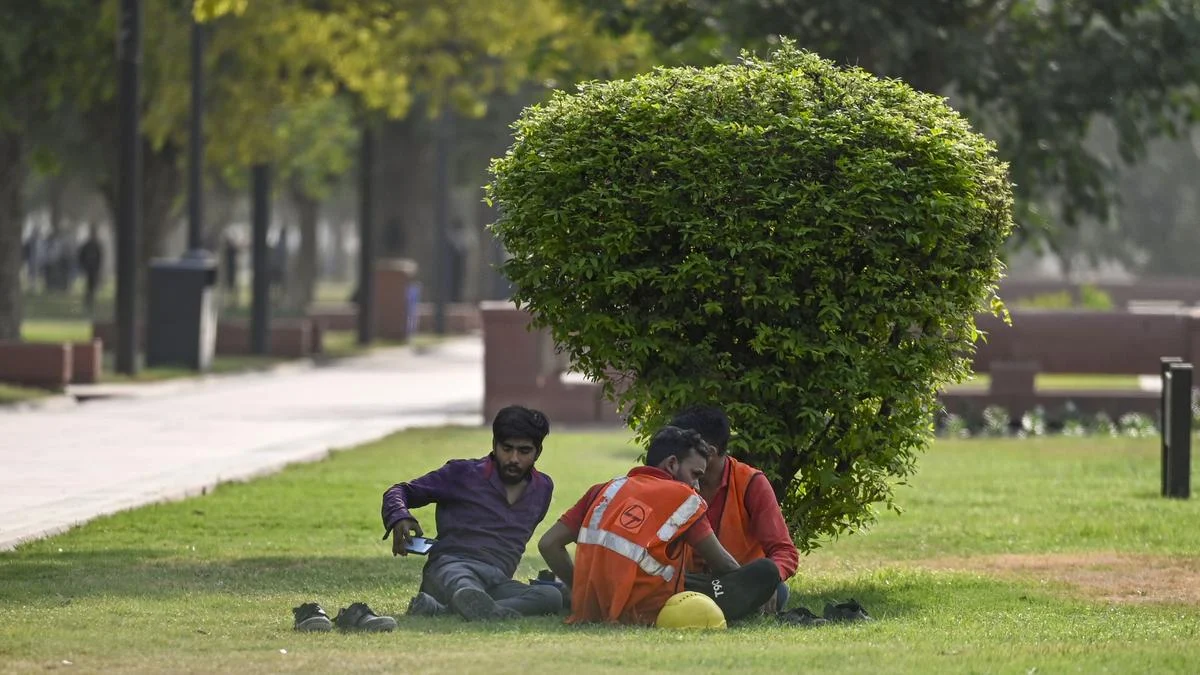
As extreme heat grips Indian cities, a stark reality emerges: while affluent enclaves boast lush greenery and cooling infrastructure, the vast majority of urban dwellers, particularly essential workers, are left to face the scorching sun with nowhere to turn. The erosion of accessible public spaces further exacerbates this crisis, creating a society of exclusion and diminishing the democratic fabric of our cities.
The Invisible Victims of Urban Heat Islands
Trees are a powerful, natural air conditioning system, capable of cooling neighbourhoods by a significant 2°C to 12°C. Noida, a city in the National Capital Region, may officially count 726 parks and 800 kilometres of green belt. However, this cooling infrastructure is far from equitably distributed. The verdant, shaded areas are overwhelmingly concentrated in its affluent sectors, leaving the very people who form the backbone of the city’s economy – delivery personnel, construction workers, and domestic staff – exposed to the relentless heat.

Shajid, a gig worker navigating the bustling streets of Greater Noida’s Patwari, embodies this disparity. His delivery platform’s stringent 10-minute guarantees force him into a relentless race against time. He shuttles between "dark stores" – often utilitarian warehouses devoid of any natural respite – and delivery points, his two-wheeler a familiar sight weaving through traffic, often pushing the limits of speed and traffic laws. All this, under a sun that can push temperatures to a staggering 46°C. For Shajid and countless others like him, moments of relief are ephemeral, usually limited to a few minutes spent in the air-conditioned lobbies of upscale residential towers while awaiting an elevator.
"Gig and domestic workers, and people who have to be in the public arena have no place to rest," states Avani Chokshi, a labour lawyer from Bengaluru. "In the afternoon, some parks in the city are locked." This sentiment is echoed by Prema Kumari, a 53-year-old cook who serves multiple families in North Bengaluru’s gated communities. Her demanding schedule, from 6:30 a.m. to 7 p.m., leaves little room for rest. "I am not allowed to even sit on the benches in the society’s gardens," she shares, her voice tinged with resignation. "The security guards shoo us away. If we want to sit down, we must go sit outside the society." Without any shaded benches outside, Kumari is forced to retreat to the stuffy basement, finding solace only in the company of the laundry woman.
The Patwari locality itself exemplifies the growing chasm. It is a rapidly developing area characterized by colossal apartment complexes, some boasting over 30 towers housing thousands. Residents pay exorbitant sums for their enclaves, complete with manicured gardens, meticulously maintained parks, walkways, and clubhouses. While these spaces are welcoming havens for residents, they are strictly cordoned off to the very workers who contribute to their upkeep and comfort. The question of where these individuals find respite after hours of strenuous labour remains largely unanswered.

Urban Planning’s Exclusionary Legacy
This exclusionary urban planning is not an isolated incident but a pervasive issue across the country. Labour lawyer Avani Chokshi argues that urban planning has become inherently hostile to the common citizen. "Gig and domestic workers, and people who have to be in the public arena have no place to rest," she emphasizes. "In the afternoon, some local parks in the city [like Bengaluru’s Lakshmidevi Park and Citizen Park in R.T. Nagar] are locked; they only open during the early morning and evening hours." When questioned, security guards often cite the need to prevent "nuisance and illegal activities."
This practice, however, directly contravenes legislation like The Karnataka Parks, Play-fields and Open Spaces (Preservation and Regulation) Act, 1985, which aims to protect and regulate urban green spaces. The irony was palpable when a citizen’s grievance on Bengaluru’s civic app, Sahaaya 2.0, regarding park access, was “resolved” with a notification stating: "Park will be open morning at 5 AM to 11 AM and evening 4 PM to 8 PM."

The global standard set by the World Health Organization (WHO) recommends 9 sq.m. of green space per capita in urban areas. Yet, Indian cities fall woefully short. Chennai and Pune offer a mere 0.81 sq.m. and 1.4 sq.m. respectively. Bengaluru manages approximately 2.25 sq.m., Delhi 2.9 sq.m., and Mumbai lags at 1.24 sq.m. Chokshi powerfully asserts, "One has the right to be in a public space. Anyone who doesn’t have a good house or place to rest should be able to find open, accessible spaces outside without spending money." This right is implicitly protected by Articles 19 and 21 of the Indian Constitution, which guarantee fundamental freedoms and the right to life and dignity. However, the awareness of these rights among the populace remains limited.
The very definition of public space, as articulated by Sameera Khan, Shilpa Phadke, and Shilpa Ranade in their seminal work "Why Loiter?", encompasses not just recreational areas like parks but also functional sites like streets, bus stops, marketplaces, and public transport. Footpaths and pavements, crucial for pedestrian movement, are also integral components of this urban infrastructure.
The Rising Cost of Staying Cool: A Societal Divide

The harsh realities faced by Shajid and Prema Kumari are amplified by the growing trend of privatized urban spaces. Gated communities and exclusive residential complexes, while offering amenities to their residents, effectively create invisible walls, barring entry to those who serve them. This reflects a deeper societal attitude highlighted by Khan: "We want the labour of working-class people, but not their presence in the spaces that surround us."
This sentiment is further elaborated by the authors of "Why Loiter? Women & Risk on Mumbai Streets." They question why citizens shouldn’t find pleasure in their city spaces and, crucially, who has access to them. Khan explains, "If women, marginalised groups, so-called ‘outsiders’ or the working-class population have no access to a space, then it hints at what kind of a person is an acceptable citizen in society." Their research suggests that urban planning is often patriarchal, designed with a privileged, able-bodied, middle-class, upper-caste, cis-het male in mind. Those who don’t fit this mould are left to adapt to inadequate infrastructure.
The escalating frequency and intensity of heatwaves underscore the urgency of this issue. A study by the non-profit HeatWave documented at least 84 heatstroke deaths across India between March 1 and June 24 of the previous year, acknowledging that the actual toll was likely higher due to diagnostic limitations. The report, "Struck by Heat: A News Analysis of Heatstroke Deaths in India in 2025," identified Maharashtra, Uttar Pradesh, and Telangana as states with the highest reported fatalities.

Erosion of Democratic Experiences in the Urban Landscape
India’s major metropolises are in a perpetual state of construction – a relentless cycle of building skyscrapers, expanding metro lines, and developing new infrastructure. In Chennai, Metro Rail work has been ongoing for over 17 years. Mumbai and Bengaluru face similar protracted development timelines, with Bengaluru’s progress averaging a mere 7 km per year.
This constant "work-in-progress" often comes at the expense of vital public spaces. Parks, maidans, beaches, footpaths, and public libraries, once vibrant testaments to India’s democratic spirit, are rapidly disappearing. Their users are increasingly policed, surveilled, or relegated to private-public spaces like malls, where their presence is tolerated only as consumers. As gated communities and exclusive experiences proliferate, truly public spaces face existential threats. This erosion leads to a loss of uncurated, mixed-class, and unfiltered encounters, diminishing the very essence of urban life.

Shruti Sah, co-founder of the initiative Cubbon Reads in Bengaluru, highlights the intrinsic value of free public parks. "A free public park does not ask who you are before letting you in. It naturally allows for a mix of classes, languages and backgrounds," she states. "For many, especially those without access to private leisure spaces, parks become essential grounds for pause, movement and presence." Cubbon Reads, which brings together diverse groups for silent reading every Saturday, has witnessed migrants, families, students, and regulars coexisting harmoniously. Harsh Snehanshu, Sah’s partner, adds, "Access to something as simple as sitting on grass now increasingly requires entry into a park. Spaces marketed as ‘living in nature’ often come at a premium and are tied to privilege."
Glimmers of Hope: Innovative Solutions and the Fight for Public Space
Amidst this concerning trend, some cities are beginning to implement innovative solutions. Jaipur, Ahmedabad, Pune, and Hyderabad are taking tentative steps to mitigate the effects of extreme heat. Jaipur’s Pink City has introduced a solar-powered cooling station, offering a welcome 5°C-6°C respite to pedestrians and workers. Chennai has opened air-conditioned rest lounges specifically for gig workers.

In Kochi, the "Kawaki" movement, a community-led urban greening initiative launched in 2021, is actively creating recreational green spaces by planting native tree saplings. Priya Narayanan, senior program manager for urban development at WRI India, explains that Kawaki empowers neighbourhood stakeholders as custodians of conservation, initiating the process with "Mapathons" to identify suitable locations for urban micro-forests.
Globally, cities like Oslo, Ljubljana, Frankfurt, Singapore, and Vienna stand as exemplars of prioritizing green spaces. Oslo boasts 67% tree coverage, Ljubljana offers over 540 sq.m. of accessible public green space per resident, Frankfurt has 52% green areas, Singapore’s "City in Nature Green Plan" aims for 50% green space, and Vienna dedicates approximately 50% of its land area to green spaces and water bodies.
The Critical Need to Demand and Defend Public Spaces

According to UN-Habitat, 30% of city land should be designated as public open space. Indian cities, however, rarely exceed 10%. This deficit, coupled with the inadequate per capita green space, paints a grim picture of urban livability for the majority.
A significant concern raised by urban advocates like Khan is the public’s lack of awareness regarding the gradual erosion of these spaces. As citizens become accustomed to living without parks, lakes, and accessible benches, they risk losing these vital amenities altogether. "If citizens don’t actively choose to use public spaces because they don’t find them in their vicinities or find them unclean or inaccessible, they won’t notice when these spaces disappear or increasingly get privatised," Khan warns. This gradual displacement towards enclosed, privatized environments erodes the fundamental concept of freely occupying and experiencing a city.
The introduction of the "Right to Public Space Bill" in India’s Rajya Sabha on December 8, 2023, marks a significant legislative push. The bill advocates for free and accessible public areas where citizens can gather, protest, and engage in social and cultural life. V. Sivadasan, the Rajya Sabha member who introduced the bill, underscored that "Free access to a deliberative public space is a fundamental human right. Access to empowering, educative and transformative public spaces is the right and necessity for every human being."

Ultimately, the survival of public spaces hinges on active citizen engagement. It requires not just protest against the felling of trees or the demolition of parks, but a consistent, everyday recognition that lakes, parks, footpaths, and playgrounds are as crucial to urban infrastructure as highways, flyovers, and tunnels. The choice lies with us: whether to build cities designed for consumption and exclusion, or cities that foster pause, inclusion, and co-existence. The future of our urban commons, and the well-being of all its inhabitants, depends on it.
