


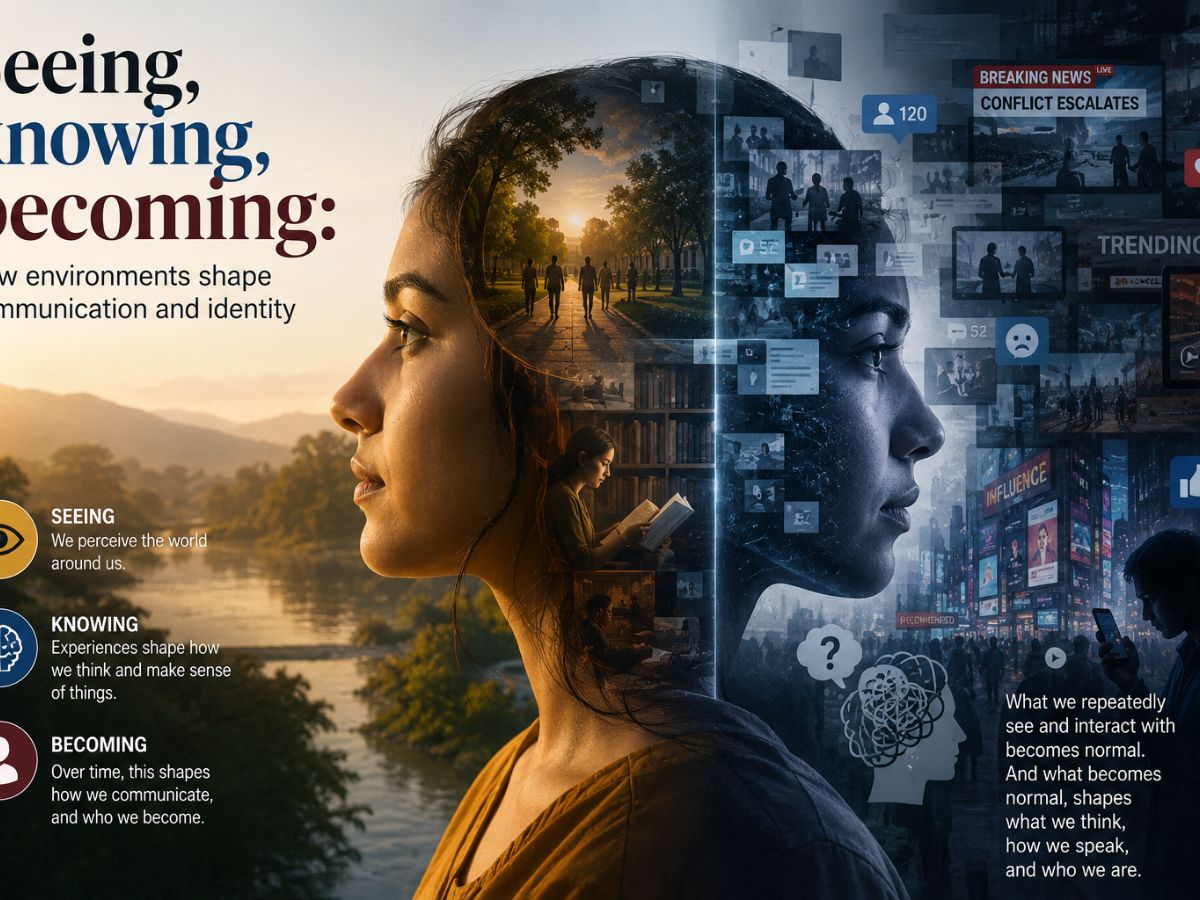
In an era defined by ceaseless digital streams and curated experiences, the very essence of who we are and how we express ourselves is being subtly but profoundly shaped by the environments we inhabit. Far from being internal constructs, our communication styles and personal identities are increasingly revealed as products of constant exposure, repetition, and the normalization of what we see, hear, and interact with daily.

The notion that our surroundings mold our inner lives is not a recent revelation. Ancient philosophical traditions have long recognized the intricate interplay between external stimuli and internal development. However, in today’s media-saturated world, this ancient wisdom takes on a new urgency. The sheer volume and pervasive nature of modern environments, from social media feeds to algorithmically tailored content, have amplified this influence to an unprecedented degree, shaping not only what we know, but how we reason, articulate, and ultimately, who we become.
)
The Foundation of Knowing: Perception as the Gateway
At the heart of this phenomenon lies the fundamental role of perception in shaping human understanding and expression. Classical Indian philosophy, particularly the Nyaya Sutra, a foundational text on logic and epistemology, provides a robust framework for understanding this connection. The Sutra posits perception (pratyaksha) as the primary and most reliable source of valid knowledge. It asserts that all knowledge originates from the direct contact between our senses and the external world. What we witness, what we hear, and what we experience forms the bedrock upon which we build our inferences, judgments, and entire reasoning processes.

This sequence is elegantly simple yet profoundly impactful: the external stimulus precedes our internal cognition, and this cognition, in turn, informs our articulation. The Nyaya school’s emphasis on the primacy of perception underscores a crucial point: our understanding of reality is intrinsically linked to what we are exposed to. If the spectrum of our perceived world narrows, so too does the scope of our reasoned thought. As the adage suggests, thought follows exposure.
)
The Accumulation of Being: Impressions and the Formation of Identity
Extending this philosophical inquiry, the Yoga Sutra delves into the formation of the mind, defining it as a flux of mental modifications or "vrittis." The famous aphorism, "Yogash chitta vritti nirodhah" (Yoga is the cessation of the fluctuations of the mind), highlights the dynamic nature of our internal landscape. These mental fluctuations, the Yoga Sutra explains, arise from impressions (samskaras) forged through sensory engagement and lived experiences.
)
Over time, repeated exposure to specific stimuli leaves deeper imprints on our consciousness. These imprints, the samskaras, gradually shape our tendencies, preferences, and ingrained patterns of response. In this light, identity is not an immutable, self-generated entity. Instead, it is something that is continuously accumulated, a tapestry woven from the threads of our accumulated experiences and the environments that have provided them. What we repeatedly encounter becomes what we recognize; what we recognize becomes what we deem valid; and what we deem valid becomes what we express.
)
The Amplified Influence: Contemporary Environments and Their Impact
The contemporary media environment has dramatically amplified these ancient insights. We are now immersed in a dense ecosystem of stimuli: the constant scroll of social media feeds, the curated narratives of news platforms, the personalized recommendations of streaming services, and the omnipresent stream of digital information. These environments are far from neutral arbiters of information. They actively, albeit often subtly, privilege certain forms of expression, amplify particular linguistic styles, and normalize specific ways of interpreting and framing the world.
)
This constant, often unexamined, exposure exerts a powerful influence on both our communication patterns and our self-perception. Consider the homogenization of language across digital platforms. Words, phrases, and linguistic conventions circulate with remarkable speed, rapidly acquiring shared meanings and functioning as markers of social belonging. What might initially serve as a descriptive term can, through repetition and widespread adoption, evolve into a signifier of identity. Expressions that once denoted a preference or a casual activity can now function as definitive labels of self-definition.
)
This linguistic standardization is not a mere coincidence; it is a direct reflection of the formative power of repeated exposure to particular linguistic patterns. These patterns, through sheer ubiquity, come to feel natural, expected, and even essential for meaningful participation in the digital sphere.
)
The Narrowing of Perspective: Opinions and the Illusion of Consensus
The same process is demonstrably at play in the formation of opinions and political positions. When individuals are consistently exposed to a limited range of perspectives, it can foster the illusion of a widespread consensus, even when dissenting voices are abundant but marginalized. Similarly, sustained engagement with specific narratives, often presented with persuasive rhetoric and emotional appeals, can powerfully shape what individuals consider credible, legitimate, or even factual.
)
The Nyaya emphasis on perception as the genesis of knowledge offers a stark warning: when the range of what is perceived is artificially narrowed, the capacity for broad and nuanced reasoning inevitably contracts. Our ability to construct complex arguments and consider alternative viewpoints is directly tethered to the richness and diversity of our perceptual inputs.
)
The Yoga Sutra’s concept of impressions adds another critical dimension. Repetition deepens impact. While a single encounter might offer information, sustained exposure fundamentally forms. Over time, the patterns of interaction within our environments leave indelible cognitive and emotional residues that profoundly influence our behavior. Preferences begin to feel inherent, even when they are the direct product of accumulated exposure. Identity appears stable and self-determined, even as it is continuously being sculpted by external forces.
)
Implications for Institutions: The Critical Role of Environmental Design
This understanding of how environments shape thought and expression carries significant implications for institutions, particularly those involved in education and communication. If our cognitive processes and communicative styles are so deeply influenced by our surroundings, then the deliberate design of these environments becomes paramount. What we choose to make visible, what we emphasize, and what we repeatedly present will not only dictate what individuals know but also how they think and how they articulate that thinking.
)
Higher education institutions, for example, often prioritize content delivery and skill development. However, they may overlook the crucial communicative environment within which learning unfolds. If exposure truly shapes cognition, then the quality of discourse, the deliberate inclusion of diverse perspectives, and the nature of intellectual engagement become central to the efficacy of the educational process. A learning environment that fosters critical thinking must be one that exposes students to a multiplicity of ideas and encourages robust, respectful debate.
)
The same principles apply to the media and public communication spheres. The increasing trend of compressing complex information into short, easily digestible formats, while potentially enhancing accessibility, carries the significant risk of diminishing nuance. When our exposure is predominantly limited to simplified representations, our capacity for complex, multi-faceted thought can erode. Communication may become more efficient, but it can also become less substantive, sacrificing depth for brevity.
)
Navigating the Influence: Awareness and Deliberate Shaping
The challenge ahead is not to eliminate influence altogether, for that is an impossible and perhaps even undesirable task. Rather, the imperative is to cultivate a profound awareness of its operation. We must recognize that what we repeatedly see will inevitably shape what we think, and what we think will, in turn, shape what we say.
)
In an era where our environments are increasingly mediated and intentionally curated, this awareness is not merely beneficial; it is essential for intellectual autonomy and genuine self-understanding. Communication and identity do not spring forth in a vacuum. They emerge at the intricate intersection of exposure, interpretation, and repetition. The fundamental question is not whether we are influenced by the world around us. It is whether we are attentive to the intricate ways that influence operates and whether we are deliberate in shaping the environments that, in turn, are shaping us. By fostering environments that champion diversity of thought, encourage critical engagement, and promote deep understanding, we can empower ourselves and future generations to communicate more meaningfully and to forge identities that are both authentic and resilient.
