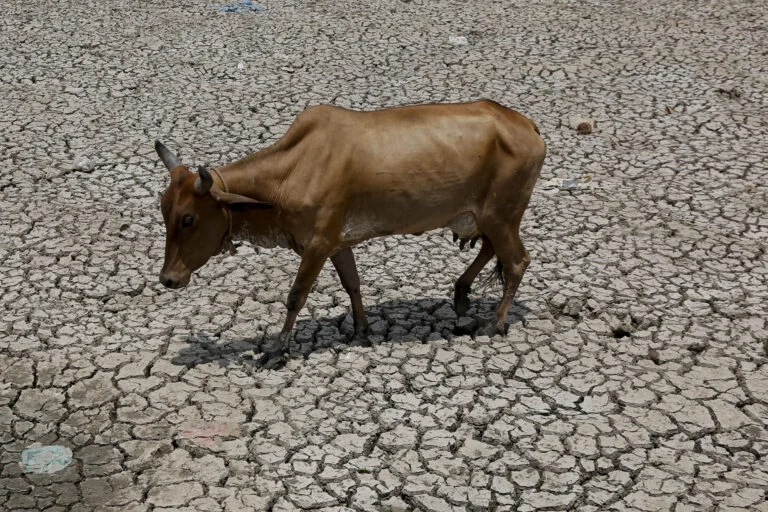
SULTANPUR, UTTAR PRADESH – For Jagdish Agrahari, a resident of Sultanpur in Ayodhya district, the transition into dairy farming was supposed to be a lifeline. In August 2025, seeking to supplement the modest income from his family’s scrap shop, Agrahari invested in a small herd: four Jersey cows, one Holstein Friesian, and three buffaloes. By March, however, the venture turned into a financial nightmare. As the seasons shifted, a sudden, searing spike in temperature left his exotic Jersey cows unable to acclimate. One cow fell severely ill, racking up a treatment bill of ₹20,000—a staggering sum for a rural household.
By the end of April, despite the costly medical intervention, the cow died.
Agrahari’s story is not an isolated tragedy; it is a harbinger of a systemic collapse facing India’s cattle economy. As climate change accelerates, the "White Revolution" that made India the world’s largest milk producer is under siege from rising temperatures, vanishing fodder, and disrupted biological cycles.
Main Facts: A Sector at the Breaking Point
India has led the world in milk production since 1998, a feat built on the backs of approximately 80 million rural households. However, this massive decentralized industry is uniquely vulnerable to the shifting climate. According to a landmark study by the Council on Energy, Environment and Water (CEEW), more than half (54%) of buffalo rearers and 50% of those rearing crossbred or exotic cattle report significant climate-related impacts on their livestock.
The crisis manifests in four primary ways:

- Reduced Productivity: Heat stress directly correlates to a drop in milk yield, often by 25% to 33% during peak summer months.
- Increased Mortality and Disease: High temperatures weaken immune systems, leading to higher calf mortality and frequent skin infections.
- Fodder Scarcity: Extreme heat and changing rainfall patterns have made green fodder a luxury, while the price of dry fodder has become unaffordable for 70% of households.
- Reproductive Failure: "Silent heat" and hormonal imbalances are making it increasingly difficult for cows and buffaloes to conceive, shortening their productive lifespans.
In Uttar Pradesh, the nation’s leading milk-producing state, the stakes are existential. The intersection of extreme heat and economic fragility is forcing many farmers to abandon the trade, contributing to a growing national crisis of stray cattle.
Chronology: From the White Revolution to the Warming Crisis
To understand the gravity of the current situation, one must look at the trajectory of India’s dairy growth.
- 2000–2023: India witnessed an unprecedented surge in production. Milk output grew from approximately 80 million tonnes at the turn of the millennium to a staggering 239 million tonnes in 2023. This growth was fueled by the adoption of high-yield crossbred cows (like Holstein Friesians and Jerseys) and the expansion of dairy cooperatives.
- The Mid-2010s: The first major warning signs of climate volatility began to emerge. Farmers noticed that traditional grazing lands were disappearing due to infrastructure projects—such as the Purvanchal Expressway—and encroaching urbanization.
- 2022: A turning point in livestock mortality. Extreme weather events across India claimed the lives of over 69,000 livestock animals, according to the Centre for Science and Environment.
- 2024–2025: Heatwaves became longer and more intense. The India Meteorological Department (IMD) began warning of "searing summers" with higher-than-average night temperatures, which prevent animals from recovering from daytime heat stress.
- Present Day: The dairy sector now faces a "new normal" where summer milk collection can drop by nearly 43%, as seen in the procurement routes of major cooperatives like Banas Dairy.
Supporting Data: The Economics of Heat Stress
The financial blow to the individual farmer is quantifiable and devastating. Nipendra Kumar, a 38-year-old dairy farmer in Moradabad and a member of the Banas Dairy cooperative, provides a stark breakdown of the seasonal deficit.
Kumar owns 15 animals. During the winter, his monthly profit hovers around ₹50,000. When the summer heatwaves hit, his profit is slashed by exactly half, to ₹25,000. "During summer months, my investment in procuring fodder, nutrition, and care rises, but milk yield is less," Kumar explains. He notes that his yield drops by at least four litres per animal per day. Furthermore, the quality of milk suffers; heatwaves lead to "sour milk" and occasionally traces of blood in the yield due to internal bovine stress.
The Fodder Inflation
The CEEW study highlights a growing "fodder poverty" in Uttar Pradesh:
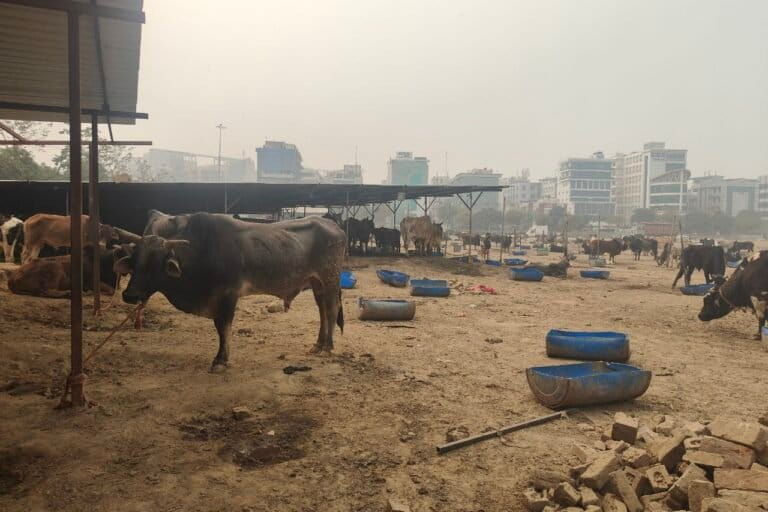
- Green Fodder: 48% of cattle-rearing households find it unaffordable (compared to a 42% national average).
- Dry Fodder: A staggering 70% of households report it as unaffordable.
- Land Access: 33% of households in the state are unable to access land for fodder cultivation, more than double the national average.
Biological Vulnerability
The biological makeup of India’s livestock determines their climate resilience. Buffaloes, which provide a significant portion of India’s high-fat milk, are particularly prone to heat. Their thick, dark skin absorbs more solar radiation, and they possess fewer sweat glands than cows, limiting their ability to thermoregulate. When water bodies—traditionally used by buffaloes to cool off—dry up due to drought or encroachment, the animals’ internal temperatures soar, leading to restlessness and reduced lactation.
Official Responses: Policy Gaps and Scientific Warnings
Government bodies and scientific institutions are beginning to sound the alarm, though policy implementation remains "uneven" at best.
The Scientific Perspective
Bishwa Bhaskar Choudhary, a scientist at ICAR’s Indian Grassland and Fodder Research Institute, emphasizes that adaptation is a luxury of the wealthy. "Effective adaptation necessitates improved feeding practices and heat-alleviating infrastructure like cooling and shade facilities," Choudhary says. "Small and marginal livestock rearers operate under constrained economic conditions, increasing their vulnerability to recurrent heatwaves."
Dr. Satya Prakash of the Ghazipur GAAI government hospital notes that the traditional breeding cycles are being "shattered" by extreme weather. Heat stress disrupts hormonal balances, leading to "early embryonic losses."
The Government’s Push for AI
The Department of Animal Husbandry and Dairying (DAHD) has promoted Artificial Insemination (AI) as a dual solution: to improve genetic quality and to mitigate the stray cattle problem by producing more female calves. While 94% of farmers in Uttar Pradesh are aware of AI, only 48% actually utilize it. Experts like Ashutosh Tripathi, Assistant Professor at Sardar Vallabhbhai Patel University of Agriculture and Technology, suggest a shift back to Indigenous breeds. These breeds, while perhaps producing less milk at peak than exotic varieties, possess a natural climate resilience and disease resistance that allows them to conceive even in the height of May and June.
The Failure of Heat Action Plans
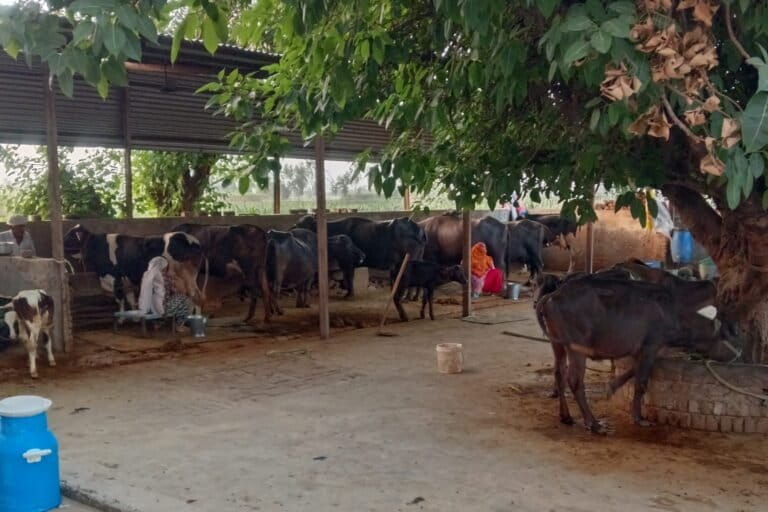
Despite being one of the most heatwave-prone states in India, Uttar Pradesh’s administrative response is lagging. An analysis by the Vasudha Foundation revealed that only two of the state’s 75 districts have comprehensive district-based climate action plans. While 44 districts have some form of heat advisory, these rarely translate into tangible support—such as subsidized cooling equipment or emergency fodder banks—for small-scale farmers.
Implications: A Threat to Nutritional and Economic Security
The crisis in the dairy sector has far-reaching consequences that extend beyond the farm gate.
1. The Stray Cattle Crisis
When a cow or buffalo becomes unproductive due to heat-induced infertility or shortened lactation, and the farmer can no longer afford the high cost of fodder, the animal is often abandoned. This has led to a massive stray cattle problem in Uttar Pradesh, where roaming herds damage crops and cause road accidents, creating a secondary economic drain on the rural community.
2. Nutritional Security
Milk is a primary source of protein and nutrition for millions of Indian children. The Lancet study projects that rising temperatures could slash milk production by 25% in India’s arid and semi-arid regions by 2085. A sustained drop in production will inevitably lead to higher retail prices, making this essential nutrient less accessible to the urban and rural poor.
3. The Collapse of the "Safety Net"
For decades, livestock has served as "living insurance" for farmers. When crops failed due to erratic monsoons, the sale of milk or the animal itself provided a financial buffer. As climate change simultaneously attacks both crops and cattle, this safety net is fraying. "Unlike seasonal crop income, livestock generates continuous returns," says scientist Bishwa Bhaskar Choudhary. If that continuity is broken, the cycle of rural poverty will only deepen.

4. Long-term Global Projections
The Food and Agriculture Organization (FAO) and the World Meteorological Organisation warn that by 2100, up to 75% of global livestock could be exposed to dangerous heat conditions. For a nation like India, where the dairy sector is a cornerstone of the rural economy, these projections are not merely environmental warnings—they are economic red alerts.
As Jagdish Agrahari gazes at his diminished herd in Sultanpur, the global statistics matter less than the immediate reality of his empty cattle stall. The "White Revolution" was won through grit and local innovation. To survive the "Heat Revolution," India will need a massive, coordinated effort to prioritize climate-resilient breeds, protect common grazing lands, and provide a financial cushion for the 80 million households currently feeling the burn of a warming planet.