

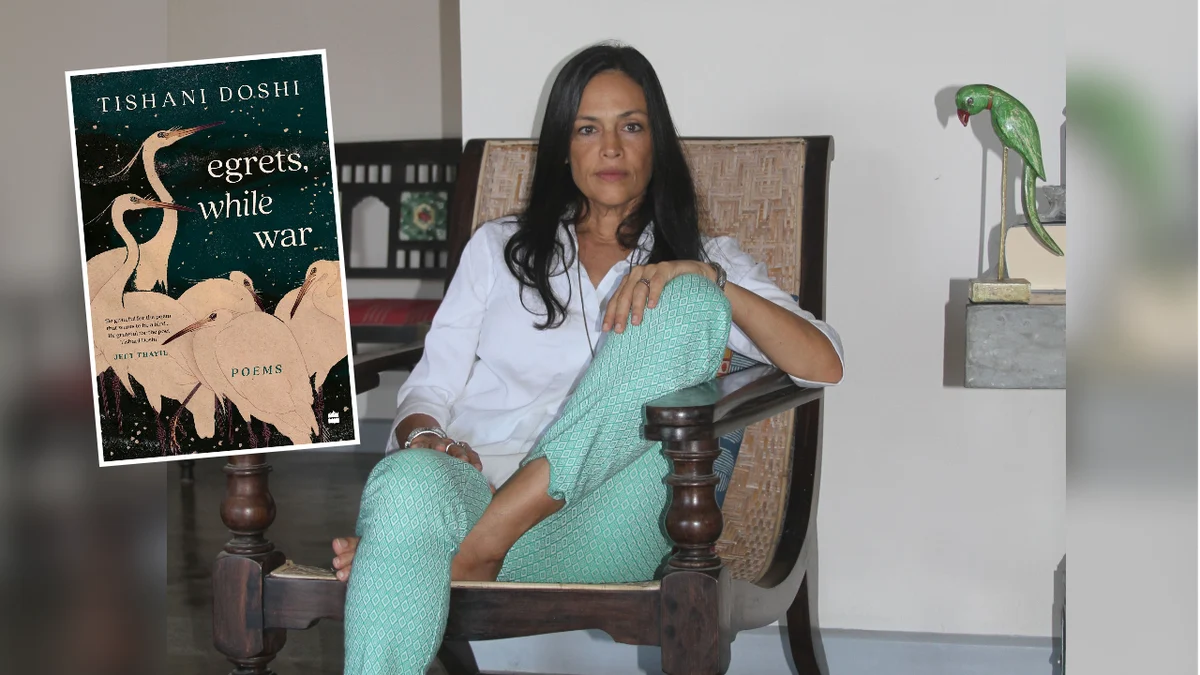
In the quiet, salt-sprayed coastal village of Paramankeni, near Chennai, the air is often thick with the calls of shorebirds and the rhythmic pulse of the Bay of Bengal. It is here that Tishani Doshi—acclaimed poet, novelist, and dancer—navigates the complexities of a world that seems increasingly perched on the precipice of collapse. Her fifth poetry collection, Egrets, While War (HarperCollins), emerges from this landscape, serving as a profound meditation on the "disbelief" of our current era.
A Fellow of the Royal Society of Literature, Doshi has long been celebrated for her ability to weave the visceral reality of the physical body with the ethereal nature of the spirit. However, in this new anthology, the tone has shifted. The poems are no longer just observations of the world; they are acts of endurance. Through the imagery of birds—ranging from the prehistoric to the extinct—Doshi explores the heavy intersections of personal grief, global conflict, and the looming shadow of the climate crisis.
Main Facts: A Collection Born of Collision
Egrets, While War is not merely a book of verse; it is a diagnostic tool for the 21st-century soul. The collection is structured around several core pillars:
- The Centrality of the Aviary: Birds are not passive symbols in Doshi’s work. From "emerald-bodied" parakeets to the tragic figure of Martha, the last passenger pigeon, birds act as "active participants" in the making of the poems.
- The Anatomy of Conflict: The title itself juxtaposes the grace of the egret with the brutality of war, reflecting a world where beauty and horror coexist in a state of constant friction.
- The Body as Archive: Drawing on her decades of experience as a professional dancer, Doshi treats the human body as a vessel that carries both ancestral history and the scars of modern trauma.
- Multimedia Expansion: To accompany the text, Doshi has created a companion film featuring three masked women, pushing the boundaries of how poetry can be experienced through movement and visual art.
The collection arrives at a time when the literary world is grappling with how to respond to "endtimes" narratives. Doshi’s response is one of "solastalgia"—the distress caused by environmental change—and a deep, unsettling Weltschmerz, or world-weariness.

Chronology: From Pandemic Silence to Global Noise
To understand the genesis of Egrets, While War, one must look at the timeline of its creation, which mirrors a period of unprecedented global upheaval.
2020–2022: The Incubation of Silence
The initial seeds of the collection were sown during the COVID-19 pandemic. Like much of the world, Doshi experienced the forced stillness of lockdowns. This period was marked by a sense of "annihilation," but also a hope for renewal. The "masking up" of the world became a central metaphor for Doshi, one she would later explore in her companion film.
2023–2025: The Rise of Disbelief
As the world emerged from the pandemic, the expected "move towards renewal" failed to materialize. Instead, the global stage was dominated by escalating conflicts, reports of genocide, and the visible acceleration of climate change. Doshi notes that the poems were born from a sense of helplessness and confusion. The transition from the "annihilation" of the virus to the "horrors" of human-led politics created a cognitive dissonance that defines the collection.
2026: Publication and Performance
The release of the book in August 2026 marks Doshi’s arrival at what she calls a "mid-path" in life. This chronological stage—being neither young nor old—allows her to look backward toward her ancestors and forward toward an "unknowable" future with equal intensity.

Supporting Data: Symbols of Extinction and Survival
Doshi’s use of avian imagery is backed by a deep interest in natural history and the tragic records of extinction. These references provide a "lightness or colour" that allows the reader to process the "horror" depicted in the text.
- The Passenger Pigeon: The poem featuring Martha, who died in 1914 at the Cincinnati Zoo, serves as a haunting reminder of how quickly a species can vanish. Once numbering in the billions, the passenger pigeon’s disappearance is used by Doshi to mirror the fragility of human civilizations.
- The Archaeopteryx: By invoking this "transitional species" fossilized in a lagoon, Doshi connects the human present to "planetary time." This geological perspective suggests that while human life may feel inconsequential in the face of "big, universe time," our capacity for grief remains immense.
- The Egret: Described as "feathered dinosaurs," egrets represent the survival of the ancient within the modern. They are the "limitless feathery blue" that persists even as the world burns.
In terms of literary structure, the anthology utilizes "cyclicity." The repetition of death and destruction throughout the poems suggests that history is not a linear progression but a recurring loop—a theme Doshi explores by intertwining the prehistoric past with the "mutilated bodies" seen on modern news screens.
Official Responses: Insights from Tishani Doshi
In a wide-ranging conversation from her home in Paramankeni, Doshi provided a deeper look into the philosophical underpinnings of the work.
On the Sense of Disbelief
"I feel, like many people, a sense of helplessness, anger and confusion about how we got here," Doshi explained. "It feels hyperbolic to talk in this way, but we have been witnessing remarkably exaggerated things—conflicts, genocide, climate change, politics of real horror. The poems come simply from a sort of disbelief that, of all the directions we could have taken, this is where we are."

On Ancestry and Belonging
Doshi highlights a "strange dependence" on her ancestors that has surfaced in this book. "I found that in these poems, I have a real longing to know about people who preceded me in my family. I don’t want to leave that behind because I need them to travel with me and take this journey." This search for belonging is a hallmark of her writing, but here it takes on a more urgent, protective quality.
On the Ageing and Mutilated Body
As a dancer, the body is Doshi’s primary medium. In Egrets, While War, she addresses the "hubris" of tech-driven quests for immortality. "It is both wanting to embrace ageing, but also acknowledging that it is difficult to see the ageing body. Then there are the bodies that I’ve seen on my screen, mutilated bodies… it is very dissonant. We are living through a time when there is not even a possibility to go through full mourning because the horrors are ongoing."
On the Companion Film and Masks
The companion film is an experiment in "elasticity." Doshi explains her fascination with the mask: "After COVID-19, when we were all masking up, this feels to be the age of unmasking. I was interested in building an alternative world of images… interchangeability, transformation, play." The use of three women in the film evokes the "trinity of gods" and the "past, present, and future."
Implications: The Role of Poetry in a Fractured World
The publication of Egrets, While War carries significant implications for the role of art in times of crisis.

1. The Necessity of "Uplifting" Horror
Doshi’s work suggests that for art to be effective in the face of "endtimes," it must find a way to hold "enormous grief" alongside the "joyous" flashes of color found in the natural world. This suggests a shift in contemporary poetry away from pure cynicism toward a "joyful resistance."
2. The Hybridization of Art Forms
By releasing a film alongside the book, Doshi is part of a growing movement of authors who refuse to be confined to a single medium. The implication is that poetry is no longer just text on a page; it is a "choreographic work" that lives in the body and the digital image.
3. The Challenge of Perpetual Mourning
The collection highlights a psychological crisis: the inability to reach "full mourning" when atrocities are broadcast in real-time. Doshi’s poems act as a placeholder for this missing ritual, providing a space for readers to "pick through the ordinary day" while acknowledging the "threat of endtimes."
4. Reclaiming the Human Present
Ultimately, Egrets, While War implies that the most radical act one can perform in a world of "real horror" is to remain grounded in the "human present." By focusing on the "soft and earthbound" dodo or the "emerald-bodied" parakeet, Doshi reminds us that while we are "small" in the face of planetary time, our sensory experiences and our capacity for disbelief are what make us human.

As Tishani Doshi continues to look in "both directions"—toward the childhood of her past and the unknowable future—her work stands as a testament to the power of the word to navigate the "strange dependence" we have on our history, our nature, and our own fragile, ageing bodies. Egrets, While War is more than a book of poems; it is a survival manual for the heart.
