

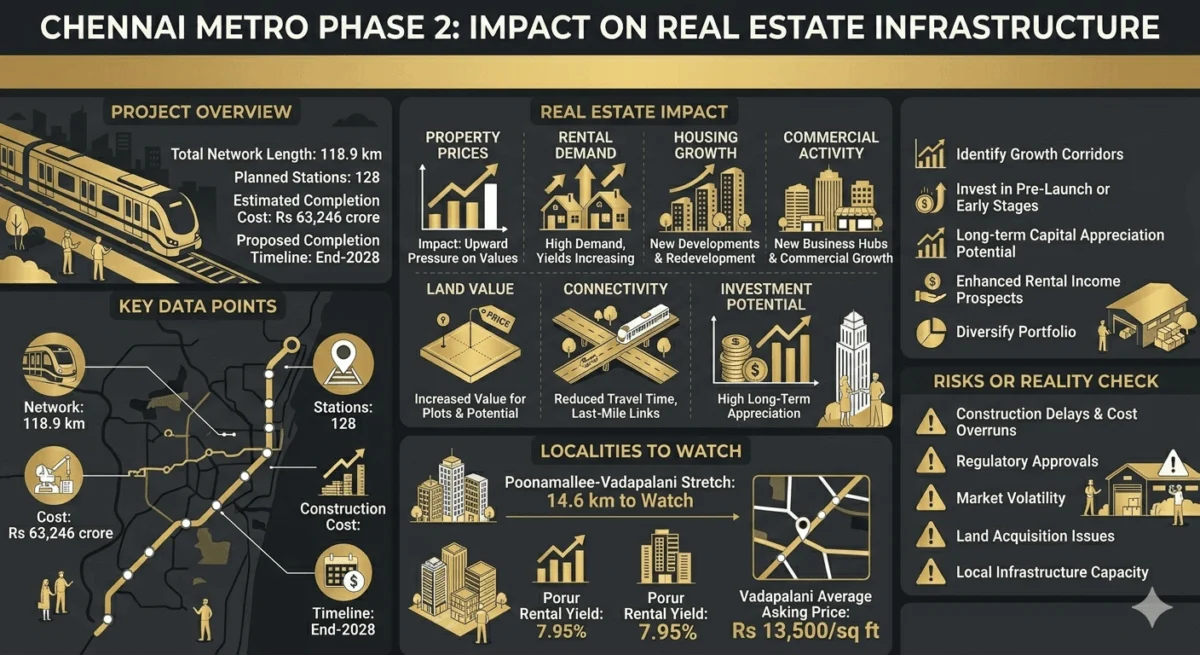
CHENNAI – The skyline of Chennai, traditionally characterized by its coastal charm and industrial heritage, is currently undergoing a radical metamorphosis. As the city moves toward the late 2020s, a massive capital infusion exceeding Rs 60,000 crore is being channeled into two landmark infrastructure projects: the Chennai Metro Phase-2 and the Port-Maduravoyal Elevated Corridor.
This is not merely a story of new roads and rails; it is a fundamental restructuring of the Tamil Nadu capital’s economic geography. By simultaneously addressing the movement of people and the movement of freight, Chennai is positioning itself as a "smart-logistics" hub, triggering a significant residential and commercial repricing across its diverse micro-markets.
I. Main Facts: A Dual-Engine Growth Model
Chennai’s growth has historically been tethered to specific corridors—the IT-heavy OMR (Old Mahabalipuram Road), the industrial GST (Grand Southern Trunk) Road, and the central business districts of Anna Salai. However, the current infrastructure pipeline introduces a dual-engine model that targets both passenger mobility and freight efficiency.
The Logistics Engine: Port-Maduravoyal Elevated Corridor
Managed by the National Highways Authority of India (NHAI), this Rs 3,500 crore project is a 20.9-km double-tier elevated highway. It is designed to bypass the city’s congested arteries, allowing heavy container traffic to move directly from the Chennai Port to the industrial hinterlands of Maduravoyal and beyond. By 2047, the corridor is expected to support a port capacity jump from 53 Million Tonnes Per Annum (MTPA) to nearly 200 MTPA.
The Mobility Engine: Chennai Metro Phase-2
With an estimated cost of Rs 63,246 crore, Phase-2 is one of the most ambitious mass rapid transit expansions in India. Spanning 118.9 km across three corridors and 128 stations, it aims to bring almost every major residential and commercial pocket within walking distance of a high-speed transit point.
| Corridor | End-to-End Points | Distance | Key Impact Areas |
|---|---|---|---|
| Corridor 3 | Madhavaram to SIPCOT | 45.8 km | IT Corridor (OMR), North Chennai, Adyar |
| Corridor 4 | Lighthouse to Poonamallee Bypass | 26.1 km | Central Business Districts, Western Industrial Hubs |
| Corridor 5 | Madhavaram to Sholinganallur | 47.0 km | Orbital Connectivity, Inner Ring Road, Western Suburbs |
II. Chronology of Transformation: Milestones to 2028
The timeline of these projects provides a roadmap for real estate investors and homebuyers to gauge when "speculative value" will turn into "utility value."
- 2022–2023: The Groundbreaking Era. Massive land acquisition and the commencement of tunneling for Metro Phase-2 began. Work on the stalled Port-Maduravoyal corridor was revived with a fresh double-tier design.
- 2024–2025: Peak Construction Phase. Significant disruption in central and western Chennai as viaducts and underground stations take shape. During this period, property prices in western suburbs like Porur and Poonamallee began to see an "anticipatory surge."
- June 2026: Infrastructure Update. (As per current reports) The city reaches a critical mass of construction, with over 60% of Metro Phase-2 civil works nearing completion.
- November 2027: The Logistics Breakthrough. The Port-Maduravoyal elevated corridor is scheduled for completion. This is expected to immediately de-congest the arterial roads of Koyambedu and Maduravoyal.
- Late 2028: The Connectivity Apex. The full commissioning of Chennai Metro Phase-2. This marks the point where "Transit-Oriented Development" (TOD) becomes the primary driver of property valuations.
III. Supporting Data: The Real Estate Impact Analysis
According to market data and Square Yards analysis, the infrastructure push is creating a "tiering" effect in property prices. While the city-wide average appreciation remains steady, micro-markets directly on the path of the new corridors are outperforming.
1. The Western Expansion: Porur and Poonamallee
The extension of Corridor 4 toward Poonamallee has turned the western periphery into a residential hotspot.
- Price Trends: Asking prices in Porur have shown a steady upward trajectory.
- The "Metro Effect": Localities previously dependent on private transport or crowded buses are now being viewed as viable rental hubs for IT professionals working in the DLF Cyber City area.
- Analysis: Analysts suggest that Porur’s next growth phase depends on "station usability." Proximity to a metro station (within 500-800 meters) is expected to command a 15-20% premium over properties further away.
2. The Mature Market Shift: Vadapalani and Koyambedu
In central-west Chennai, the focus is shifting from "new development" to "redevelopment and liquidity."
- Vadapalani: As a mature market, sharp percentage appreciation is unlikely. However, the presence of an interchange and improved connectivity to the Port corridor ensures high "rental stickiness."
- Koyambedu: Once known primarily for its bus terminus and market, Koyambedu is evolving into a logistics and commercial nerve center. The double-tier elevated road will remove heavy trucks from the surface level, making the area more attractive for premium commercial office spaces.
3. The Port-Led Logistics Boom
The expansion of port capacity to 200 MTPA by 2047 necessitates a massive increase in "back-end" real estate.
- Warehousing: Demand for Grade-A warehousing in the North-West corridor (near the outer edges of the Port corridor) is projected to grow by 12% annually.
- Employee Housing: The increase in logistics activity will create a surge in demand for affordable to mid-segment housing for the thousands of workers employed in the expanded port ecosystem.
IV. Official Responses and Expert Perspectives
Government bodies and urban planners emphasize that this is a holistic approach to urban design.
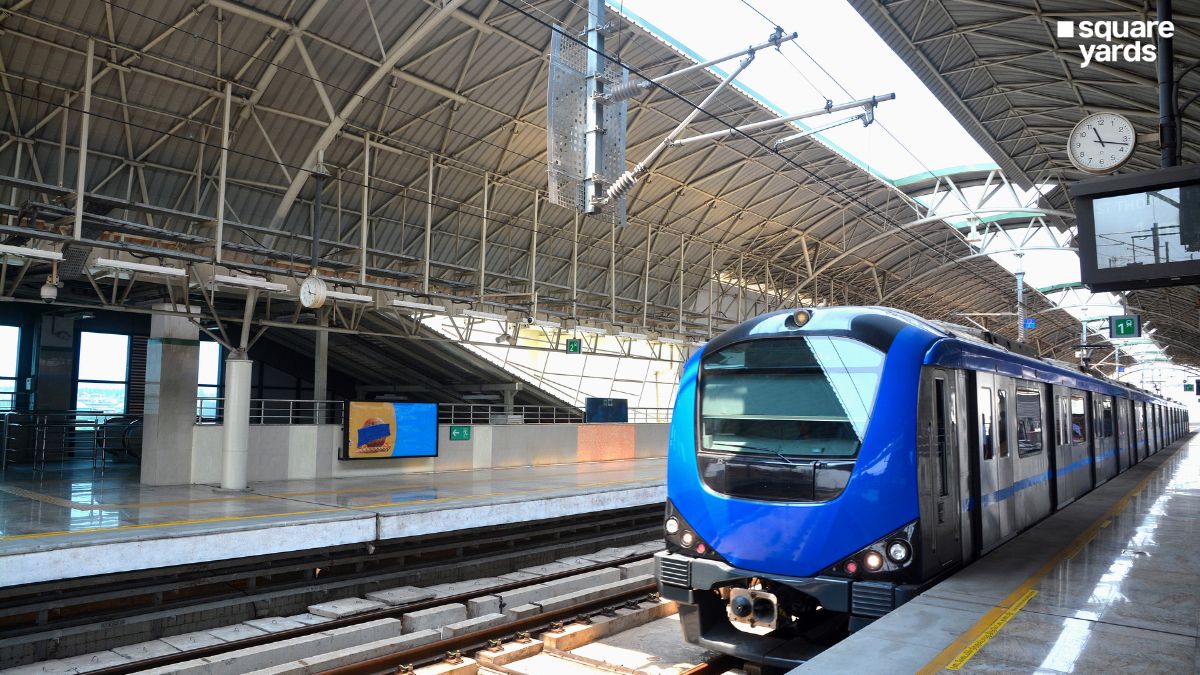
Chennai Metro Rail Limited (CMRL) Officials have noted that Phase-2 is specifically designed to integrate with other modes of transport. "We aren’t just building a train line; we are building a multi-modal network. Our stations are being planned at locations that intersect with suburban rail, bus depots, and eventually, the elevated highway access points," stated a senior project consultant.
NHAI Representatives highlighted the strategic importance of the double-tier structure. "The first tier is for local traffic, and the second is for port-bound containers. This separation is the key to unlocking the real estate potential of central Chennai. By removing the ‘freight friction’ from city roads, we are making these neighborhoods more livable and commercially viable."
Real Estate Analysts at Square Yards provide a more cautious, data-driven view. "One cannot apply a blanket ‘metro premium’ to every project. The winners will be projects that offer ‘first-and-last-mile’ connectivity. If a buyer has to navigate a waterlogged or unlit road to get to a multi-billion rupee metro station, the value proposition drops. Functionality is the new luxury in Chennai," says a regional research head.
V. Implications: The Move Toward "Functional Premium"
The massive infrastructure spend in Chennai is ushering in a new era of real estate investment where "functionality" dictates the "premium."
1. The Death of the "Generic" Investment
The era of buying land anywhere on the outskirts and waiting for it to double in value is over. Investors are now looking at "Utility Yields." A property’s value will be directly proportional to how much time it saves the occupant. This makes the Metro Phase-2 corridors the safest bets for long-term rental income.
2. Commercial Decoupling
As the Port-Maduravoyal corridor streamlines freight, we may see a decoupling of commercial real estate. "Clean" commercial (IT, BFSI) will cluster around Metro stations, while "Heavy" commercial (Logistics, Distribution, Manufacturing) will migrate toward the elevated corridor exit points in the West and North-West.
3. The Gentrification of North and West Chennai
Historically, South Chennai (Adyar, Besant Nagar) held the highest prestige. However, the massive investment in North and West Chennai—areas previously considered industrial or "blue-collar"—is leading to rapid gentrification. High-rise gated communities are now replacing old industrial sheds in areas like Madhavaram and Perambur, driven by the promise of 20-minute commutes to the city center via the Metro.
4. Risks and Realities
Despite the optimism, risks remain. Project delays (as seen in the decade-long wait for the Port corridor) can stagnate capital. Furthermore, the "entry price" is crucial. In areas like Vadapalani, where prices are already high, investors must be wary of overpaying for an "infrastructure story" that is already priced in.
Conclusion: The Address That Works
As Chennai pushes toward 2028, the narrative of its real estate market is being rewritten by the hum of tunnel boring machines and the rise of elevated viaducts. The Rs 60,000 crore investment is more than just a budgetary figure; it is a commitment to making Chennai one of the most efficient urban centers in South Asia.
For the homebuyer, the lesson is clear: the next decade of growth will not belong to the most "exclusive" address, but to the "address that works." Whether it is a flat in Porur that offers a seamless commute to an IT park or a commercial space in Koyambedu that sits at the nexus of global trade, the value is in the access. In the new Chennai, mobility is the ultimate amenity.
