New Delhi: In an era defined by an unending deluge of information, the very foundations of who we are and how we express ourselves are being subtly, yet profoundly, reshaped. Far from being immutable internal constructs, our communication styles and personal identities are deeply contingent on the external world we inhabit. This age-old philosophical observation, rooted in ancient wisdom, has taken on an unprecedented urgency in our media-saturated reality, where constant exposure to curated content, pervasive language, and amplified narratives acts as a silent sculptor of our perceptions, reasoning, and ultimately, our very selves.
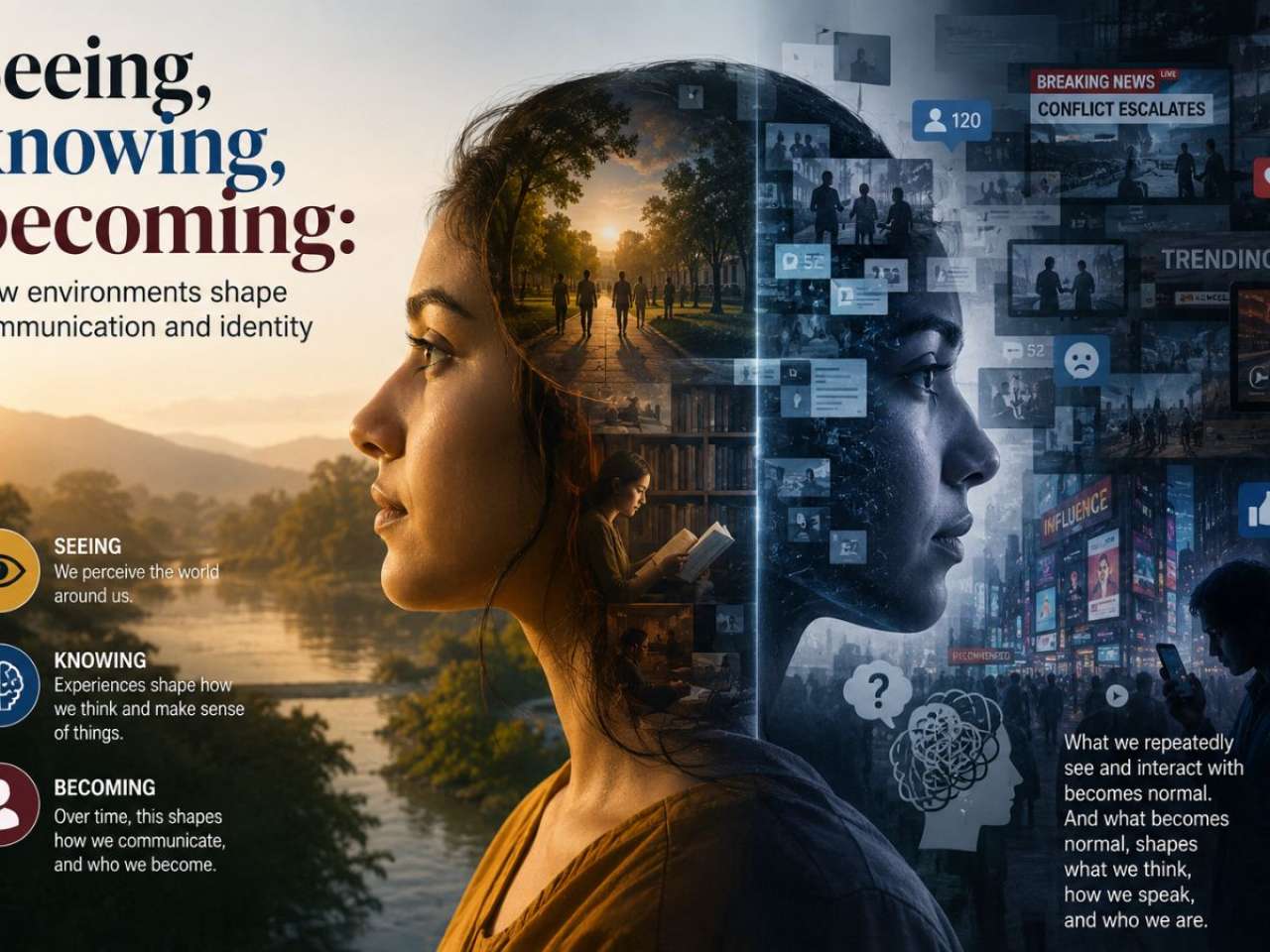
The conventional view often divorces expression from experience, framing identity as an isolated, self-generated entity. However, a closer examination reveals a far more intricate interplay. Our communication and identities are not merely declarations of inner states; they are the emergent properties of what we repeatedly encounter, absorb, and internalize. What we see, hear, and experience doesn’t just add to our knowledge base; it actively structures our cognitive processes, influences our linguistic choices, and molds the individuals we evolve into. This profound interconnectedness, recognized by thinkers for millennia, has been amplified exponentially by the pervasive influence of modern media.

The critical question then shifts from if our environments shape us to how deeply this influence operates and what its ramifications are in a world of constant, often unexamined, exposure. This exploration draws significant parallels with classical Indian philosophical traditions, offering a sophisticated lens through which to understand this dynamic relationship.

The Ancient Roots of Environmental Influence
The Nyaya Sutra, a foundational text in Indian logic and epistemology, places immense importance on pratyaksha, or perception, as the primary conduit for valid knowledge. The Sutra posits that all learning originates from the sensory engagement with the external world. The initial contact between our senses and the environment serves as the bedrock upon which all subsequent inference, judgment, and reasoning are built. This establishes a clear epistemological sequence: stimulus precedes cognition, and cognition, in turn, informs articulation. What we perceive directly forms the raw material of our understanding.

Extending this insight into the realm of mental processes, the Yoga Sutra delves into the concept of vrittis, or mental fluctuations. The famous aphorism "yogahchittavrittinirodhah" (Yoga Sutra 1.2) signifies the cessation of these mental modifications. These fluctuations, the Sutra explains, arise from impressions formed through our sensory experiences and interactions with the world. Over time, repeated exposure to certain stimuli leaves indelible imprints, known as samskaras. These deeply ingrained patterns shape our predispositions, preferences, and habitual responses. Consequently, identity, from this perspective, is not a static, pre-ordained entity but rather an accumulated construct, continuously built upon the layers of our experiences.

The Modern Amplification: Media as a Sculpting Force
The core tenet derived from these philosophical frameworks is the profound impact of external environments on our internal states. What we repeatedly encounter becomes what we recognize as familiar and valid. What we deem valid then dictates what we express. Communication, therefore, is not simply an unadulterated projection of internal thoughts; it is the sophisticated outcome of a layered process where the external world plays a formative, even constitutive, role. This understanding holds direct and urgent relevance in today’s hyper-connected landscape.

Individuals are now immersed in environments saturated with an unprecedented density of stimuli. Digital platforms, social media feeds, algorithmically curated content, and an incessant stream of information bombard our senses daily. These environments are far from neutral; they actively promote certain forms of expression, amplify specific linguistic patterns, and normalize particular ways of conceptualizing and framing reality.

The Language of Belonging and the Erosion of Nuance
The impact of this constant exposure is particularly evident in the increasing standardization of language across digital platforms. Words, phrases, and expressions gain rapid circulation, acquiring shared meanings and becoming potent signals of belonging and group affiliation. What might initially serve as a mere descriptor can, over time, morph into a marker of identity. Terms that once denoted a preference or an activity can now function as definitive self-definitions. This shift is not coincidental; it reflects the deep influence of repeated exposure to particular linguistic patterns, which, through sheer repetition, begin to feel natural, expected, and even essential for participation in the digital sphere.

This phenomenon extends beyond mere vocabulary. The formation of opinions and perspectives is equally susceptible to environmental influence. Exposure to a limited spectrum of viewpoints can foster an illusion of consensus, while sustained engagement with specific narratives can powerfully shape what individuals perceive as credible or legitimate. The Nyaya emphasis on perception as the genesis of knowledge implies that when the scope of what is perceived narrows, so too does the scope of what can be reasoned about. Our thought processes are increasingly following the contours of our exposure.

The Yoga Sutra’s emphasis on samskaras adds another critical dimension. Repetition intensifies impact. A single exposure might provide information, but sustained exposure actively forms. Over time, patterns of interaction leave behind cognitive and emotional residues that subtly influence our behavior. Preferences begin to feel intrinsic, even when they are the product of accumulated external influences. Identity appears stable and self-derived, even as it is in a continuous state of being shaped by the surrounding environment.

Implications for Education and Communication
This dynamic raises critical questions for institutions, particularly those responsible for education and communication. If our thoughts and expressions are fundamentally shaped by our environments, then the deliberate design and curation of these environments become paramount. What is made visible, what is emphasized, and what is repeatedly presented will not only influence what individuals know but profoundly impact how they think and how they articulate those thoughts.

Higher education institutions, for instance, often prioritize content delivery and skill development. However, insufficient attention is often paid to the communicative environment within which learning occurs. If exposure is indeed the bedrock of cognition, then the quality of discourse, the diversity of perspectives represented, and the nature of engagement within academic settings become central to the educational process. A sterile, homogenous communicative environment can inadvertently stifle critical thinking and limit the intellectual horizons of students.

The same holds true for the broader landscape of media and public communication. The relentless drive towards compressing information into short, easily digestible formats, while perhaps enhancing accessibility, carries the significant risk of diminishing complexity. When exposure is limited to simplified representations, the capacity for nuanced thought and sophisticated reasoning can be eroded. Communication may become efficient, but it risks becoming substantively shallow.

Navigating the Sculpted Landscape
The challenge, therefore, is not to attempt the impossible task of eliminating external influence. Rather, it is to cultivate a profound awareness of its operation. We must recognize that what we repeatedly witness will inevitably shape what we think, and what we think will, in turn, shape what we say. In an era where our environments are increasingly mediated and intentionally curated, this awareness is not merely beneficial; it is essential for intellectual autonomy and genuine self-understanding.

Communication and identity do not emerge in a vacuum. They are forged at the intricate intersection of exposure, interpretation, and repetition. The crucial question is not if we are influenced by what surrounds us, but rather whether we are attentive to how that influence operates. Furthermore, it is about our capacity to be deliberate in shaping the environments that, in turn, shape us, ensuring that these influences foster growth, critical engagement, and a more nuanced understanding of ourselves and the world. The sculpted self is an inevitable reality; the nature of that sculpting is, to a significant degree, within our collective and individual power to direct.