

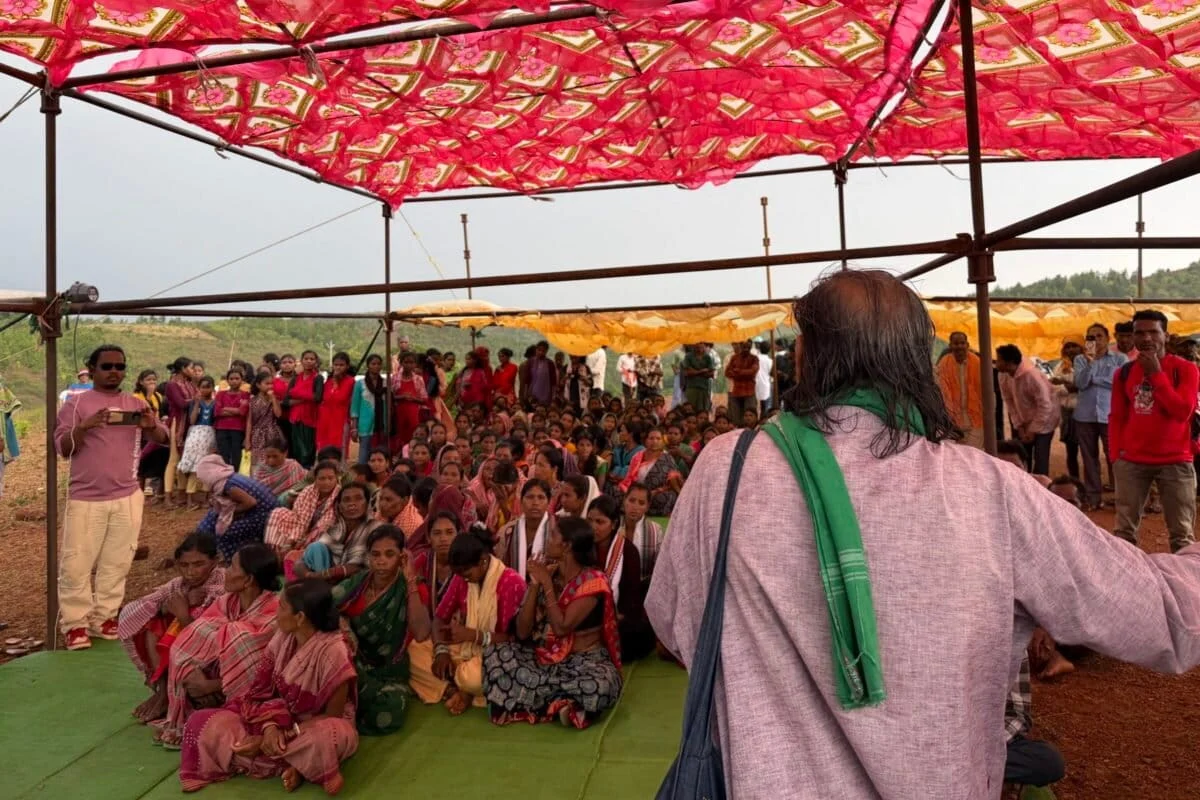
KANTAMAL, ODISHA — At 2:30 a.m. on April 7, 2026, the silence of the Sijimali foothills was shattered by the heavy thud of boots and the splintering of wooden doors. In Kantamal, a village tucked away in the intersection of Odisha’s Rayagada and Kalahandi districts, the electricity had been cut hours earlier. Under the shroud of total darkness, more than 200 police personnel reportedly encircled the settlement.
“We had no idea what was happening,” recalls Subash Singh Majhi, the 32-year-old leader of the Maa Mati Mali Suraksha Manch, a local collective organized to protect their land and mountains. “Before we could even orient ourselves, they were dragging people out of their beds. In the dark, the beating began.”
The raid on Kantamal is the latest and most violent flashpoint in a burgeoning conflict over the Sijimali bauxite mine—a project that pits one of India’s largest mining conglomerates, Vedanta Limited, against indigenous Kondh and Dalit communities who have inhabited these hills for generations. As the state moves to fast-track mineral extraction, the foothills of the Eastern Ghats have become a zone of heavy militarization, disputed legalities, and a desperate struggle for ecological survival.

Main Facts: The Stakes of Sijimali
The Sijimali bauxite deposit is one of the most significant mineral prizes in eastern India. Spanning 1,548 hectares, the site holds an estimated 311 million tonnes of high-grade bauxite. In 2023, Vedanta Limited won the mining lease through a competitive auction. The company’s operational plan is staggering in scale: it intends to extract 9 million tonnes of ore annually for 31 years.
However, the cost of this extraction is not merely financial. The project area encompasses more than 44 villages and requires the diversion of over 700 hectares of forest land. For the state, Sijimali represents billions in revenue and industrial growth. For the locals, it represents the potential destruction of an entire ecosystem.
The conflict reached a boiling point in early April 2026 over the construction of a three-kilometer access road near Sagabari village. This road is designed to connect State Highway 44 to the Sijimali hilltop—the final infrastructural link needed to begin mining operations. Residents, viewing the road as the "beginning of the end," launched a blockade that was met with a massive police crackdown, leading to the April 7 raid.

Chronology of a Conflict: From Auction to Arrests
The timeline of the Sijimali dispute reveals a rapid escalation of tensions over a three-year period:
- Early 2023: The Odisha state government auctions the Sijimali bauxite lease. Vedanta Limited emerges as the successful bidder.
- October 2023: Official public hearings are conducted in Rayagada and Kalahandi. Despite heavy police presence, villagers overwhelmingly record their opposition to the project, citing concerns over water and displacement.
- December 2023: The government announces that Gram Sabhas (village councils) have officially approved the project. Villagers immediately dispute these claims, alleging fraud and coercion.
- August–September 2024: Defying the official narrative, villagers organize their own independent Gram Sabhas, where they pass unanimous resolutions rejecting the mine.
- December 2025: A government committee recommends Stage-1 forest clearance for 708 hectares of land, moving the project closer to operational reality.
- April 3, 2026: Police and paramilitary forces arrive at the Sagabari site to begin road construction. The administration invokes Section 163 of the Bharatiya Nagarik Suraksha Sanhita, prohibiting gatherings of more than four people.
- April 6, 2026: Approximately 250 villagers defy the prohibitory orders to block the road. Violent clashes ensue. Media reports indicate over 60 people were injured, including 40 police personnel.
- April 7, 2026: The midnight raid on Kantamal occurs. Residents allege indiscriminate beatings and the use of tear gas in residential areas.
- May 5, 2026: Amidst the local turmoil, the central government grants Stage-2 forest clearance—the final administrative hurdle for forest diversion.
Supporting Data: The Ecological and Cultural Cost
The resistance in Sijimali is rooted in a sophisticated understanding of the local hydrology. Environmentalists and tribal leaders argue that the bauxite caps on the mountains act as "natural sponges."
“The thick layer of bauxite on top of these hills is porous,” explains Samarendra Das, researcher and co-author of Out of This Earth. “It soaks up the monsoon rains and releases them slowly throughout the year, feeding the perennial springs that sustain agriculture in the valleys. Open-cast mining rips that sponge away. Once the bauxite is gone, the water system collapses.”

This is not a theoretical fear. At the nearby Panchpatmali plateau, where bauxite mining has been active for years, local streams have largely dried up, turning once-fertile lands into seasonal dust bowls. In Kantamal, the contrast is stark. Even in the height of a parched summer, the village remains green. Farmers grow paddy, mangoes, jackfruit, and sunflowers.
“Except for salt, we buy nothing from the outside,” says Subash Singh Majhi. “The mountain gives us everything.”
Beyond the economics of farming, the mountain—known locally as Tijimali—holds profound spiritual significance. For the Kondh Adivasis, it is the home of Tijraja, their primary deity. The threat to the mountain is viewed not just as a loss of livelihood, but as "cultural genocide," a term Das uses to describe the total erasure of an indigenous way of life.

The Gram Sabha Controversy
A critical pillar of the legal dispute involves the validity of the Gram Sabhas held in December 2023. Under India’s Fifth Schedule and the PESA Act (Panchayats Extension to Scheduled Areas), the "free, prior, and informed consent" of tribal communities is a mandatory prerequisite for mining in these regions.
A study by the National Law School of India University (NLSIU), titled Under the Surface, highlighted disturbing discrepancies in the official records. Villagers who used Right to Information (RTI) requests to access the meeting minutes found:
- Signatures of individuals who had been deceased for years.
- Thumbprints attributed to college graduates who normally sign their names.
- Signatures of migrant workers who were documented to be in other states on the day of the meeting.
- Reports of Gram Sabhas held in "uninhabited" villages (Pelanakona and Katibhata) where no population exists according to the 2011 Census.
Narendra Mohanty, state convenor of the Campaign Against Fabricated Cases, noted that the government claimed eight different Gram Sabhas took place simultaneously in eight different villages with the same set of officials present at all of them—a physical impossibility.

Official Responses and Legal Limbo
Despite the gravity of the allegations regarding police brutality and procedural fraud, official communication from the state and the corporation has been sparse.
In early May 2026, journalists from Mongabay-India visited the District Magistrate’s office in Rayagada, but officials declined to comment on the April 7 raid. Follow-up emails to Vedanta Limited and the district administration have similarly gone unanswered as of late May.
The matter is currently before the National Green Tribunal (NGT). While a hearing was originally scheduled for May 18, 2026, the violence in April prompted villagers to petition for an earlier date. The NGT took up the matter on May 14, but the granting of Stage-2 forest clearance by the central government on May 5 has created a "fait accompli" scenario that often makes legal reversals difficult in the Indian judicial system.

Police spokespersons have maintained that the raid on Kantamal was a necessary response to the violence of April 6, asserting that villagers attacked officers first with stones and traditional weapons. However, the 86-year-old Gaseb Dei Majhi, holding an empty tear gas shell found in her yard, offers a different perspective: "They fired these at us while we slept. They beat us in the dark. Is this how a government talks to its people?"
Implications: A Precedent for the Eastern Ghats
The struggle for Sijimali is not an isolated incident; it is a barometer for the future of resource federalism in India. Environmentalist Prafulla Samantara, a Goldman Environmental Prize winner, warns that the current pace of mining leases is unsustainable.
“At this rate, Odisha will be resource-less within a generation,” Samantara says. “The question is simple: Will the Gram Sabhas mean anything, or will the government keep handing these mountains to mining companies while ignoring their own rules?”

The situation in Sijimali mirrors the historic Niyamgiri battle, where the Dongria Kondh successfully stopped a Vedanta refinery project after a Supreme Court-mandated referendum. However, observers note that the state’s tactics have evolved since then, utilizing more aggressive policing and tighter control over the public hearing process to prevent a repeat of the Niyamgiri "setback."
Furthermore, the proximity of other projects—such as the Adani Group’s proposed mine in the Kutrumali hills—suggests a coordinated effort to transform the entire Sijimali-Kutrumali range into an industrial corridor. For the Adivasi communities, this represents an existential threat.
As the 3km access road nears completion and the Stage-2 clearance stands, the people of Kantamal remain in a state of defiant mourning. "This is our deity. We worship here," says Narangi Dei Majhi, a tribal leader from Sagabari. "We will not sell our Maa, Mati, aur Mali (Mother, land, and mountain). We will fight until the end."

The outcome of the Sijimali conflict will likely define the boundaries of indigenous rights and environmental protections in India for the next decade. For now, the "green sponge" of the mountain continues to feed the streams, but the shadow of the excavator grows longer with each passing day.
