

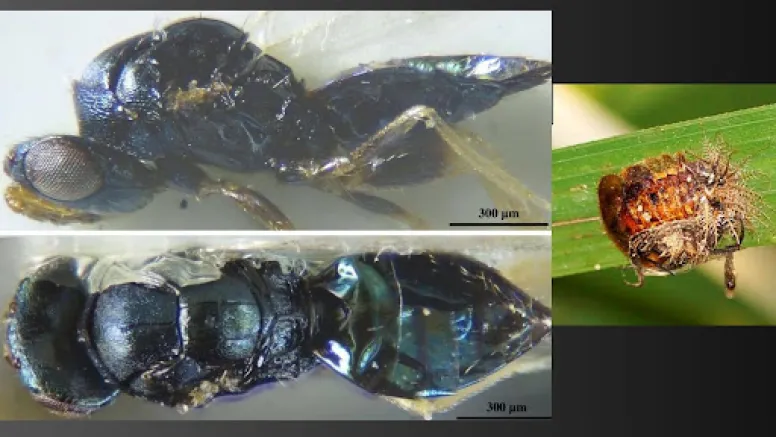
KOLKATA — In the sprawling, often overlooked fringes of West Bengal’s capital, a team of international researchers has uncovered a microscopic marvel that underscores the immense, hidden biodiversity of India’s wetland ecosystems. The discovery of a new species of parasitoid wasp, named Tetrastichus narayandebnathi, offers not only a glimpse into the complex evolutionary "arms race" between insects but also provides a potential new tool for sustainable agriculture and biological pest control.
The discovery, published in a recent scientific study, was the result of a collaborative effort between the University of Kalyani, the iForNature – Nature Club of West Bengal, and Cairo University in Egypt. The finding highlights the Rajarhat wetlands—a region often under pressure from urban expansion—as a critical habitat for specialized life forms that maintain the ecological balance of the region.
The Discovery: A Serendipitous Find in Rajarhat
The journey to identifying Tetrastichus narayandebnathi began not in a high-tech laboratory, but on a simple blade of grass. While conducting a routine biodiversity survey of local vegetation in the Rajarhat wetlands, researchers noticed something unusual. Their attention was drawn to the pupa of a tortoise beetle (subfamily Cassidinae).
Under normal circumstances, these pupae exhibit a healthy, vibrant appearance. However, this specific specimen was strikingly dark, possessing a sickly yellowish-orange hue that suggested it had been compromised. Suspecting the presence of a parasite, the team carefully collected the specimen and transported it to the iForNature—Nature Club Research Laboratory in Kolkata.
Under the controlled conditions of the lab, the researchers monitored the pupa. Their suspicions were soon confirmed when, instead of a beetle, eight tiny wasps emerged from the casing. The group consisted of five females and three males. This emergence identified the species as a "gregarious primary parasitoid"—a type of insect where multiple larvae develop within a single host, eventually killing it as they reach maturity.

Chronology of the Research and Identification
The identification of a new species is a meticulous process that involves comparing the specimen against all known relatives in its genus. The chronology of the study followed a rigorous path from field observation to digital fingerprinting:
- Field Collection (August 2026): Researchers identified the parasitized tortoise beetle pupa in the wetlands of Rajarhat.
- Incubation and Emergence: The specimen was kept under observation until the adult wasps emerged, providing the team with live subjects for morphological study.
- Morphological Analysis: Using high-powered microscopy, the team measured the insects, noting their length (1.4 to 1.7 mm) and their distinct metallic bluish-greenish luster against a black body.
- Comparative Study: The team compared the new specimens with Tetrastichus tunicus, its closest known relative. They noted significant differences in leg coloration, body size, and the length of the hypopygium (a plate on the underside of the abdomen).
- Digital Fingerprinting: To provide definitive proof of its status as a new species, the team employed Wing Interference Pattern (WIP) imaging. This advanced technique captures the unique, rainbow-like light patterns reflected off the wasp’s transparent wings, creating a "biological barcode" for the species.
- Formal Naming and Publication: The species was officially named to honor a local cultural icon, bridging the gap between scientific discovery and regional heritage.
Supporting Data: The Science of Wing Interference Patterns (WIP)
One of the most significant aspects of this discovery is the use of Wing Interference Pattern (WIP) imaging. For decades, identifying tiny wasps was an arduous task that relied almost exclusively on subtle physical traits that could vary even within a single species.
WIP imaging utilizes the thin-film interference of light passing through and reflecting off the microscopic layers of an insect’s wing. Because the thickness and topography of the wing membrane are genetically determined and species-specific, the resulting "rainbow" patterns are unique to each species.
In the case of Tetrastichus narayandebnathi, the WIP analysis provided a clear distinction from other members of the Tetrastichus genus. This data, combined with the fact that this is only the third time globally—and the second time in India—that a wasp from this genus has been found associated with tortoise beetles, solidified its place in the taxonomic record.
A Tribute to Art: Honoring Narayan Debnath
In a move that has resonated with the public in West Bengal, the researchers chose to name the species Tetrastichus narayandebnathi. The name is a tribute to the late Shri Narayan Debnath, the legendary Bengali cartoonist and illustrator.

Debnath, a recipient of the Padma Shri (India’s fourth-highest civilian award), is the creator of iconic characters like Bantul the Great, Handa Bhonda, and Nonte Phonte. By naming a native species after him, the scientists intended to link the biological heritage of the Rajarhat wetlands with the cultural and artistic heritage of the region. This practice, known as "commemorative naming," helps to bring public attention to biodiversity by connecting scientific facts with familiar cultural figures.
Implications for Agriculture and Pest Control
The discovery of Tetrastichus narayandebnathi is far more than a taxonomic curiosity; it has profound implications for the future of sustainable farming.
Biological Control Agents
Tortoise beetles are known to feed on various plants, including several agricultural crops and ornamental species. While they are a natural part of the ecosystem, their populations can sometimes surge, leading to significant crop damage.
Parasitoid wasps like the newly discovered T. narayandebnathi act as nature’s internal regulators. Because they are "specialist predators," they target specific hosts with surgical precision. Unlike broad-spectrum chemical pesticides, which kill beneficial insects and pollinators along with pests, these wasps only affect the target beetle population.
Reducing Chemical Dependency
The researchers believe that by mapping the diversity of these parasitoids, agricultural scientists can develop "biological control" strategies. This involves encouraging or introducing native wasp populations into farmland to manage beetle outbreaks naturally. This discovery provides a potential path toward reducing the reliance on chemical pesticides, which often leach into groundwater and harm human health.

Wetland Preservation as a Scientific Necessity
The fact that this species was found in the Rajarhat wetlands serves as a stark reminder of the value of urban-fringe ecosystems. Often dismissed as "wastelands" or prime targets for real estate development, these wetlands are, in fact, complex biological laboratories.
The loss of these habitats would mean the loss of undiscovered species that could hold the key to pest management, carbon sequestration, or even new medicines. The researchers emphasize that protecting the Rajarhat wetlands is not just an environmental concern but a scientific and economic necessity for the region.
Official Responses and Collaborative Efforts
The study represents a successful model of international scientific cooperation. By combining the local field expertise of the University of Kalyani and iForNature with the advanced taxonomic resources of Cairo University, the team was able to move from a field observation to a peer-reviewed discovery with remarkable efficiency.
Dr. Mousumi Das of the University of Kalyani and the lead researchers from iForNature have expressed that this discovery is likely "the tip of the iceberg." They suggest that the wetlands of West Bengal may host hundreds of undiscovered parasitoid species, each playing a vital role in the state’s ecological health.
"This discovery proves that you don’t need to travel to the Amazon or the deep ocean to find new life," said one of the researchers involved in the study. "Some of the most important biological discoveries are happening in our own backyards, in the very wetlands we walk past every day."

Conclusion: The Microscopic Guardians
As India continues to modernize and expand its urban centers, the discovery of Tetrastichus narayandebnathi serves as a call to action. It highlights the intricate connections between a tiny wasp, a beetle pupa, and the health of our agricultural systems.
The naming of the wasp after Narayan Debnath ensures that this scientific milestone remains anchored in the hearts of the people of West Bengal. However, the true legacy of this discovery will be determined by how well the region protects the fragile wetlands that these "microscopic guardians" call home. Without the preservation of the Rajarhat ecosystem, the stories of species like T. narayandebnathi may end before they are ever truly understood.
