

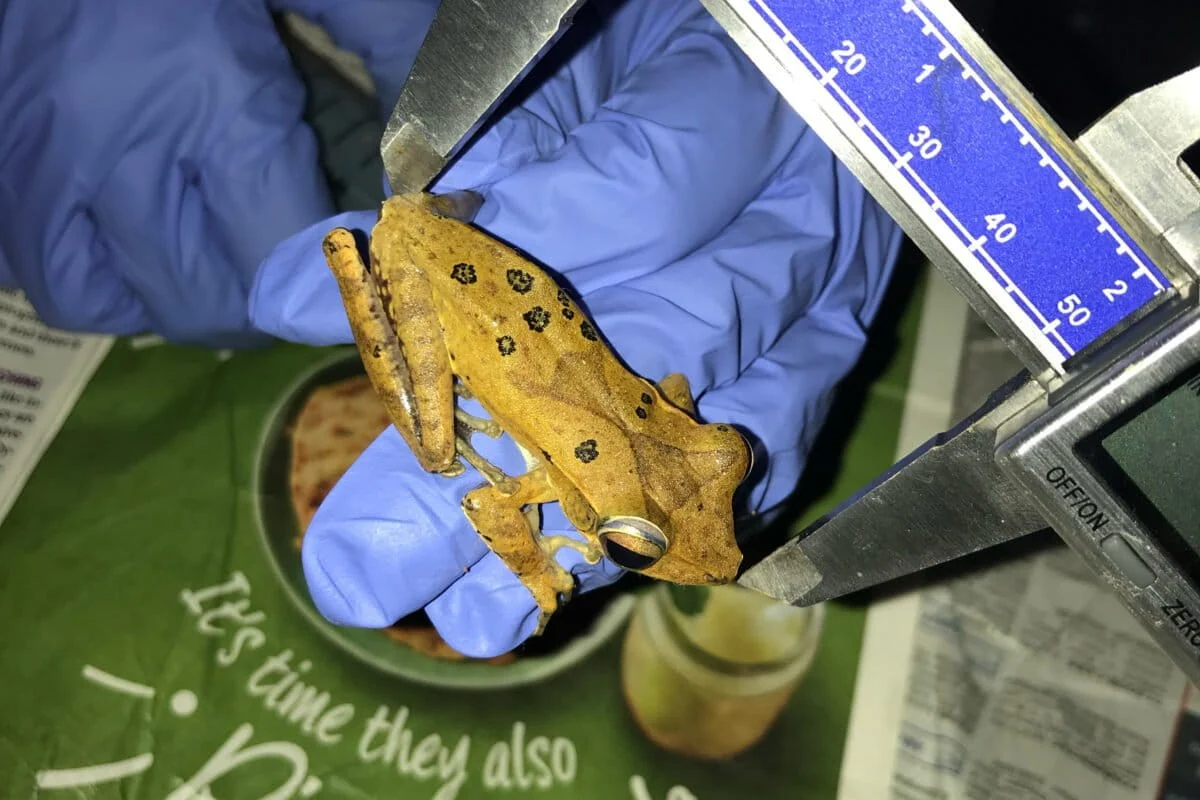
In the humid foothills of the Western Ghats, one of the world’s most significant biodiversity hotspots, a quiet transformation is underway. While the rapid expansion of India’s Tier-2 cities is often measured in concrete poured and kilometers of asphalt laid, a new study reveals a more subtle, biological restructuring. Urbanization in these regions is not merely reducing the number of species; it is fundamentally rewriting the functional "blueprint" of amphibian communities.
A study published in the journal Urban Ecosystems suggests that as cities like Udupi expand, they act as a "trait filter." This mechanism selectively allows generalist species to thrive while systematically "filtering out" specialist frogs based on their physical size, reproductive methods, and habitat preferences. This finding challenges traditional conservation metrics that rely solely on species counts, revealing a hidden "functional homogenization" that could precede total biodiversity collapse.
Main Facts: The Functional Shift in Urban Ecosystems
The research, centered in the Udupi district of Karnataka, highlights a critical shift in how we understand urban ecology. Traditionally, scientists have measured the health of an ecosystem by its "species richness"—the total number of different species present. However, the Udupi study suggests that species richness can be a deceptive metric.

The study’s most significant finding is that urbanization serves as a trait filter. In less-urbanized areas and forest interiors, researchers found a high prevalence of "specialist" frogs. These include:
- Arboreal species: Tree-dwelling frogs that require intact canopy cover.
- Fossorial species: Burrowing frogs that need specific soil conditions.
- Direct-developers: Species that bypass the tadpole stage, hatching directly as miniature frogs, which requires highly stable moisture levels.
- Large-bodied species: Such as the Malabar gliding frog (Rhacophorus malabaricus), which require more space and specific resources.
As the landscape shifts toward the urban center, these specialists disappear. They are replaced by "generalists"—adaptable species with broad ecological tolerances that can exploit artificial light, noise, and human-modified water sources. While the number of species might remain relatively stable in moderately urbanized areas, the type of roles those species play in the ecosystem changes drastically.
“The study’s most novel finding is that urbanization acts as a trait filter rather than simply a diversity filter,” explains Aravind N.A., Senior Fellow at the Ashoka Trust for Research in Ecology and the Environment (ATREE) and the study’s supervising author. This means that while a city park might have as many frogs as a forest edge, the city frogs are all "doing the same thing" ecologically, leaving the environment less resilient to change.
Chronology: A Two-Year Deep Dive into the Monsoon
The research was conducted by a team led by Madhushri Mudke, currently a postdoctoral researcher at the Centre for Wildlife Studies. To capture the full scope of the urban-to-rural transition, the team employed a "gradient approach."

2018–2019: The Fieldwork Phase
Over two consecutive monsoon seasons, the researchers surveyed 23 distinct sites radiating outward from the city center of Udupi toward the dense forests of the Western Ghats. This gradient included:
- 13 City Sites: Characterized by high building density, road networks, and artificial lighting.
- 2 Edge Sites: Located at the urban-forest interface, where human development meets natural vegetation.
- 8 Forest Sites: Located in relatively undisturbed habitats in the foothills.
During these two years, the team recorded a total of 947 individual amphibians belonging to 19 different species. They didn’t just count the frogs; they meticulously documented environmental variables at each site, including ambient temperature, humidity, elevation, and the presence of "microhabitats" like leaf litter and rocky crevices.
Analysis and Publication
Following the field seasons, the researchers utilized statistical modeling to correlate the physical traits of the frogs with the environmental pressures of their habitats. The results, recently published, provide a rare glimpse into the "Global South" perspective on urban ecology—a region where urbanization is occurring at a pace far exceeding that of the Western world.
Supporting Data: The Importance of Microhabitats and Laterite Plateaus
The study brings much-needed attention to a specific and often ignored ecosystem: the laterite plateaus. These flat-topped rock outcrops are a defining feature of the Western Ghats foothills. Despite being hotspots for endemic and threatened species, they are frequently misclassified by government agencies.

“Many of the [Western Ghats] foothills are now considered as wasteland,” says Madhushri Mudke. This "wasteland" label makes these plateaus prime targets for conversion into mines, agricultural fields, or housing projects. However, the data shows these areas are vital for specialized biodiversity.
The Role of Microhabitats
The study found that the presence of microhabitats can act as a "buffer" against the harsh realities of urban life. These small-scale features include:
- Ephemeral Pools: Temporary rain-filled puddles that serve as breeding grounds.
- Leaf Litter: Provides moisture and camouflage for ground-dwelling species.
- Rocky Crevices: Essential for species like the Indirana genus, whose tadpoles survive on moist rocky patches.
The data revealed that even a minor temperature fluctuation of one or two degrees—common in "urban heat islands"—can be catastrophic for these species. Specialists are often tied to specific micro-climates that disappear when a rocky outcrop is leveled or a patch of forest is cleared for a parking lot.
Diversity Peaks at the Edge
Interestingly, the study found that species richness actually peaked at the "urban-forest edge." This phenomenon, often called the "edge effect," suggests that these transitional zones can support a mix of both forest specialists and urban generalists. However, the authors caution that this is a precarious balance; if the "edge" continues to move deeper into the forest, the specialists will eventually have nowhere left to go.

Official Responses: Expert Insights and Critiques
The study has garnered attention from the herpetological community in India, sparking a dialogue on how conservation efforts should be structured in rapidly growing Tier-2 cities.
Karthikeyan Vasudevan, a scientist at the CSIR-Centre for Cellular and Molecular Biology (CCMB) who was not involved in the study, described the findings as "informative." He noted that the study proves "intense human-use areas have paramount diversity," which should change how planners view urban "green" spaces.
However, experts also pointed out the limitations of the current data. Aravind N.A. himself noted that because the study was conducted in a single city (Udupi) over a two-year period, the results might not be universally applicable to all tropical cities. He characterized the observed differences in community composition as "statistically significant" but "relatively weak," suggesting that more long-term data is needed.
Vasudevan also suggested that future research should look closer at the health of individual frogs. "It would be valuable to study deformity and scale mass index (a measure of body weight relative to size) to obtain a measure of their body condition," he noted. This would help determine if urban frogs are merely surviving or if they are actually thriving.

Implications: Biodiversity-Sensitive Urban Planning
The findings of this study come at a pivotal moment for India’s urban development. As metropolitan areas become overcrowded, Tier-2 cities are experiencing an explosion in growth. The Udupi model suggests that this growth does not have to mean an immediate loss of all biodiversity, but it does require a fundamental shift in urban planning.
1. Reclassifying "Wastelands"
The most immediate policy implication is the need to recognize laterite plateaus and other "barren" landscapes as high-value ecosystems. By removing the "wasteland" label, local governments can implement stronger protections against unregulated mining and construction.
2. Protecting Sacred Groves
The study noted that Udupi has managed to retain significant biodiversity partly due to the presence of "sacred groves"—small patches of forest protected for generations through cultural and religious practices. These groves act as "stepping stones" for wildlife moving through an urban landscape. Integrating these cultural heritage sites into formal urban planning could be a key strategy for conservation.
3. Maintaining "Messy" Landscapes
Modern urban planning often favors "clean" aesthetics—manicured lawns and paved drainage systems. However, the study proves that frogs need "messy" environments: piles of leaf litter, unpaved rocky patches, and seasonal puddles. "We have to look at cities as areas that can retain microhabitats because they are not just home to biodiversity, but they also act as spaces for ecosystem functioning," says Mudke.

4. Future Research on Urban Stressors
The study opens the door for more specific investigations into how urban life affects wildlife. Future research will likely focus on:
- Sensory Pollution: How artificial light at night (ALAN) and traffic noise affect frog calling and mating patterns.
- Genetic Isolation: Whether roads and buildings are creating "islands" of frog populations, leading to inbreeding and reduced genetic health.
- Climate Resilience: How urban frog communities will fare as climate change intensifies the "heat island" effect in Indian cities.
As the Global South continues to urbanize at an unprecedented rate, the Udupi study serves as both a warning and a roadmap. It warns that we may be losing the functional diversity of our ecosystems long before the last species disappears. But it also provides a roadmap for a different kind of city—one where the sound of the monsoon is still met with a diverse chorus of frogs, signaling a healthy, resilient environment for both amphibians and humans alike.
