

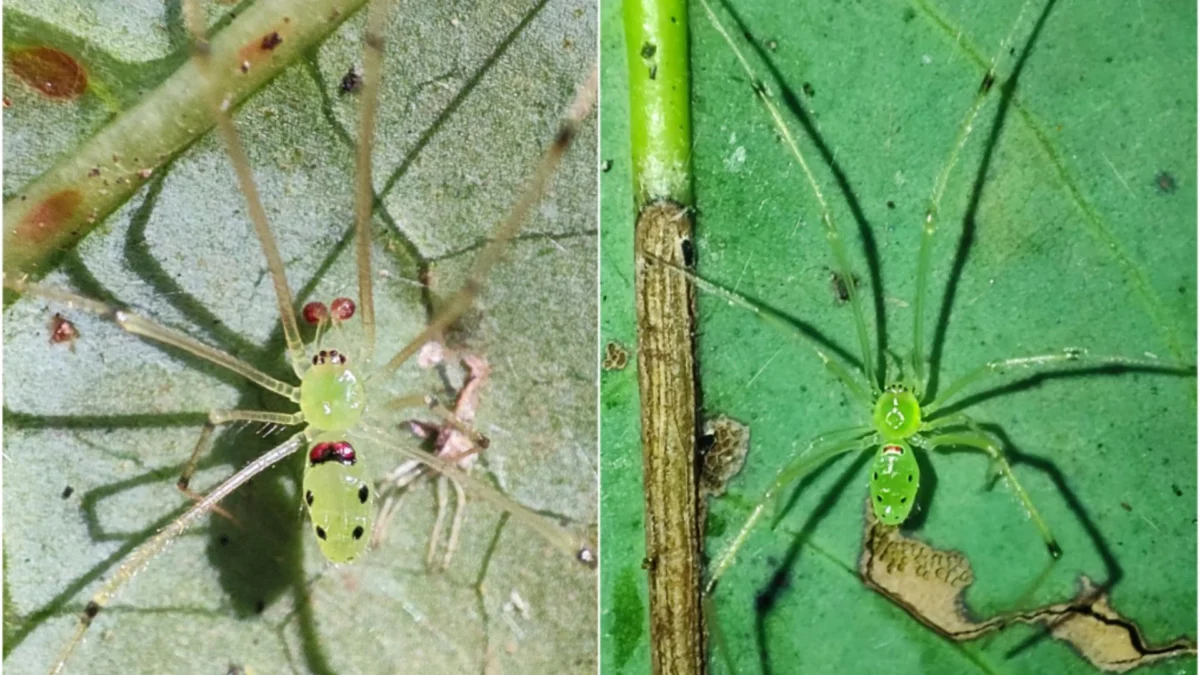
DEHRADUN, UTTARAKHAND — In the dense, mist-shrouded temperate forests of the Western Himalayas, a remarkable discovery has emerged that bridges the gap between high-altitude ecology and evolutionary wonder. Researchers have identified a new species of "happy-face" spider, a tiny but vibrant arachnid that sports a bizarre, smiling-face pattern on its abdomen.
The discovery of Theridion himalayana marks a significant milestone in Indian arachnology, revealing that the famous "happy-face" trait—once thought to be the primary hallmark of a specific Hawaiian species—has a parallel evolutionary cousin living thousands of miles away in the rugged terrain of Uttarakhand.
Main Facts: A New Addition to the Himalayan Biodiversity Map
The new species, officially named Theridion himalayana, was uncovered during extensive ecological field surveys in the mountainous regions of Northern India. The research team, led by Ashirwad Tripathy from the Forest Research Institute (FRI) in Dehradun and Devi Priyadarshini from the Regional Museum of Natural History, located the spiders clinging to the undersides of leaves in the moist, temperate deciduous forests of the Chamoli and Rudraprayag districts.
Measuring only a few millimeters in length, Theridion himalayana is characterized by its striking coloration and extreme polymorphism. While many spiders use camouflage to disappear into their surroundings, this species often displays a vivid arrangement of red, black, and white dots that, to the human eye, form the unmistakable image of a grinning face.
This discovery is not merely a curiosity for photographers; it represents a complex case of parallel evolution. Genetically, the Himalayan spider is distinct from its famous relative, the Hawaiian happy-face spider (Theridion grallator), despite their uncanny physical resemblance. This suggests that the "smiling" trait may offer a specific evolutionary advantage that nature has selected for in two vastly different parts of the world.

Chronology: From the Forest Floor to the Laboratory
The journey to identifying Theridion himalayana began with a series of systematic field surveys aimed at documenting the understudied micro-fauna of the Uttarakhand Himalayas.
The Field Surveys
Researchers Tripathy and Priyadarshini focused their efforts on the broad-leafed native plants of the Chamoli and Rudraprayag districts. These areas, characterized by high humidity and temperate climates, provide the perfect "micro-niche" for small arachnids.
The team employed several collection techniques:
- Bush Beating: Gently striking vegetation to dislodge spiders into a collection tray.
- Sweeping Nets: Using fine-mesh nets to capture insects and spiders from tall grasses and shrubs.
- Direct Capture: Hand-picking specimens from the undersides of leaves, where the spiders spend most of their lives suspended from thin silk strands.
Over the course of the survey, the duo collected over 60 specimens, noting the spiders’ peculiar habit of hanging upside down, hidden from the view of predators flying above.
Laboratory Verification (2025-2026)
Following the field collection, the specimens were brought to the Forest Research Institute in Dehradun for rigorous morphological and genetic analysis. Initial visual inspections suggested a close link to the Theridion genus, but it was the internal anatomy and DNA sequencing that provided the definitive proof of a new species.

By early 2026, the data was conclusive. The researchers confirmed that while the spider shared a visual "brand" with the Hawaiian Theridion grallator, its reproductive organs and genetic markers told a different story. The findings were subsequently prepared for publication, officially introducing Theridion himalayana to the scientific community on May 9, 2026.
Supporting Data: Genetics, Anatomy, and Polymorphism
The classification of Theridion himalayana as a new species rests on three pillars of scientific evidence: genetic divergence, unique reproductive morphology, and sexual dimorphism.
Genetic Divergence
One of the most startling revelations of the study was the genetic distance between the Himalayan species and its Hawaiian counterpart. DNA barcoding revealed a genetic variation of approximately 8.5% to 12% between T. himalayana and T. grallator. In the world of arachnology, a genetic gap of this magnitude is a "smoking gun" for separate species status, proving that the two spiders followed independent evolutionary paths for millions of years.
Morphological Distinctions
The researchers utilized high-resolution microscopy to examine the spiders’ reproductive anatomy—a standard method for differentiating spider species.
- Females: The female T. himalayana possesses unique "sew-hook" shaped copulatory ducts. Additionally, their fertilization ducts are short and V-shaped. These structures are absent in other members of the Theridion genus, serving as a biological "lock and key" that prevents interbreeding with other species.
- Males: The male anatomy also showed distinct differences in the palp (the male reproductive organ), further solidifying its unique taxonomic placement.
The Mystery of the 32 Morphs
Theridion himalayana exhibits an extraordinary level of polymorphism. The researchers identified 32 distinct visual variations, or "morphs," within the species.

- The "Happy Face" Morph: Typically features a vibrant red blob centered on the abdomen, often surrounded by a white ring or flanked by two black "eyes."
- Other Variations: Some individuals appear almost entirely translucent yellow, while others sport intricate geometric patterns of black and white without any red pigment.
Interestingly, this polymorphism is tied to the spider’s sex. The study found that the "happy face" pattern is predominantly a female trait. Nearly 90% of the males observed were plain yellow or cream-colored. Scientists believe this is a survival strategy: the plain males are better camouflaged as they wander the forest canopy in search of mates, while the patterned females may use their "face" to startle or confuse predators (such as birds or wasps) while they remain stationary to guard their egg sacs.
Official Responses and Scientific Context
While official government statements regarding specific spider discoveries are rare, the scientific community in India has hailed the discovery as a testament to the country’s "hidden" biodiversity.
Representatives from the Forest Research Institute (FRI) emphasized that this discovery underscores the importance of protecting the "micro-habitats" of the Himalayas. "We often focus on the ‘charismatic megafauna’ like tigers and leopards," a source close to the institute noted. "But the discovery of Theridion himalayana reminds us that the health of our ecosystem is built on the backs of these tiny, specialized creatures that maintain the balance of the forest floor."
Arachnologists at the Regional Museum of Natural History have pointed out that the Western Himalayas remain one of the most under-explored regions in the world for invertebrate biology. They suggest that for every species like T. himalayana that is discovered, there may be dozens more that go extinct before they are ever documented due to habitat loss.
The research duo, Tripathy and Priyadarshini, have expressed hope that their work will inspire a new generation of Indian taxonomists. In their report, they noted that naming the spider after the Himalayas was a conscious choice to highlight the "extraordinarily biodiverse mountain range" that acts as a cradle for such unique evolutionary experiments.

Implications: Evolution, Camouflage, and Conservation
The discovery of Theridion himalayana carries profound implications for our understanding of evolutionary biology and the conservation needs of the Himalayan region.
Insights into Parallel Evolution
The existence of "happy-face" spiders in both Hawaii and the Himalayas is a textbook example of parallel evolution—where two unrelated or distantly related species evolve similar traits independently. This suggests that the "smiling" pattern is not a random fluke of nature but a highly effective biological tool. Whether it serves as "aposematism" (warning coloration) or "disruptive coloration" (breaking up the spider’s outline to confuse predators), the pattern clearly works in high-humidity, leaf-heavy environments.
The Fragility of Microhabitats
The study highlights a grim reality: Theridion himalayana is a specialist. It requires specific native plants and the precise humidity levels found in the moist, temperate deciduous forests of Uttarakhand. These "microhabitats" are currently under siege from:
- Climate Change: Rising temperatures are shifting the boundaries of temperate forests, potentially pushing these spiders into altitudes where their host plants cannot survive.
- Habitat Degradation: Increased road construction and tourism in the Chamoli and Rudraprayag districts are fragmenting the forests, isolating spider populations and reducing genetic diversity.
- Invasive Species: The introduction of non-native plants can deprive the spiders of the specific leaf structures they need to spin their webs and hide from predators.
The Path Forward for Conservation
The researchers conclude that the discovery of the Himalayan happy-face spider should serve as a wake-up call. To protect T. himalayana, we must protect the integrity of the Western Himalayan forests. This involves not just preventing large-scale deforestation, but also managing the "understory" of the forest—the bushes and shrubs that are often cleared for "beautification" or agriculture but are essential for the survival of specialized invertebrates.
As India continues to grapple with the balance between development and environmental stewardship, Theridion himalayana stands as a tiny, smiling ambassador for the wild. Its presence is a reminder that the mountains still hold secrets, provided we are careful enough to look under the leaves.
