

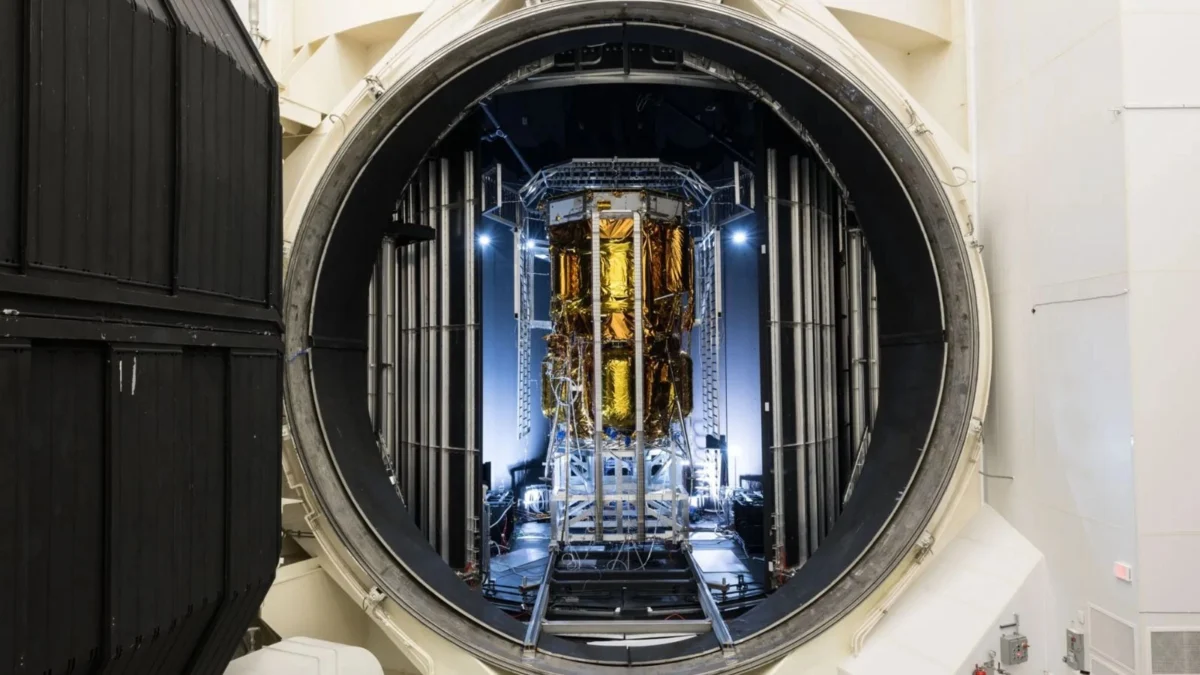
HOUSTON, TX — In a significant stride toward re-establishing a sustainable human presence on the Moon, Blue Origin has announced the successful completion of a rigorous environmental testing campaign for its Blue Moon Mark 1 (MK1) lunar lander. The spacecraft, affectionately dubbed "Endurance," underwent weeks of grueling simulations inside the historic Thermal Vacuum Chamber A at NASA’s Johnson Space Center.
This milestone marks a critical transition for Jeff Bezos’s space venture, moving the MK1 from the design and assembly phase into the realm of flight-ready hardware. As part of NASA’s Artemis program, the MK1 is designed to serve as a high-capacity, unmanned cargo delivery system, paving the way for the more complex crewed missions scheduled for the turn of the decade.
Main Facts: The ‘Endurance’ Test and the Path to the South Pole
The Blue Moon MK1 is a versatile, single-launch lander designed to provide frequent and reliable access to the lunar surface. Unlike previous lunar modules that were built for specific, one-off missions, the MK1 is engineered as a "workhorse" for the burgeoning lunar economy. It is capable of delivering up to three metric tons of cargo to any location on the Moon, though its primary focus remains the resource-rich lunar South Pole.
The Thermal Vacuum Challenge
The testing conducted at Johnson Space Center was not merely a formality. Thermal Vacuum Chamber A is one of the most sophisticated facilities on Earth, famously used to test the Apollo Command and Service Modules and, more recently, the James Webb Space Telescope.
During the testing period, "Endurance" was subjected to "space-like" conditions:
- Extreme Temperatures: The lander faced the radical thermal swings of the lunar environment, where temperatures can plummet to -280 degrees Fahrenheit in shadow and soar to 240 degrees Fahrenheit in direct sunlight.
- Total Vacuum: Engineers evacuated the air from the chamber to simulate the near-perfect vacuum of translunar space, ensuring that the lander’s pressurized systems, electronics, and structural seals remained intact.
- Operational Validation: Beyond survival, the test confirmed that the lander’s onboard computers, communication arrays, and thermal control systems could function harmoniously under stress.
Mission Objectives of MK1
The MK1 mission is a "pathfinder." Its primary goal is to validate the core technologies that Blue Origin will rely on for decades. These include:
- Cryogenic Propulsion: Utilizing liquid hydrogen and liquid oxygen—propellants that are efficient but notoriously difficult to manage over long durations due to "boil-off" issues.
- Autonomous GNC: Advanced Guidance, Navigation, and Control systems that allow the craft to land precisely within 100 meters of a designated target without human intervention.
- Precision Landing: Using sensors to detect hazards such as boulders or craters in real-time during the final descent.
Chronology: The Evolution of Blue Moon
The road to "Endurance" has been a multi-year journey of engineering hurdles and strategic pivots. To understand the significance of the recent vacuum tests, one must look at the timeline of Blue Origin’s lunar ambitions.
- May 2019: Jeff Bezos officially unveils the "Blue Moon" concept in Washington D.C., showcasing a large-scale mockup and emphasizing the need for a "permanent" lunar infrastructure rather than a "flags and footprints" approach.
- April 2020: NASA selects Blue Origin’s "National Team" (including Lockheed Martin, Northrop Grumman, and Draper) as one of three companies to develop designs for the Human Landing System (HLS).
- April 2021: In a surprise move, NASA awards a sole HLS contract to SpaceX for its Starship lander. This leads to a period of litigation and intense lobbying by Blue Origin, arguing for the necessity of a second, dissimilar landing system to ensure mission redundancy.
- May 2023: NASA awards Blue Origin a $3.4 billion contract under the Sustaining Lunar Development (SLD) program. This contract tasks Blue Origin with developing the Mark 2 (MK2) lander for the Artemis V mission.
- Late 2023 – Early 2024: Blue Origin shifts focus to the MK1 "Endurance" as a technology demonstrator. The company decides to fly the MK1 as a private venture and cargo service to "de-risk" the technologies needed for the NASA-contracted MK2.
- May 2026: "Endurance" successfully completes its environmental testing at Johnson Space Center, clearing the final major ground-based hurdle before its inaugural flight.
Supporting Data: Technical Specifications and Payload Capacity
The Blue Moon MK1 is built on a modular architecture, meaning its "bus" can be adapted for various mission profiles. Below is a breakdown of the technical data that makes the MK1 a formidable competitor in the "New Space" era.
Propulsion and Power
- Engine: The lander is powered by the BE-7 engine, an additive-manufactured, high-performance dual-expander cycle engine. It produces 10,000 lbf (44.5 kN) of thrust and is capable of deep throttling, which is essential for a soft touchdown.
- Fuel Cells: For power during the long lunar nights, Blue Origin utilizes fuel cells that combine hydrogen and oxygen to produce electricity and water, a more mass-efficient solution than heavy batteries for long-duration missions.
Scientific Payloads
On its maiden flight, MK1 will carry several high-priority scientific instruments:
- SCALPSS (Stereo Cameras for Lunar Plume-Surface Studies): A suite of NASA-provided cameras that will monitor how the BE-7 engine’s exhaust plume interacts with the lunar regolith (soil). This data is vital for understanding how landing rockets might damage nearby base infrastructure.
- LRA (Laser Retroreflector Array): A small array of mirrors that will stay on the Moon forever, allowing Earth-based lasers to measure the exact distance between the Earth and the Moon and providing a permanent "marker" for future incoming craft.
Comparative Advantage
Unlike the SpaceX Starship, which is a gargantuan vessel designed to carry dozens of people, the Blue Moon MK1 is sized for the "medium-lift" market. It can be launched atop Blue Origin’s own New Glenn rocket or other commercial heavy-lift vehicles like the ULA Vulcan, providing NASA with launch vehicle flexibility.
Official Responses: A Partnership for the Future
The success of the "Endurance" tests has drawn praise from both the private sector and the federal government, highlighting the efficacy of the Space Act Agreement.
Blue Origin Leadership Statement:
"The successful completion of the thermal vacuum testing is a testament to the hard work of our engineering teams," said a Blue Origin spokesperson. "Endurance is more than just a name; it represents our commitment to building the infrastructure that will allow humanity to stay on the Moon for good. We are proving that the cryogenic systems and autonomous controls required for the South Pole are ready for the vacuum of space."
NASA’s Perspective:
NASA officials at the Johnson Space Center emphasized the importance of private-public synergy. "By providing our world-class facilities like Chamber A to commercial partners, we accelerate the entire Artemis timeline," said a NASA spokesperson for the Moon-to-Mars Program Office. "Blue Origin’s MK1 provides a critical cargo capability that complements our crewed missions. We need a robust logistics chain to the Moon, and this test brings us one step closer to that reality."
Implications: Why the MK1 Matters for the 21st Century
The implications of a successful Blue Moon MK1 mission extend far beyond a single landing. It represents a shift in how the United States approaches deep-space exploration.
1. Enabling the South Pole Base
The lunar South Pole is the "New Frontier" because of the presence of water ice in permanently shadowed regions. Water is the "oil" of the solar system—it can be converted into breathable oxygen and liquid hydrogen fuel. The MK1 is specifically designed to land in these rugged, low-light regions, delivering the mining and life-support equipment necessary to harvest these resources.
2. The Path to MK2 and Human Landings
The MK1 is the direct ancestor of the MK2 lander, which will carry NASA astronauts. By testing the BE-7 engine and cryogenic storage on the MK1, Blue Origin is ensuring that the human-rated version is as safe and reliable as possible. Any anomalies discovered during the MK1’s mission can be corrected before astronauts ever step foot inside the MK2.
3. Geopolitical Leadership
With China actively planning its own lunar base (the ILRS), the progress of American commercial partners like Blue Origin is a matter of national strategic importance. The ability to deliver heavy cargo to the Moon autonomously ensures that the U.S.-led Artemis Accords nations maintain a technological edge in lunar logistics.
4. Economic Expansion
The MK1 opens the door for "non-traditional" space actors—universities, small nations, and private companies—to send experiments and hardware to the Moon at a lower cost. By offering a standardized cargo service, Blue Origin is essentially creating a "FedEx to the Moon," which could trigger an explosion in lunar research and commercial activity.
Conclusion
As "Endurance" exits the vacuum chamber at Johnson Space Center, it carries with it the aspirations of a new generation of explorers. The successful testing of the Blue Moon MK1 proves that the technologies required for a sustainable lunar presence are no longer theoretical—they are tangible, tested, and ready for the launch pad. With the Artemis program gaining momentum, the sight of a Blue Moon lander descending toward the lunar South Pole may soon become a routine occurrence, marking the beginning of humanity’s true expansion into the stars.
