

SCIENCE
Main Facts
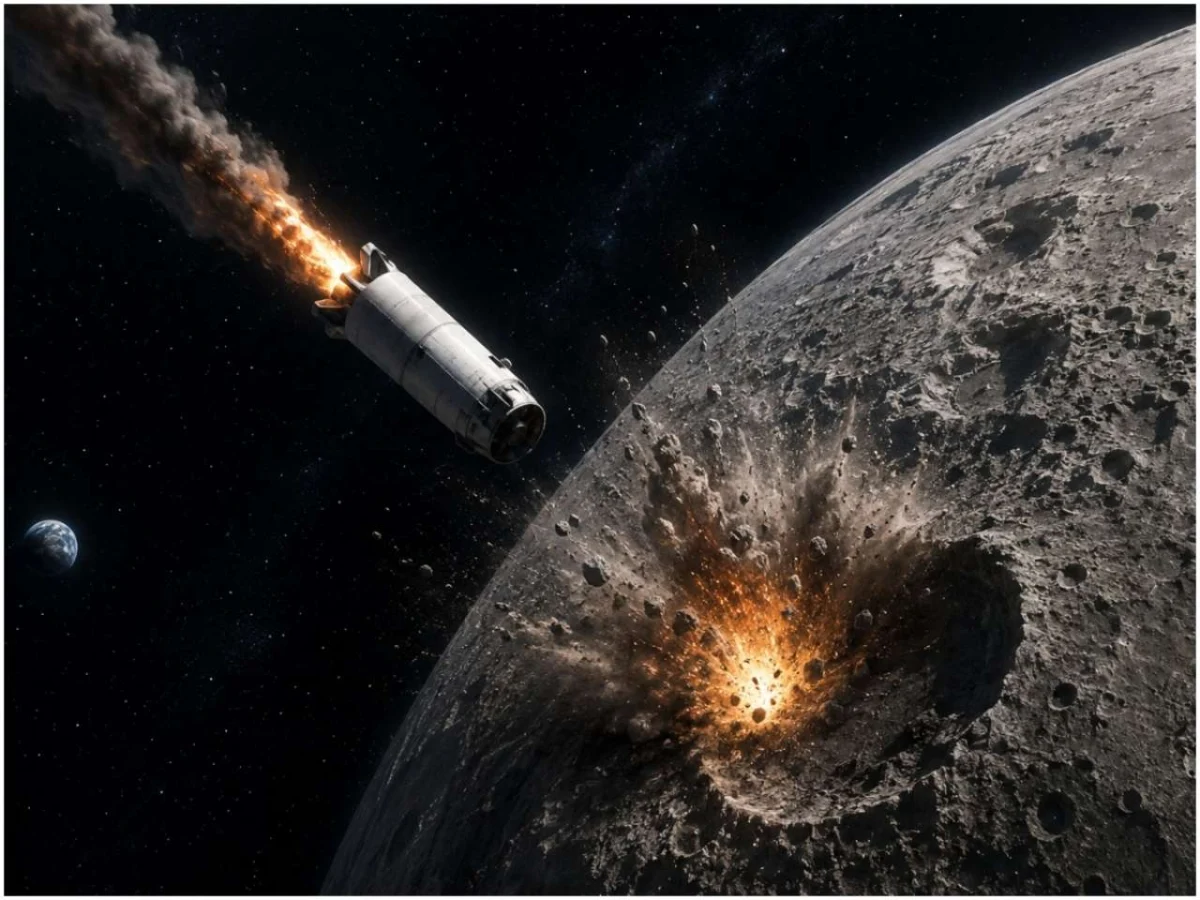
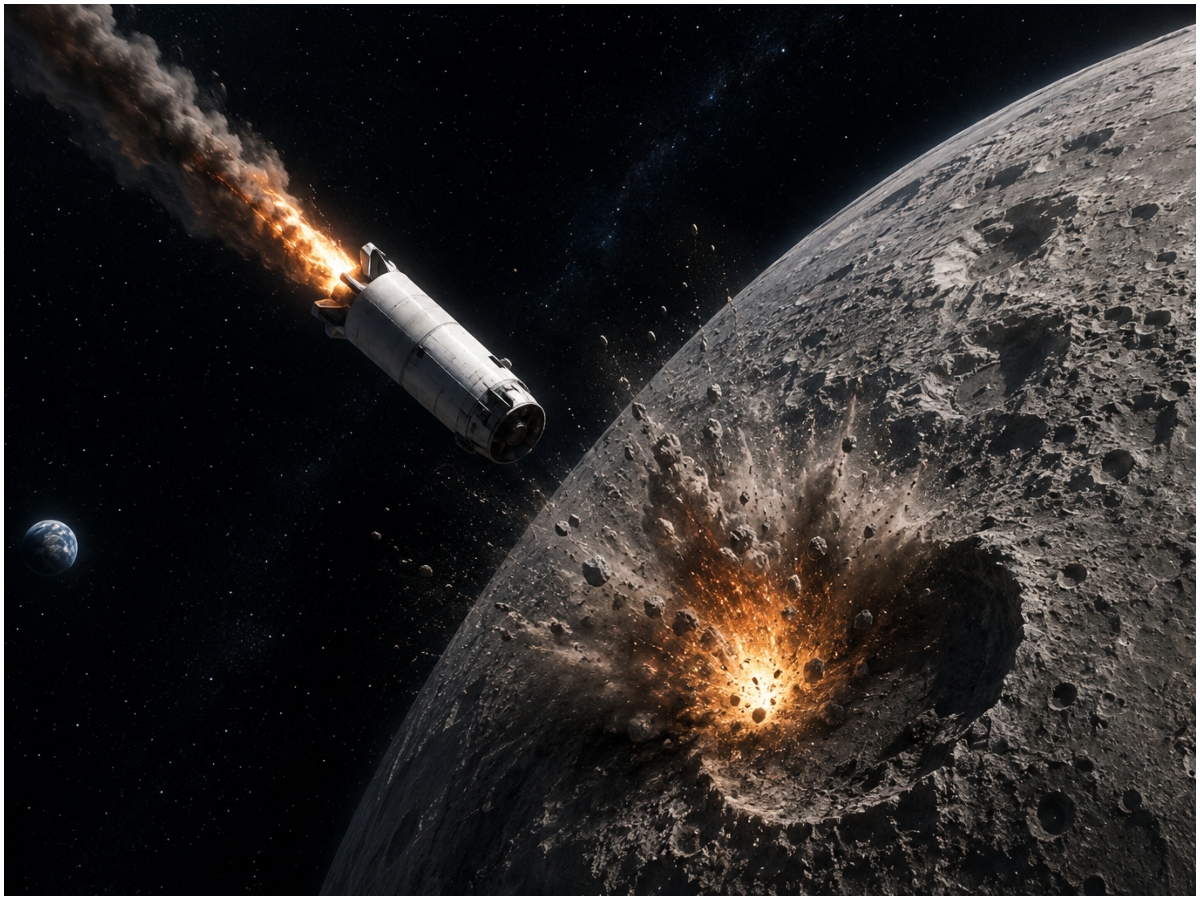
A discarded upper stage of a SpaceX Falcon 9 rocket, an inert relic of a mission launched nearly seven years prior, concluded its unpredictable journey through space with an unprecedented and unintentional impact on the lunar surface. The incident, which occurred on March 4, 2022, saw the four-tonne booster collide with the Moon’s far side at an estimated speed of 8,700 kilometers per hour (approximately 5,400 mph), near the remote Einstein Crater. This marks the first known accidental lunar impact of human-made space debris, drawing significant attention from the global scientific community and rekindling discussions about space traffic management beyond Earth’s immediate orbit.
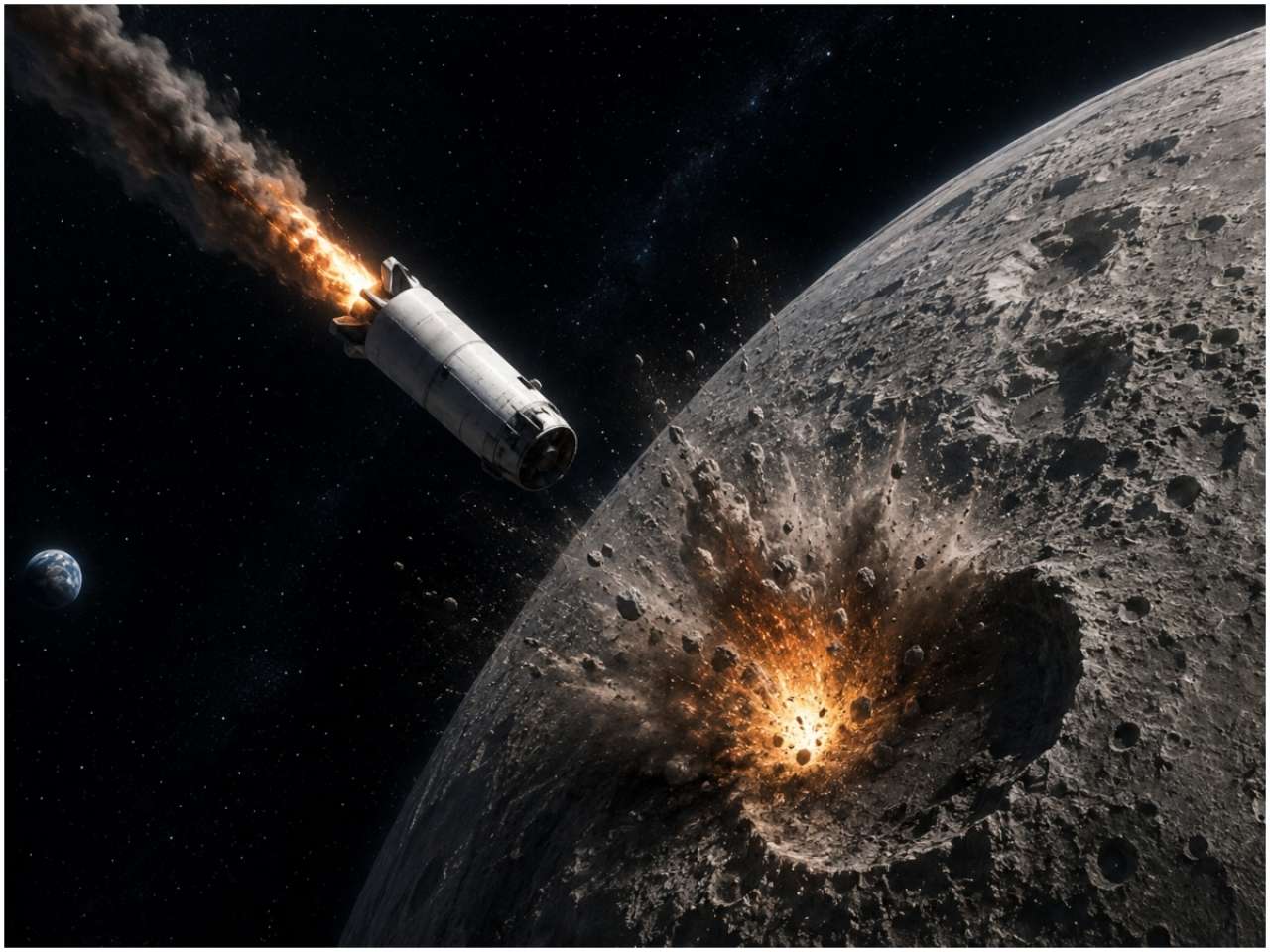
The object in question was the second stage of a Falcon 9 rocket that launched the Deep Space Climate Observatory (DSCOVR) satellite in February 2015. After deploying its payload to a distant Lagrange Point (L1), the booster, lacking the fuel for a controlled re-entry into Earth’s atmosphere or an escape trajectory, was left adrift in a chaotic orbit. Over the ensuing years, a complex interplay of gravitational forces from the Earth, Moon, and Sun, along with subtle solar radiation pressure, guided it towards its lunar rendezvous. While SpaceX acknowledged the collision as accidental and of no concern to its operational missions, the event serves as a stark reminder of the growing problem of space junk and the need for comprehensive tracking and disposal protocols for objects in translunar space.
Chronology of a Lunar Rendezvous
The journey of the Falcon 9 second stage to its lunar grave is a testament to the intricate and often unpredictable dance of orbital mechanics. Its story begins not with a crash, but with a launch.
)
The DSCOVR Mission: A New Eye on Earth
On February 11, 2015, a SpaceX Falcon 9 rocket lifted off from Cape Canaveral Air Force Station in Florida. Its primary mission was to deploy the Deep Space Climate Observatory (DSCOVR) satellite, a joint venture between NASA, NOAA, and the U.S. Air Force. DSCOVR was designed to monitor solar wind and coronal mass ejections for space weather forecasting, as well as to provide a continuous view of the entire sunlit side of Earth for climate observation. To achieve its mission, DSCOVR needed to be placed in a halo orbit around the Sun-Earth Lagrange Point 1 (L1), a gravitationally stable position approximately 1.5 million kilometers (930,000 miles) from Earth towards the Sun.
The Falcon 9’s first stage performed its controlled descent and landed on an autonomous drone ship, a pioneering feat in reusable rocket technology. However, the second stage, responsible for the final push to L1, conducted a prolonged burn to impart the necessary velocity to DSCOVR. This deep space injection left the second stage with insufficient fuel to perform a de-orbit burn back into Earth’s atmosphere, which would have ensured its controlled destruction. Unlike missions to Low Earth Orbit (LEO) or Geostationary Transfer Orbit (GTO) where de-orbiting is often standard procedure, the trajectory to L1 placed the booster on a path that would keep it in space indefinitely.
Years Adrift: The Chaotic Path
Following DSCOVR’s successful deployment, the 4-meter-long, 1.8-meter-diameter Falcon 9 second stage became a piece of uncontrolled space debris. It entered a highly eccentric Earth-crossing orbit, occasionally swinging close to the Moon. For nearly seven years, the object, designated as WE0913A by some trackers, was largely forgotten by official space agencies, as its trajectory posed no immediate threat to Earth-orbiting satellites or crewed missions.

However, a community of amateur astronomers and orbital mechanics enthusiasts continued to track various pieces of space junk. Among them was Bill Gray, a developer of astronomical software (Project Pluto), who identified the object in January 2022. Initially, Gray and others mistakenly identified it as an upper stage from a Chinese Chang’e 5-T1 lunar mission. This initial misidentification caused a brief stir before further analysis, primarily by Gray and Jonathan McDowell of the Harvard-Smithsonian Center for Astrophysics, conclusively identified it as the Falcon 9 second stage from the 2015 DSCOVR launch.
The Predictive Moment: A Lunar Collision Course
By late January 2022, Gray’s refined orbital calculations, incorporating detailed tracking data and sophisticated gravitational models, confirmed that the inert booster was on a definitive collision course with the Moon. The prediction narrowed down the impact date to March 4, 2022, with a precise impact time and location. The object’s path was a complex consequence of gravitational slingshots and perturbations over years, eventually nudging it into a lunar intercept trajectory.
The Impact: March 4, 2022
As predicted, on March 4, 2022, at approximately 12:25 UTC (5:55 PM IST), the Falcon 9 second stage slammed into the far side of the Moon. The estimated impact site was near the Hertzsprung crater, close to the larger Einstein Crater, specifically within a region that is perpetually out of direct view from Earth. This made direct visual confirmation of the impact from ground-based telescopes impossible. However, the confidence in the prediction was extremely high due to the extensive tracking and modeling performed by experts. While no immediate visual confirmation was obtained, the subsequent search for the impact crater by lunar orbiters has provided indirect evidence.
)
Supporting Data: The Physics of a Lunar Crash
The impact of the Falcon 9 booster on the Moon was a significant event, not just for its novelty but also for the scientific data it could potentially yield. Understanding the specifics of the object and the collision sheds light on the dynamics of space debris and lunar geology.
The Projectile: A School Bus-Sized Relic
The Falcon 9 second stage is a substantial piece of hardware. It measures approximately 12 meters (39 feet) in length and 3.7 meters (12 feet) in diameter, akin in size to a school bus. Its dry mass (without propellants) is around 4,000 kilograms (approximately 8,800 pounds). While the stage was empty of its volatile propellants (liquid oxygen and RP-1 kerosene), it still contained residual propellants, pressurant gasses, and the dense structure of its engine, tanks, and avionics, making it a considerable mass impacting the lunar surface.
)
The Velocity and Energy of Impact
The estimated impact speed of 8,700 km/h (5,400 mph) is extremely high, translating to roughly 2.4 kilometers per second (1.5 miles per second). At this velocity, the kinetic energy unleashed upon impact was immense, equivalent to approximately 1.1 tonnes of TNT. To put this into perspective, it’s roughly the energy released by a small tactical conventional bomb. Such an impact is powerful enough to excavate a new crater of significant size and depth.
The Target: Einstein Crater Region
The predicted impact site was on the far side of the Moon, near the western edge, specifically within the Hertzsprung crater, close to the larger Einstein Crater. This area is characterized by older, heavily cratered terrain. The far side of the Moon is a challenging region for observation from Earth due to tidal locking, meaning the same side always faces Earth. This geographical constraint meant that no direct real-time observation of the plume or flash from the impact was possible from Earth. However, lunar orbiters, such as NASA’s Lunar Reconnaissance Orbiter (LRO) and India’s Chandrayaan-2 orbiter, were positioned to potentially image the fresh crater in the days and weeks following the event.
The Science of Impact: Crater Formation and Seismology
When an object impacts a celestial body like the Moon, the kinetic energy is converted into heat, seismic waves, and the excavation of material. The resulting crater’s size and morphology depend on the projectile’s mass, velocity, composition, and the target’s surface properties. Scientists estimate the Falcon 9 impact likely created a crater between 10 to 20 meters (33 to 66 feet) in diameter.
)
Crucially, such impacts can generate seismic waves that propagate through the Moon’s interior. During the Apollo missions, seismometers were deployed on the lunar surface, and the controlled impacts of spent Apollo SIVB rocket stages (the third stage of the Saturn V) provided invaluable data about the Moon’s internal structure. While no active seismometers were near the Falcon 9 impact site, the event highlighted the potential for using such accidental impacts as "free experiments" to study lunar geology if future lunar seismic networks are established. Observing the new crater from orbit can also reveal fresh geological material, providing insights into the Moon’s subsurface composition.
Official Responses and Scientific Reactions
The unintentional lunar impact of the Falcon 9 booster, while not a planned mission, generated considerable interest among space agencies, astronomers, and policy experts.
)
SpaceX’s Stance
SpaceX, the manufacturer and operator of the Falcon 9, did not issue a specific public statement regarding the impact itself. This is largely because the booster was an old, defunct piece of hardware, launched nearly seven years prior to the collision. Its trajectory was beyond the company’s control or operational responsibility once its mission was complete. Julianna Scheiman, SpaceX director of NASA science and Dragon programs, had previously commented on the phenomenon of space junk, stating that "What has happened is essentially a mixture of solar activity and gravity forces have put it on a path toward the moon." This general acknowledgment underscored the accidental nature of the event from SpaceX’s perspective. The company’s focus remains on its active missions and its pioneering efforts in reusable rocket technology, which aim to reduce space debris by bringing first stages back to Earth.
The Astronomical Community’s Insights
The primary voices confirming and analyzing the impact came from independent astronomers and orbital mechanics experts. Bill Gray, whose software initially tracked the object and predicted its impact, was instrumental in bringing the event to light and correcting the initial misidentification. His detailed analysis provided the scientific community with the most accurate predictions for the impact time and location.
Jonathan McDowell, an astrophysicist at the Harvard-Smithsonian Center for Astrophysics and a renowned tracker of space objects, corroborated Gray’s findings. McDowell emphasized the scientific curiosity surrounding the event, noting that "It’s a good opportunity to learn more about the Moon’s geology." He also highlighted the broader issue of space junk, particularly in regions beyond Earth orbit where tracking is less rigorous.
)
NASA’s Role and Future Investigations
NASA acknowledged the impact event and expressed interest in its scientific potential. The agency’s Lunar Reconnaissance Orbiter (LRO), which has been mapping the Moon since 2009, was tasked with attempting to locate and image the new impact crater. LRO’s high-resolution cameras (NACs) are capable of resolving features as small as 0.5 meters, making it an ideal tool for identifying the fresh crater. Such images would provide definitive confirmation of the impact location and offer valuable data on the crater’s morphology and the ejected material.
While direct confirmation of the impact flash was not possible, NASA’s interest lies in the post-impact analysis. Scientists hope to use LRO data to understand the subsurface composition revealed by the impact and to compare it with other natural and artificial lunar craters. This kind of event, while accidental, provides a unique opportunity for passive remote sensing of the Moon’s interior.
Implications: Space Junk, Lunar Exploration, and Future Governance
)
The accidental lunar impact of the Falcon 9 second stage is more than just a curious astronomical event; it carries significant implications for the future of space exploration, the management of orbital debris, and international space policy.
The Growing Problem of Space Debris Beyond Earth Orbit
The issue of space junk is typically discussed in the context of Low Earth Orbit (LEO) and Geostationary Earth Orbit (GEO), where collisions between active satellites and debris pose an increasing threat. However, the Falcon 9 incident highlights a less-discussed but equally important aspect: debris in translunar space and beyond. Unlike LEO, where atmospheric drag eventually causes most objects to re-enter and burn up, objects in highly eccentric Earth-Moon orbits or interplanetary trajectories can persist for millennia, posing potential hazards to future missions.
The lack of comprehensive tracking for objects beyond GEO is a significant concern. The Falcon 9 booster was only identified and tracked effectively due to the diligent efforts of amateur astronomers. Official space surveillance networks primarily focus on Earth-orbiting objects. As more nations and private companies embark on lunar missions, including orbiters, landers, and potential human habitats, the need for robust tracking and collision avoidance systems in translunar space becomes critical.
)
The Environmental Impact on the Lunar Surface
While the Moon is constantly bombarded by natural meteoroids, the impact of a large, artificial object like a rocket stage is different. Such impacts introduce materials not naturally found on the Moon (e.g., specific alloys, plastics, residual propellants). While a single impact may have negligible environmental consequences for a body as vast as the Moon, the cumulative effect of many such uncontrolled impacts over time could become a concern for future lunar research, especially if humanity establishes permanent bases or observatories on the Moon. Scientists are increasingly advocating for the "protection of the lunar environment" from excessive contamination.
Scientific Opportunities from Accidental Impacts
Despite its accidental nature, the impact presents a valuable scientific opportunity. As noted, the Apollo missions deliberately crashed spent rocket stages onto the Moon to generate seismic waves, which were then recorded by seismometers left on the surface. These "active seismic experiments" provided unprecedented data on the Moon’s internal structure.
While there were no active seismometers near the Falcon 9 impact site, the event stimulates renewed interest in deploying lunar seismic networks. Future missions, such as NASA’s Artemis program or commercial lunar landers, could carry seismometers to better monitor natural impacts and potentially "listen" for future accidental ones. Furthermore, the new crater created by the Falcon 9 offers a fresh, unweathered exposure of lunar subsurface material. High-resolution imagery from lunar orbiters like LRO can analyze this exposed material, providing insights into the Moon’s geology, regolith properties, and potentially even water ice distribution.
)
The Need for International Guidelines and Regulations
The Falcon 9 incident underscores a significant gap in international space law and guidelines. While there are established, albeit sometimes debated, guidelines for mitigating space debris in Earth orbit (e.g., the 25-year rule for de-orbiting), similar comprehensive rules for objects sent beyond Earth’s gravitational influence are largely absent. There is no international treaty or widely accepted standard dictating the end-of-life disposal of rocket stages or spacecraft sent to the Moon, Lagrange points, or interplanetary trajectories.
This lack of regulation raises questions about accountability, environmental stewardship, and the long-term sustainability of deep space exploration. As more players enter the lunar domain, the potential for similar, or even more problematic, uncontrolled impacts will increase. Experts are calling for the development of new international norms and best practices for the responsible disposal of objects in translunar space, perhaps including controlled impacts in designated "graveyard" zones, or even controlled disposal into the Sun.
Historical Context and Future Precedents
Impacts on the Moon by human-made objects are not entirely new, but previous ones were almost exclusively deliberate. These include the controlled crashes of Apollo SIVB stages, the European Space Agency’s SMART-1 probe (2006), NASA’s LCROSS mission (2009) which deliberately targeted a polar crater to search for water ice, and Japan’s SLIM lander (2024) which successfully landed but later tipped over. However, several spacecraft have also crashed accidentally during attempted soft landings, such as India’s Chandrayaan-2 lander (2019) and Israel’s Beresheet lander (2019). The Falcon 9 impact stands out as the first known instance of a discarded rocket stage unintentionally colliding with the Moon after years of uncontrolled orbital decay, setting a unique precedent.
)
Conclusion
The accidental lunar impact of the SpaceX Falcon 9 second stage in March 2022 serves as a powerful, albeit unintended, case study in orbital dynamics, space debris management, and lunar science. While posing no immediate threat to humanity, it has ignited important conversations within the space community about the need for enhanced tracking, clear international guidelines, and responsible practices for the increasing number of objects venturing beyond Earth’s immediate vicinity. As humanity looks to return to the Moon and beyond, understanding and managing our orbital footprint will be paramount to ensuring the sustainable and scientific exploration of the cosmos. The legacy of this "space junk" impact will likely extend far beyond the newly formed crater on the lunar far side, influencing how we approach our presence in the broader solar system.
