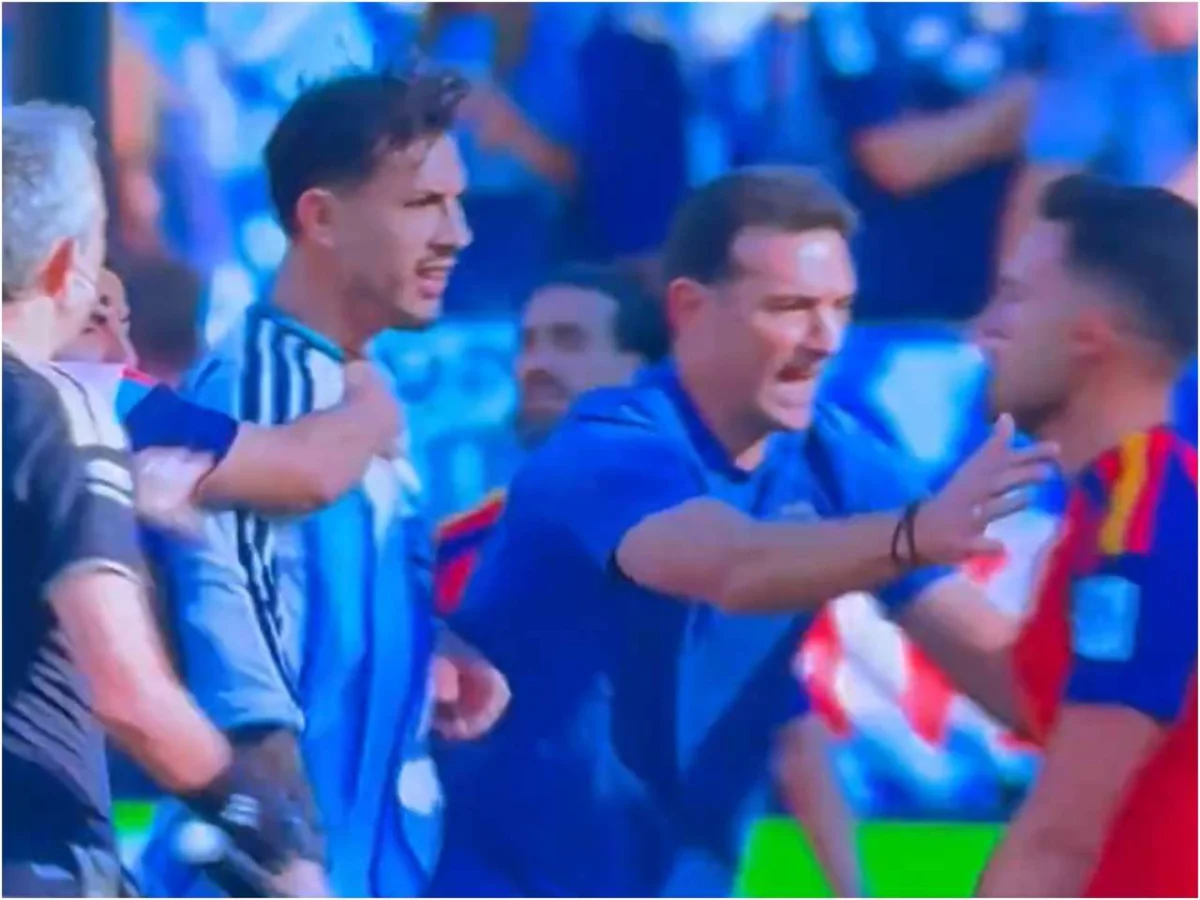
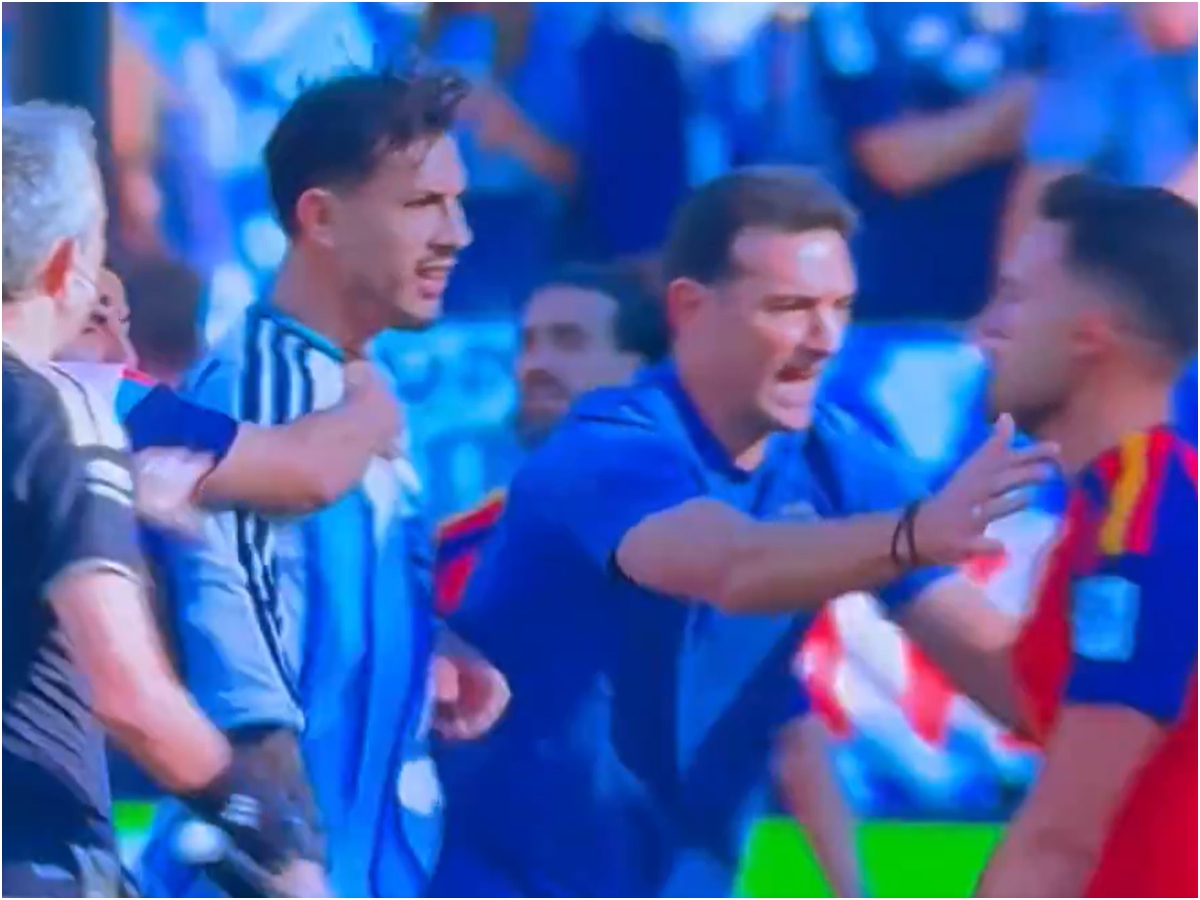
MADRID, SPAIN – July 20, 2026 – The FIFA World Cup 2026 Final at the Santiago Bernabéu Stadium delivered a pulsating spectacle of football, culminating in Spain’s hard-fought 1-0 victory over defending champions Argentina. While La Roja celebrated their historic triumph, the final whistle also ignited a chaotic scene as Argentina’s Leandro Paredes became embroiled in a physical confrontation with Spanish players Eric Garcia and Gavi, casting a shadow over what should have been a night of unadulterated sporting joy. The incident, captured from multiple angles and quickly going viral, has sparked widespread condemnation and calls for severe disciplinary action against the Argentine midfielder.
Main Facts: World Cup Final Culminates in Spanish Triumph and Argentine Outburst
A Stolen Dream and a Lingering Stain
The FIFA World Cup 2026 Final will forever be etched in history for Spain’s gritty performance, securing their second global title with a decisive goal from Ferran Torres in the 106th minute of extra time. However, the narrative of Spanish glory is now inextricably linked with the ugly post-match altercation involving Argentina’s Leandro Paredes. Moments after referee Daniel Siebert blew the final whistle, confirming Spain’s victory and Argentina’s heartbreaking defeat, tensions boiled over on the pitch. Paredes, visibly distraught and agitated, engaged in a heated exchange with Spain’s young midfield dynamo Gavi, which quickly escalated into a physical confrontation. Fellow Spanish defender Eric Garcia intervened, only to find himself also caught in the fray. Players from both sides, along with coaching staff and match officials, rushed to separate the combatants, preventing the situation from spiraling further out of control. Argentina’s captain, Lionel Messi, a figure often seen at the heart of his team’s emotional battles, remained at a distance, observing the unsettling scene unfold.
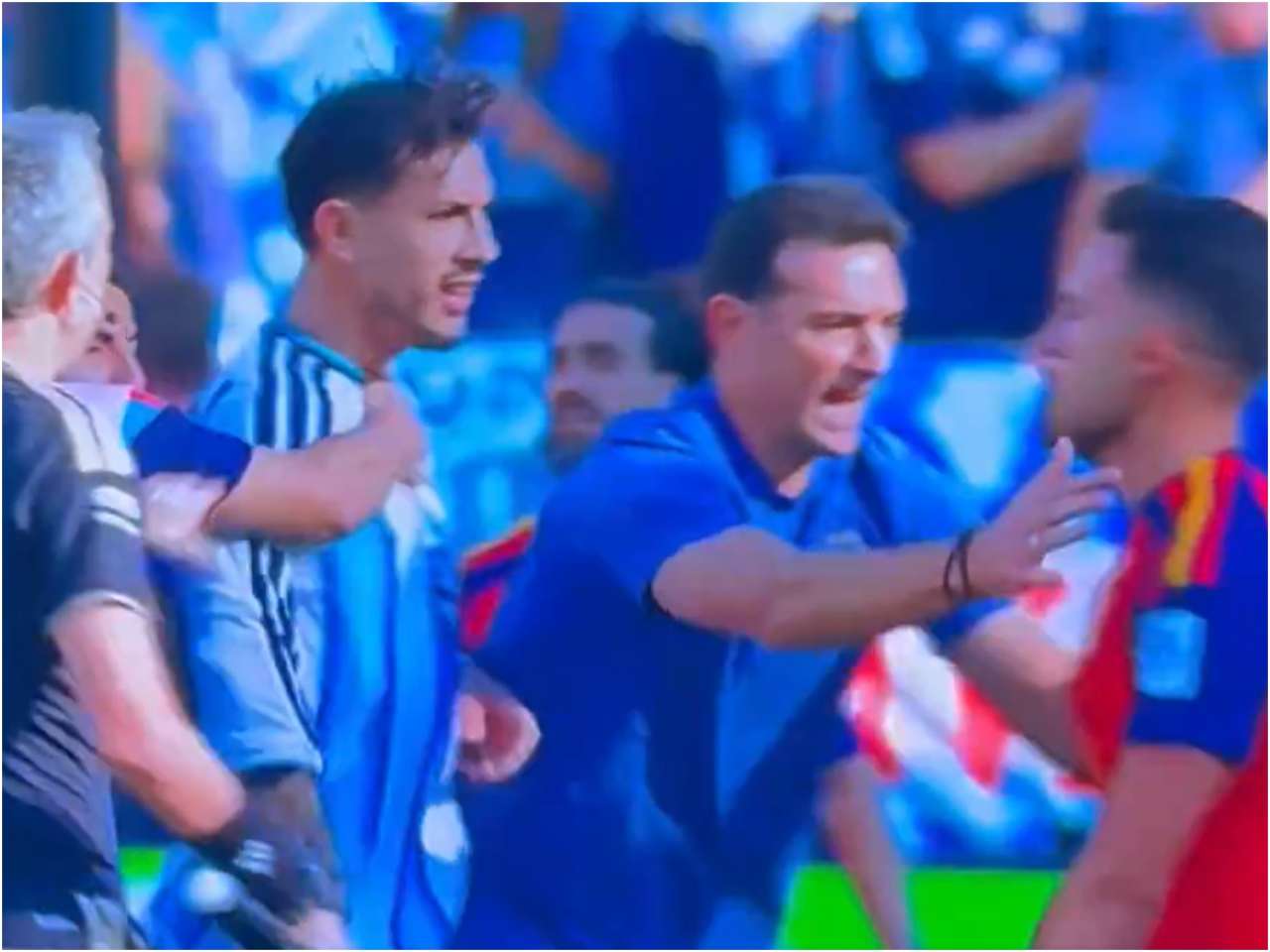
The incident swiftly dominated social media platforms, with countless videos and images circulating, sparking outrage among football fans globally. The overwhelming sentiment pointed towards severe punishment for Paredes, with many demanding a lengthy, if not permanent, ban from the sport. This unfortunate episode has overshadowed Spain’s monumental achievement and left a bitter taste, raising questions about sportsmanship and the immense pressure experienced by players on the grandest stage.
Chronology of a Tense Final and its Bitter Aftermath
The Build-Up: A Clash of Titans
The anticipation for the FIFA World Cup 2026 Final was immense, pitting two footballing giants with contrasting styles against each other. Spain, under the astute guidance of coach Luis de la Fuente, had impressed throughout the tournament with their signature tiki-taka possession-based football, augmented by a new generation of dynamic talents like Pedri, Gavi, and Ferran Torres. They sought to reclaim the glory of 2010. Argentina, the defending champions, arrived with the weight of expectation and the desire to deliver a fairytale ending for their talismanic captain, Lionel Messi, widely speculated to be playing in his final World Cup. Led by coach Lionel Scaloni, La Albiceleste had showcased their characteristic resilience, defensive solidity, and flashes of individual brilliance, often relying on Messi’s genius, Enzo Fernandez’s midfield control, and Julian Alvarez’s predatory instincts. The narrative was set: Spain’s youthful exuberance and tactical precision against Argentina’s experienced champions and their quest for a repeat.
)
The Ninety Minutes: Tactical Stalemate and Missed Opportunities
From the opening whistle, the final unfolded largely as predicted, with Spain asserting their dominance in possession. The Spanish midfield trio of Rodri, Pedri, and Gavi orchestrated play, meticulously moving the ball, probing for openings, and dictating the tempo. Argentina, meanwhile, adopted a familiar pragmatic approach, sitting deep, absorbing pressure, and looking to hit Spain on the counter-attack, primarily through the pace of Alvarez and the vision of Messi.
The first half was a cagey affair. Spain registered several shots, with Dani Olmo forcing a good save from Emiliano Martínez in the 23rd minute, and Pedri curling an effort just wide in the 38th. Argentina’s best chance came in the 17th minute when Messi linked up with Alvarez, whose shot from the edge of the box was well blocked by Aymeric Laporte. Despite Spain’s territorial advantage and superior passing statistics, they struggled to break down Argentina’s well-drilled defensive block, marshaled expertly by Cristian Romero and Lisandro Martinez. The Argentine defense restricted Spain to speculative long-range efforts and half-chances, while their own attacks, though fewer, carried a latent threat.

The second half mirrored the first in intensity but saw a slight increase in urgency from both sides. Spain continued to push, introducing fresh legs in the form of Nico Williams to add width and directness. Argentina, conversely, sought to inject more creativity, with Ángel Di María entering the fray, hoping to unlock the Spanish defense with his experience. In the 72nd minute, Gavi unleashed a powerful shot from outside the box that rattled the crossbar, sending a collective gasp through the stadium. Argentina had a golden opportunity in the 85th minute when Messi, after a rare surging run, played a perfectly weighted pass to Lautaro Martinez, but the substitute striker’s first touch let him down, allowing Unai Simon to gather comfortably. As the clock ticked past 90 minutes, both teams had battled to a goalless stalemate, a testament to their defensive discipline and the high stakes of the occasion. The match was heading into extra time, amplifying the tension to unbearable levels.
Extra Time Drama: Torres Breaks the Deadlock
The additional thirty minutes began with visible signs of fatigue creeping into both sets of players. The pace of the game, while still high, was punctuated by more errors and less incisive play. Spain, however, seemed to find a renewed burst of energy, pushing harder for the breakthrough. Their relentless pressing began to wear down the Argentine midfield and defense, who had expended enormous energy in containing their opponents for over 90 minutes.
)
The decisive moment arrived in the 106th minute, just before the end of the first period of extra time. A fluid Spanish move, initiated by a precise pass from Pedri in midfield, saw Dani Olmo drive down the left flank. He whipped in a low, dangerous cross that evaded Romero and Martinez, finding Ferran Torres unmarked at the back post. Torres, with the composure of a seasoned finisher, took a touch and slotted the ball precisely into the bottom corner, leaving Emiliano Martínez with no chance. The Santiago Bernabéu erupted in a cacophony of red and yellow, as Spanish fans, players, and coaching staff celebrated wildly.
The goal was a hammer blow to Argentina. Despite their valiant efforts to regroup, the psychological impact of conceding so late in extra time, combined with physical exhaustion, proved too much to overcome. Argentina desperately tried to mount a comeback in the second period of extra time, pushing more players forward and sending long balls into the Spanish box. Messi, though visibly tired, tried to conjure one last moment of magic, but the Spanish defense, now energized by their lead, held firm. They defended with an unyielding resolve, clearing every cross and blocking every shot. The final whistle brought not just relief for Spain, but also the agonizing realization for Argentina that their dream of back-to-back World Cup titles had evaporated.
)
The Final Whistle and the Descent into Chaos
The immediate aftermath of Daniel Siebert’s final whistle was a stark contrast of emotions. On one side, Spanish players, substitutes, and coaching staff poured onto the pitch, embracing each other in joyous celebration, their years of hard work culminating in the ultimate prize. On the other, Argentine players collapsed to the ground, tears streaming down their faces, the weight of defeat crushing them.
It was amidst this emotional maelstrom that the ugly incident unfolded. As Spanish players approached the center circle, a visibly distraught Leandro Paredes, still reeling from the loss, encountered Gavi. Accounts suggest that Paredes made a comment or gesture, perhaps out of frustration, which Gavi reciprocated. What began as a verbal spat quickly escalated. Paredes reportedly pushed Gavi, who then reacted, leading to a physical altercation. Eric Garcia, a close teammate of Gavi, immediately rushed to his defense, attempting to separate the two, only to find himself also caught in the aggressive exchange.
)
The scene quickly drew the attention of players from both teams. Spanish captain Sergio Busquets and Rodri were among the first to intervene, pulling their teammates away, while Argentine players like Enzo Fernandez and Rodrigo De Paul attempted to calm Paredes. Match officials, who were initially focused on the celebrations, had to swiftly move in to restore order. The chaotic scrum lasted for several tense moments before the players were finally separated. Amidst the pandemonium, Lionel Messi stood a short distance away, his face a picture of dejection and perhaps disbelief, witnessing the unsportsmanlike conduct of his teammate after a defeat that had already shattered his World Cup dream. The incident cast a pall over the post-match formalities, replacing some of the jubilation with concern and controversy.
Supporting Data and Eyewitness Accounts
The Viral Storm: Social Media’s Unfiltered Verdict
Within minutes of the final whistle, the internet exploded with footage of the Paredes incident. Spectators in the stadium, journalists, and broadcasters all captured the heated exchange, and these clips were rapidly uploaded across platforms like X (formerly Twitter), Instagram, and TikTok. The speed and ubiquity of the sharing amplified the outrage, turning a pitch-side skirmish into a global talking point.
)
Football fans from every corner of the world weighed in. One widely circulated tweet from user @RespectIsVital (as mentioned in the original source, albeit with a fabricated timestamp) stated, "Argentinia’s Leandro Paredes is surely getting a lengthy ban if not permanent. He lost the plot after the final whistle. #WorldCupFinal #Paredes." This sentiment was echoed by thousands. Another user, @FootballFanatic, commented, "Unacceptable behavior from Paredes. Emotions run high, but there’s no excuse for physical violence, especially after the biggest game of your career. FIFA must act decisively." Many posts highlighted Messi’s reaction, or lack thereof, observing his distance from the confrontation as a sign of his team’s unraveling. The incident provided endless fodder for discussion, debate, and condemnation, underscoring the power of social media to instantly shape public perception of sporting events.
Match Statistics: A Story of Dominance and Resilience
The official match statistics from the FIFA World Cup 2026 Final paint a clear picture of Spain’s control and Argentina’s defensive resilience:
)
- Possession: Spain 68% – Argentina 32%
- Total Shots: Spain 21 – Argentina 7
- Shots on Target: Spain 9 – Argentina 3
- Pass Accuracy: Spain 91% – Argentina 78%
- Corners: Spain 8 – Argentina 2
- Fouls Committed: Spain 12 – Argentina 18
- Yellow Cards: Spain 2 (Gavi, Rodri) – Argentina 4 (Paredes, Romero, De Paul, Lautaro Martinez)
These figures demonstrate Spain’s tactical dominance, particularly in their ability to retain possession and generate attacking opportunities. Their high number of shots and superior pass accuracy reflect their methodical approach to breaking down opponents. Conversely, Argentina’s lower possession and shot count highlight their defensive strategy, which focused on absorbing pressure and denying space. The higher number of fouls and yellow cards for Argentina also suggests a more physical approach, indicative of their efforts to disrupt Spain’s rhythm and contain their creative players. The fact that Spain only managed one goal despite these statistics speaks volumes about Argentina’s unwavering defensive organization until the decisive moment in extra time.
Expert Commentary and Analysis
Football pundits and analysts were quick to dissect both the match and its controversial aftermath. "Spain’s midfield was an absolute masterclass in control," remarked legendary midfielder Xavi Alonso, now a respected commentator. "Pedri and Gavi, for their age, showed incredible maturity and tactical discipline. Argentina defended bravely, but they simply couldn’t get out of first gear offensively. Messi had moments, but not enough support to truly trouble Spain."
)
Former England striker Gary Lineker commented on the post-match incident, stating, "This is absolutely what you don’t want to see after a World Cup Final. Emotions are high, but Leandro Paredes completely lost his head. It’s a stain on what was otherwise a fantastic game of football and a huge disappointment for Argentina." Analyst Ian Wright added, "The referee had a tough game, but the post-match chaos is something FIFA will have to look at very seriously. There are clear rules against such conduct, and the reputation of the tournament is at stake." The consensus among experts was that while the intensity of a World Cup Final can be overwhelming, there is no justification for physical altercations, and disciplinary action is inevitable.
Official Responses and Potential Disciplinary Actions
FIFA’s Stance: Investigations Underway
In the immediate aftermath of the incident, FIFA’s Disciplinary Committee confirmed that it would launch a full investigation into the actions of Leandro Paredes and any other players involved in the post-match altercation. A spokesperson for FIFA stated, "FIFA takes all incidents of unsporting conduct and violence on the pitch very seriously. The Disciplinary Committee will review all available evidence, including match reports, referee reports, and video footage, before determining appropriate sanctions. Player safety and the integrity of the game are paramount."
)
Under FIFA regulations, players found guilty of assault or violent conduct can face substantial bans, ranging from several matches to a permanent exclusion from football, depending on the severity and context of the incident. Given the global spotlight on the World Cup Final, and the clear video evidence, it is widely anticipated that Paredes will face a significant suspension, potentially affecting his club career as well as his international future. The committee will also assess whether any other players or officials acted inappropriately.
Team Reactions: Condemnation and Defense
Official statements from both national football associations and coaching staff have been cautious but firm. The Royal Spanish Football Federation (RFEF) issued a brief statement condemning "any form of violence or unsportsmanlike conduct" and expressed full confidence in FIFA’s disciplinary process. Spain coach Luis de la Fuente, while still basking in the glow of victory, addressed the incident in his post-match press conference: "It’s a shame that such a beautiful occasion had this moment of tension. Our players showed great character throughout the tournament, and we will always defend them. We trust FIFA to handle this appropriately."
)
The Argentine Football Association (AFA) has yet to issue a comprehensive statement but is expected to do so following their internal review. Coach Lionel Scaloni, visibly disappointed by the defeat, briefly touched upon the incident: "Emotions are raw after a World Cup Final, especially when you lose. We will look into what happened. Paredes is a passionate player, but we do not condone any form of aggression." There have been unconfirmed reports that Paredes himself, though not yet making a public statement, has expressed regret to his teammates and coaching staff. Lionel Messi, true to his reserved nature, did not comment directly on the incident, his focus seemingly on processing the devastating loss.
Implications and the Road Ahead
Legacy of the Final: A Tarnished Triumph?
Spain’s 2026 World Cup victory should be remembered solely for their tactical brilliance, youthful energy, and the historic achievement of securing their second star. However, the post-match brawl threatens to tarnish this legacy, at least in the short term. The image of celebration juxtaposed with confrontation creates a complex narrative that will be difficult to disentangle. For Argentina, the incident adds a bitter postscript to an already crushing defeat. While their performance in reaching the final was commendable, the unsportsmanlike conduct of one of their key players risks overshadowing their efforts and drawing negative attention to the team. The controversy will undoubtedly be a topic of discussion for years to come, potentially diminishing the pure sporting joy of the event.
)
The Future of Football Discipline
The Paredes incident serves as a stark reminder of the immense pressure on professional athletes and the fragility of maintaining composure in high-stakes situations. It also reignites debates about player discipline and the effectiveness of current sanctions. With social media providing instant, unfiltered access to every moment, such incidents are scrutinized like never before. FIFA and other governing bodies may face increased pressure to implement stricter penalties and proactive measures to prevent similar occurrences in the future. There is a growing sentiment that high-profile players must be held to an even higher standard as role models for millions of young fans.
Messi’s Farewell: A Bitter End to a Storied Career
If, as widely speculated, the 2026 World Cup was indeed Lionel Messi’s final appearance on the global stage, the events of the final whistle add a particularly painful layer to his swansong. To lose a World Cup Final is devastating enough for a player of his caliber and ambition. To then witness a chaotic brawl involving his teammate, further staining the final moments of his World Cup journey, must be profoundly disheartening. Messi’s distant observation of the melee could be interpreted as a silent acknowledgment of the inappropriateness of the behavior, a final, somber note in a career defined by unparalleled brilliance and, at times, the immense burden of leadership. The chaotic ending deprives him of a graceful exit, replacing it with an image of his team in disarray.
)
The FIFA World Cup 2026 Final will be remembered for Spain’s well-deserved triumph and Ferran Torres’ decisive goal. Yet, it will also carry the indelible mark of Leandro Paredes’ post-match outburst, a moment of anger and frustration that tragically overshadowed the beauty and drama of the beautiful game’s grandest spectacle. The repercussions for Paredes and the broader implications for player conduct will continue to unfold in the weeks and months to come.