

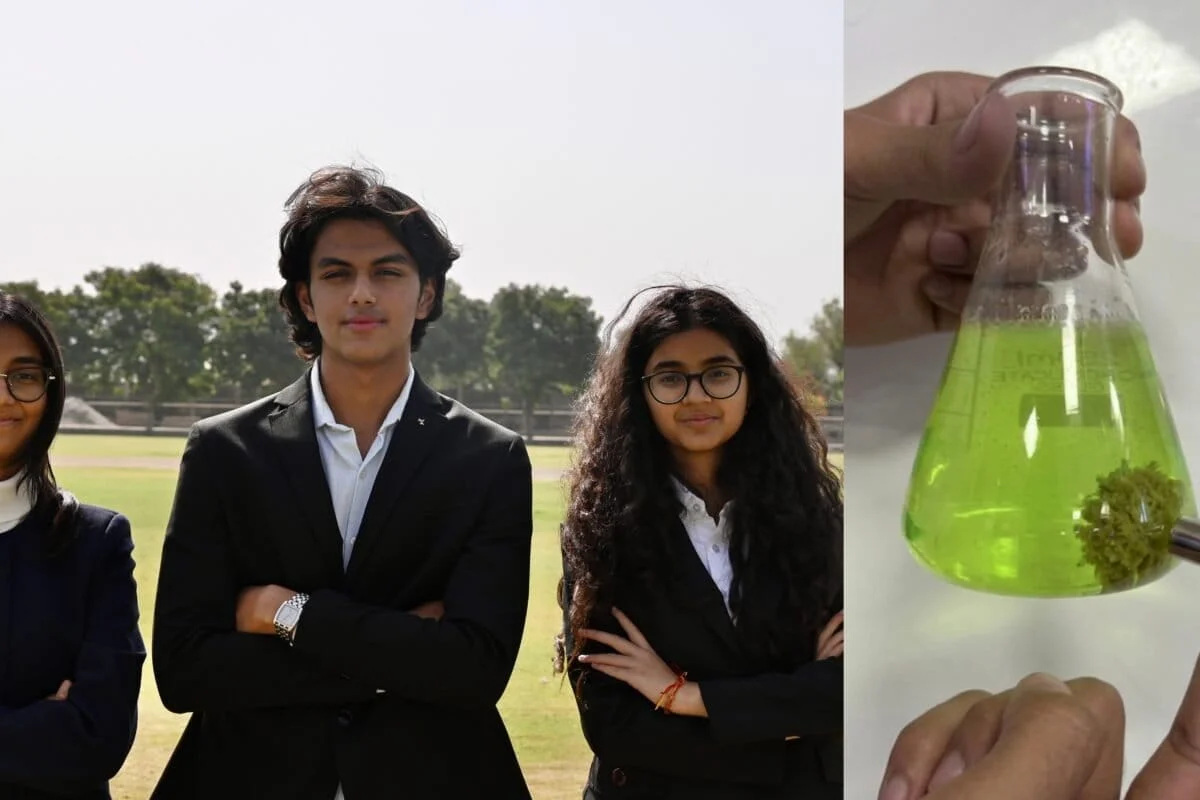
NEW DELHI – In an era where the global environmental discourse is often dominated by dire warnings and systemic inertia, a trio of 16-year-old students from India has emerged as a beacon of pragmatic innovation. Avyana Mehta, Vivaan Chhawchharia, and Ariana Agarwal have been named the winners of The Earth Prize 2026, a prestigious global environmental competition, for their groundbreaking invention: Plas-Stick.
Their solution addresses one of the most insidious environmental crises of the 21st century—microplastic pollution—using an elegantly simple, low-cost material: waste tamarind seeds. By converting these discarded seeds into a functional powder capable of sequestering microplastics from water, the team has provided a scalable blueprint for water safety in resource-constrained environments.
Main Facts: The Genesis of Plas-Stick
The innovation, dubbed "Plas-Stick," utilizes the natural binding properties of tamarind seeds to tackle the "invisible" threat of microplastics. Microplastics, defined as plastic particles less than five millimeters in diameter, have infiltrated every level of the global food chain and water supply. While high-tech filtration systems exist, they are often prohibitively expensive and require significant infrastructure, making them inaccessible to the world’s most vulnerable populations.
The Innovation at a Glance
- The Product: A specialized powder derived from waste tamarind seeds.
- The Mechanism: The powder acts as a natural coagulant. When introduced to contaminated water, it attracts microplastic particles, causing them to clump together (flocculation).
- The Extraction: These clumps are then easily removed using a handheld magnet, leaving the water significantly clearer of plastic contaminants.
- Target Audience: Rural communities and households relying on shared water containers without access to electricity or advanced Reverse Osmosis (RO) systems.
The Earth Prize, organized by the Geneva-based Earth Foundation, recognized the team not only for the scientific viability of their solution but for its potential to be deployed immediately in real-world settings. Already, the project has reached over 8,000 students and educators across India, demonstrating a rare transition from a classroom concept to a field-tested reality.
Chronology: From Classroom Theory to Global Recognition
The journey of Plas-Stick began in the halls of environmental science classrooms, where Mehta, Chhawchharia, and Agarwal first grappled with the complexities of the plastic crisis. However, the theoretical risk became a tangible mission during a pivotal visit to a rural Indian community.
Observation and Identification (2024–2025)
During their field visit, the students observed a common practice in rural India: the use of large, shared containers for drinking water. While these communities often lacked the means for sophisticated filtration, they were also largely unaware of the microscopic contaminants present in their supply.
"Microplastics stood out to us because they are invisible, but the risk is very real," the team explained. "In many rural communities, people drink water without knowing what may be present in it." This observation served as the catalyst for their research. They realized that any viable solution had to meet three criteria: it had to be inexpensive, it had to require no electricity, and it had to utilize locally available materials.
Research and Development (2025)
The team began experimenting with various natural materials that possessed "mucoadhesive" or binding properties. Tamarind seeds, a ubiquitous waste product in Indian households and the food processing industry, emerged as the frontrunner. Through a process of drying, grinding, and treating the seeds, they developed a powder that could effectively "grab" plastic particles.
To refine the extraction process, they integrated a magnetic component. By ensuring the microplastic-tamarind clumps were responsive to magnetism, they simplified the removal process, allowing a user to "sweep" the contaminants out of a container with a simple handheld tool.
Validation and Scaling (Early 2026)
Before entering The Earth Prize, the team sought institutional validation. They collaborated with professionals and researchers from the Indian Institute of Technology (IIT), Guwahati, one of India’s premier technical universities. This partnership allowed them to test the efficacy of Plas-Stick in controlled environments and refine the chemical engineering behind the seed-based powder.
The successful deployment of the solution to 8,000 individuals served as the final proof of concept needed to secure the top spot at the 2026 Earth Prize ceremonies in Switzerland.
Supporting Data: The Science of the Solution
To understand the impact of Plas-Stick, one must examine the scale of the microplastic problem and the chemical ingenuity of the tamarind seed.
The Microplastic Crisis in India
India’s water bodies are among the most plastic-stressed in the world. According to various environmental studies, microplastics are found in high concentrations in the Ganges and Yamuna rivers, which serve as primary water sources for millions.

- Global Ingestion: Research suggests the average human may ingest approximately 5 grams of plastic per week—the equivalent of a credit card.
- Health Risks: While long-term studies are ongoing, microplastics are linked to endocrine disruption, oxidative stress, and the introduction of toxic chemicals into the human bloodstream.
Why Tamarind?
The choice of tamarind seeds (Tamarindus indica) is a masterclass in circular economy principles. India is the world’s largest producer of tamarind. The seeds are typically discarded as agricultural waste after the pulp is extracted for culinary use.
- Natural Polysaccharides: Tamarind kernel powder contains a high percentage of "jellose," a polysaccharide that acts as a natural binder.
- Cost-Effectiveness: Because the raw material is a waste product, the production cost of Plas-Stick is a fraction of that of synthetic chemical flocculants or membrane filters.
- Sustainability: Unlike synthetic filters that eventually end up in landfills, the tamarind-based clumps are biodegradable, though the team is currently researching safe disposal methods for the plastic-heavy residue.
Official Responses: A Vision for the Future
The win has garnered praise from environmentalists and educators alike. The Earth Foundation, which hosts the competition, emphasized that the 2026 cohort represents a shift toward "frugal innovation"—the art of doing more with less.
The Earth Foundation’s Mandate
Founded in the wake of the 2019 global climate strikes, The Earth Foundation aims to bridge the gap between youth activism and scientific implementation. "The Earth Prize was launched as the world’s largest environmental competition and ‘ideas incubator’ for young people," a spokesperson for the foundation stated. "Team Plas-Stick embodies exactly what we look for: a solution that is scientifically sound, socially responsible, and immediately actionable."
The Team’s Roadmap
The $100,000 prize money (the standard award for the winning team) is already earmarked for expansion. The students are not looking to build a centralized factory; instead, they are advocating for a decentralized production model.
"The prize money will help us scale Plas-Stick in a more structured and responsible way," the team told Mongabay-India. "By the end of 2026, we hope to grow from educating 8,000 people about it to around 35,000–40,000."
Their plan involves setting up "production hubs" in rural villages. By providing the technology and training to local communities, they aim to empower residents to produce their own Plas-Stick powder, creating local jobs while solving a local health crisis.
Implications: A Paradigm Shift in Water Safety
The success of Avyana Mehta, Vivaan Chhawchharia, and Ariana Agarwal carries profound implications for the future of environmental science and public health.
1. The Democratization of Water Filtration
For decades, water safety has been treated as a luxury of the middle and upper classes, who can afford expensive filtration hardware. Plas-Stick challenges this narrative by proving that effective filtration can be achieved with "kitchen-table" chemistry and agricultural waste. This democratization of technology is essential for meeting the United Nations’ Sustainable Development Goal 6: Clean Water and Sanitation for All.
2. The Power of "Waste-to-Value"
The project serves as a premier example of the circular economy. By taking a byproduct that would otherwise rot in a landfill and using it to clean the environment, the students have demonstrated how economic and environmental goals can align. This "waste-to-value" approach is a critical component of modern sustainability strategies.
3. Youth-Led Innovation
The Earth Prize 2026 highlights a growing trend: the most agile environmental solutions are increasingly coming from the generation that will be most affected by climate change. These students are not waiting for governmental policy to catch up with the crisis; they are building the tools to survive it themselves.
4. Scalability and Global Application
While the project is currently focused on India, the team’s methodology could be applied globally. Other regions with high tamarind production—such as Southeast Asia and parts of Africa—could adopt similar models. Furthermore, the research into natural coagulants could pave the way for removing other contaminants, such as heavy metals or dyes, from industrial runoff.
Conclusion
As the world grapples with the pervasive and growing threat of microplastics, the story of Team Plas-Stick offers a rare moment of optimism. Avyana Mehta, Vivaan Chhawchharia, and Ariana Agarwal have shown that the solutions to our most complex problems do not always require the most complex technology. Sometimes, the answer lies in the seeds we throw away, the curiosity of the youth, and a simple magnet.
With the backing of The Earth Foundation and the technical support of IIT Guwahati, Plas-Stick is poised to move from a prize-winning project to a standard-setting utility in rural water management. By the end of 2026, tens of thousands of people across India may be drinking safer water, thanks to three teenagers who refused to ignore the invisible.
