DARJEELING, West Bengal — In the mist-shrouded highlands of the Eastern Himalayas, where the air smells of damp earth and ancient oak, a centuries-old legend persists among the forest-dwelling communities. It is the story of a "rain-bringer"—not a deity or a shaman, but a reclusive, chestnut-hued bird whose laughter-like call is said to command the clouds.
For generations, the elders of Sirikhola, Gurdum, and the Lepcha villages of North Sikkim have looked to the canopy rather than the horizon to forecast the weather. Today, this traditional ecological knowledge (TEK) is finding a new resonance within the corridors of modern conservation biology. As researchers delve deeper into the avian corridors of the Singalila National Park and its surrounding human-managed landscapes, they are discovering that the Bay Woodpecker (Blythipicus pyrrhotis) is more than a mythological weather vane; it is a critical bio-indicator of the health of one of the world’s most sensitive ecosystems.
Main Facts: The Elusive ‘Messenger of the Monsoon’
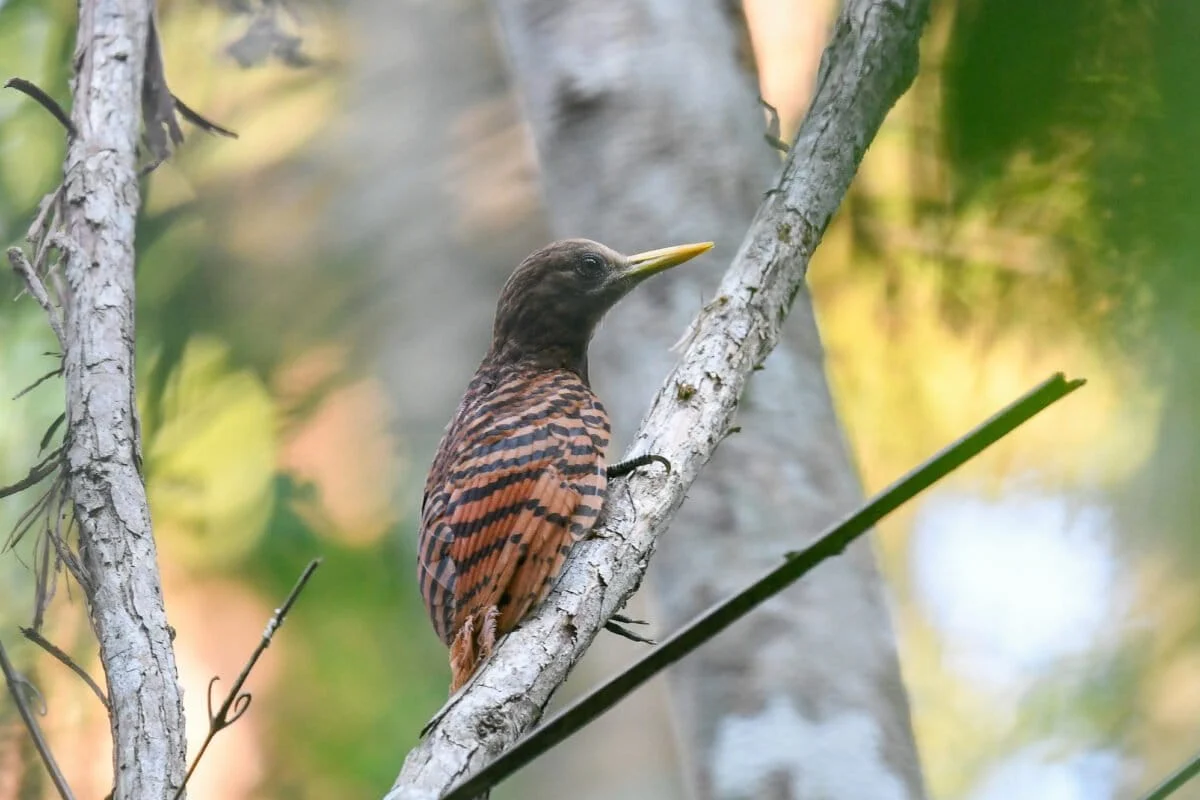
The Bay Woodpecker is a medium-sized member of the Picidae family, distinguished by its rich, velvety reddish-chestnut plumage. Unlike many of its more flamboyant relatives, the Bay Woodpecker is a master of stealth. It favors the dense, dark understory and mid-canopy of mature temperate forests, particularly those dominated by the Nepalese alder (Alnus nepalensis) and various species of oak.
The bird’s most striking feature is its vocalization—a loud, descending series of notes that many locals describe as "maniacal laughter." This rhythmic, tumbling sound begins rapidly, then slows and drops in pitch, carrying with remarkable clarity through the thick mountain air.
![A bird call that signals rains [Commentary]](https://imgs.mongabay.com/wp-content/uploads/sites/30/2026/05/25095719/Blythipicus_pyrrhotis_545764671-1200x800.jpg)
In the Darjeeling-Sikkim Himalaya, this call serves as a biological alarm. To the Lepcha people, the indigenous inhabitants of the region, the woodpecker is an "oracle." In the village of Dzongu, North Sikkim, the bird’s call is often met with a mixture of respect and frustration; for farmers working the terraced fields, the "rain-calling bird" signals a narrow window to finish their labor before the inevitable downpour arrives.
Chronology: From Village Tales to Scientific Validation
The journey to understanding the Bay Woodpecker’s role began not in a laboratory, but in the memories of those who grew up in the forest’s shadow.
The Childhood Legend
Mingma Tamang, a veteran field technician at the Ashoka Trust for Research in Ecology and the Environment (ATREE), recalls hearing the stories from his father. In the rural villages near Singalila National Park, the rhythm of life was dictated by the forest. "The bird has called," the elders would say with quiet certainty. "Rain will come." For decades, this remained a "charming folk belief"—a piece of local color often overlooked by mainstream ornithology.
The Field Encounter
The transition from folklore to field data occurred during a multi-year Ph.D. research project led by conservation biologist Aditya Pradhan. While conducting surveys along the fringes of Singalila, the research team experienced a moment of synchronicity. A resonant, tumbling call echoed through the trees, freezing the team in their tracks.
![A bird call that signals rains [Commentary]](https://imgs.mongabay.com/wp-content/uploads/sites/30/2026/05/25100516/Photo-4-768x512.jpg)
Using high-powered optics, they finally spotted the elusive subject: a Bay Woodpecker drumming against a moss-covered Alnus nepalensis. This sighting provided the crucial link, allowing researchers to match the "laughter" of the legend to the physical specimen of Blythipicus pyrrhotis.
The Pattern Emerges
Over several months of rigorous fieldwork, the correlation between the bird’s activity and local weather patterns became impossible to ignore. Pradhan noted that an evening call almost invariably preceded a rainy morning, while daytime calls were followed by evening showers. This consistent repetition transformed the "myth" into a reliable field observation, prompting a deeper investigation into the bird’s ecological requirements and its sensitivity to atmospheric changes.
Supporting Data: Darjeeling as a Woodpecker Hotspot
The Eastern Himalayas are globally recognized for their biodiversity, but the specific importance of woodpeckers has been historically under-studied. Recent research highlights why this region—and the Bay Woodpecker specifically—is vital to conservation efforts.
- Species Density: India is home to 32 species of woodpeckers. Of these, an astonishing 25 species are found in the Himalayan region. Darjeeling alone hosts 21 species, making it one of the most significant woodpecker hotspots in the country.
- Habitat Specificity: The Bay Woodpecker is a "specialist." Data shows it is strictly associated with dense, mature forests characterized by high tree density and a closed canopy. These environments provide the acoustic chamber necessary for its call to travel while offering the cover required for its reclusive lifestyle.
- Community Health: Research indicates that forests supporting the Bay Woodpecker also support a higher diversity of other avian species. Woodpeckers are "ecosystem engineers"; their cavity-nesting habits provide homes for dozens of other birds and small mammals. Where the Bay Woodpecker thrives, the entire forest community is typically robust.
- The Role of Non-Protected Areas: Perhaps the most significant data point to emerge from recent studies is the value of "human-modified" landscapes. While National Parks are crucial, the tea gardens, community-managed forests, and agroforests of Darjeeling support surprisingly high abundances of woodpeckers, provided the forest structure remains complex with a mix of tree sizes and standing deadwood.
Scientific Perspectives: Why Does the Bird ‘Call’ the Rain?
While the bird does not literally "summon" the rain, scientists provide several plausible biological explanations for why its vocalization precedes precipitation.
![A bird call that signals rains [Commentary]](https://imgs.mongabay.com/wp-content/uploads/sites/30/2026/05/25100950/Photo-1-768x512.jpg)
Bioacoustic Amplification:
As humidity rises before a storm, the density of the air changes. Moist air is less dense than dry air, which can alter the way sound waves propagate through a forest canopy. The Bay Woodpecker’s specific frequency may be optimized for these conditions, making its call more audible and resonant just as the atmosphere reaches a saturation point.
Entomological Triggers:
The primary diet of the Bay Woodpecker consists of wood-boring insects and larvae. Many insects are highly sensitive to barometric pressure changes. As rain approaches, insect activity often increases or shifts to different parts of the tree trunk. This surge in prey activity likely triggers heightened foraging and territorial calling in the woodpeckers.
Physiological Sensitivity:
Birds possess a paratympanic organ (PTO), a specialized mechanoreceptor in the middle ear capable of detecting minute changes in barometric pressure. It is highly probable that the Bay Woodpecker reacts to the "falling barometer" that precedes Himalayan storms, using its call to signal territory or communicate before the heavy rain silences the forest.
Implications: Conservation and the Future of the Landscape
The story of the Bay Woodpecker carries profound implications for the future of conservation in the Eastern Himalayas.
![A bird call that signals rains [Commentary]](https://imgs.mongabay.com/wp-content/uploads/sites/30/2026/05/25095939/Photo-3-768x512.jpg)
The Value of Indigenous Knowledge
The validation of the "rain-caller" legend underscores the necessity of integrating Traditional Ecological Knowledge (TEK) into scientific frameworks. For centuries, local communities have acted as "citizen scientists," accumulating longitudinal data through observation. Ignoring these stories risks losing vital clues about species behavior and environmental health.
Protecting the ‘Specialists’
As development and plantation management alter the Himalayan landscape, "generalist" species often survive while "specialists" like the Bay Woodpecker vanish. The loss of these birds is a "silent" indicator that the forest is losing its structural complexity. Conservation efforts must move beyond merely counting trees to ensuring the maintenance of "old-growth" characteristics, such as standing dead timber (snags) and multi-layered canopies.
A Resilience Benchmark
The Bay Woodpecker serves as a benchmark for landscape resilience. In an era of climate change, where Himalayan weather patterns are becoming increasingly erratic, monitoring the behavior and population of "indicator species" can provide early warnings of ecological shifts.
In the final analysis, the Bay Woodpecker is more than a bird; it is a bridge. It connects the childhood memories of forest technicians like Mingma Tamang to the data-driven world of PhD researchers. It links the spiritual beliefs of the Lepcha people to the practical realities of climate adaptation. As long as the "maniacal laughter" of the Bay Woodpecker echoes through the Darjeeling hills, there is hope that the deep, healthy forests it represents will continue to thrive, forever tied to the rhythm of the rain.