

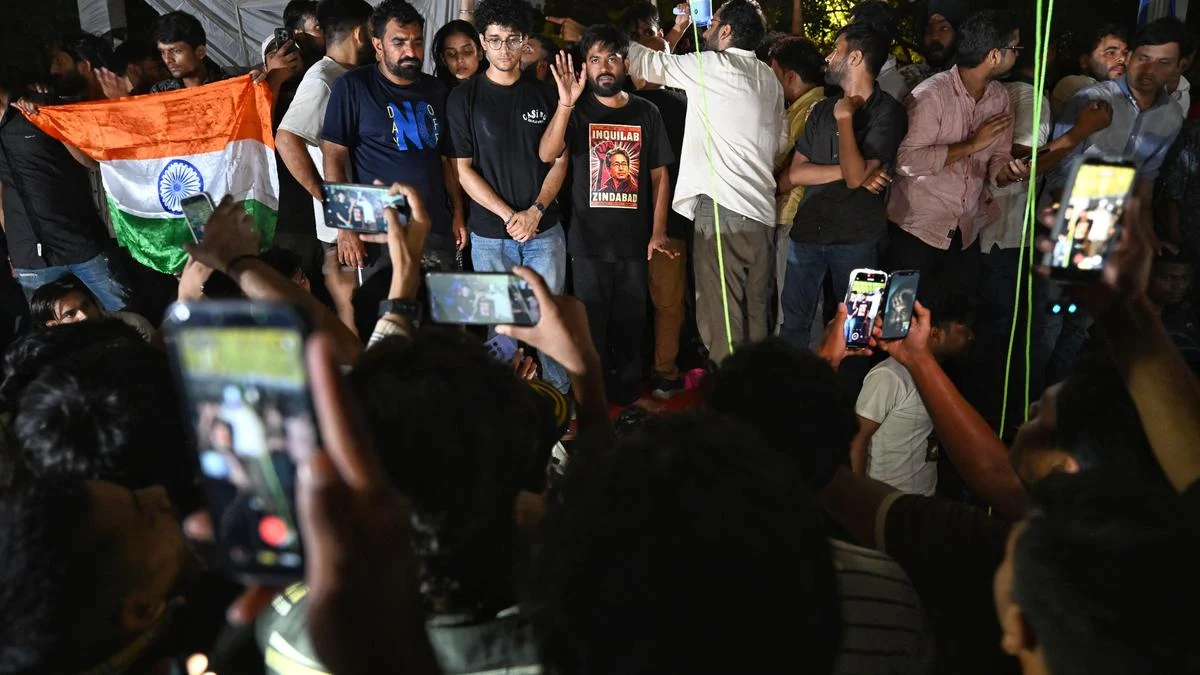
New Delhi, July 22, 2026 – The heart of India’s capital, New Delhi, was gripped by a tense standoff on July 20, 2026, as thousands of protesters, spearheaded by the nascent yet influential Cockroach Janta Party (CJP), converged on Jantar Mantar. Their unified demand echoed through the streets: the immediate resignation of Union Education Minister Dharmendra Pradhan, held accountable for a cascade of alleged examination irregularities and the pervasive issue of paper leaks, particularly concerning the highly contentious National Eligibility and Entrance Test (NEET). What began as a determined march towards Parliament on the opening day of its Monsoon Session swiftly escalated into a profound test of democratic freedoms, punctuated by an unprecedented and controversial shutdown of mobile internet services across parts of Central Delhi.
The digital blackout, which persisted throughout the day, drew immediate and sharp condemnation from leading digital rights organizations, including the Internet Freedom Foundation (IFF) and the Software Freedom Law Centre, India (SFLC). Reports from the ground indicated that signal jammers were actively deployed, effectively severing protesters’ vital connections to the outside world, hindering their ability to document the unfolding events, coordinate, or even navigate the unfamiliar terrain of a digitally silenced city.
The Spark: Widespread Anger Over Examination Irregularities
The protest, dubbed "Chalo Sansad" (Let’s Go to Parliament), was not an isolated incident but the culmination of months of simmering public outrage. For aspiring doctors, engineers, and civil servants across India, competitive examinations represent the gateway to their futures. However, a string of alleged paper leaks and administrative discrepancies has severely eroded public trust in the integrity of these crucial tests. The National Eligibility and Entrance Test (NEET), a single gateway for undergraduate medical and dental courses, stands at the epicentre of this crisis. Accusations of question paper leaks, irregularities in scoring, and opaque grievance redressal mechanisms have plagued recent NEET cycles, leaving millions of students and their families in a state of anxiety and despair. The CJP capitalized on this widespread disillusionment, channeling it into a potent political demand.
The Cockroach Janta Party: A New Voice for Discontent
While relatively new on the national stage, the Cockroach Janta Party (CJP), under the charismatic leadership of its founder Abhijeet Dipke, has rapidly gained traction by positioning itself as the voice of the resilient, the marginalized, and those repeatedly let down by the system. The party’s evocative name, "Cockroach," is explained by its proponents as a symbol of their unwavering persistence and ability to survive and thrive even in the harshest environments – much like the common person navigating a system perceived as corrupt and unresponsive. Dipke and his supporters have skillfully articulated the frustrations of students, parents, and educators, arguing that the repeated examination failures are not mere administrative glitches but systemic flaws indicative of a deeper governance crisis. Their demand for Minister Pradhan’s resignation is not merely symbolic; it represents a call for accountability at the highest levels and a complete overhaul of the examination administration framework.
The Digital Blackout: A Controversial Response
The most striking and controversial aspect of the July 20 protest was the deliberate imposition of a mobile internet shutdown. For hours, vast swathes of Central Delhi, encompassing critical government installations, protest sites, and bustling commercial areas, found themselves in a digital void. This measure effectively isolated protesters, preventing them from live-streaming their messages, sharing evidence of alleged police action, or even using basic communication and navigation tools. The government’s rationale, often cited in similar situations, typically revolves around maintaining public order, preventing the spread of misinformation, and ensuring national security. However, critics argue that such broad-brush shutdowns constitute a disproportionate response, infringing upon fundamental rights to freedom of speech, assembly, and access to information, particularly in a democracy that prides itself on its digital ambitions.
The Chronology of Discontent: From Grievance to Jantar Mantar
The "Chalo Sansad" protest on July 20, 2026, was not an impromptu gathering but the culmination of weeks of meticulous planning by the CJP and a growing wave of public anger. The sequence of events leading up to and during the protest highlights the escalating tensions surrounding the issue of examination integrity in India.
Pre-Protest Build-up: A Brewing Storm
The seeds of the July 20 protest were sown months earlier, with a series of smaller demonstrations and online campaigns following successive reports of NEET paper leaks and other exam irregularities. Social media platforms became conduits for student grievances, uniting disparate groups under the banner of a common injustice. The CJP, under Abhijeet Dipke, deftly harnessed this energy, organizing public meetings, town halls, and issuing fiery statements demanding transparency and accountability. As the Monsoon Session of Parliament approached, the call for a "Chalo Sansad" march gained momentum, positioned as a direct appeal to lawmakers to address the crisis. Police and intelligence agencies were reportedly monitoring the CJP’s activities closely, anticipating a large turnout and preparing for potential disruptions. Warnings were issued, and advisories for commuters in Central Delhi were widely circulated, signaling the government’s awareness of the impending demonstration.
Monsoon Session Opening Day: A Call to Parliament
The choice of July 20, the opening day of Parliament’s Monsoon Session, was strategic. It aimed to maximize visibility, ensuring that the protesters’ demands resonated not only with the public but also directly with the nation’s policymakers. Early morning saw thousands begin to converge at designated assembly points around Jantar Mantar, the traditional hub for protests in the capital. Students, parents, educators, and CJP cadres, many having travelled from different states, arrived bearing placards, banners, and chanting slogans condemning the alleged corruption and demanding Minister Pradhan’s resignation. The atmosphere was charged with a mix of frustration and resolute determination.
On the Ground: Confrontation and Communication Blackout
As the day progressed, the sheer volume of protesters overwhelmed initial police cordons. Attempts by sections of the crowd to march towards Parliament House, a short distance from Jantar Mantar, led to confrontations with security forces. Barricades were reinforced, and riot police were deployed in significant numbers. It was during this period of heightened tension, around late morning, that the mobile internet services in the vicinity began to falter and then completely shut down. Protesters, many of whom relied on their smartphones to document police actions, live-stream speeches, or simply communicate with their families, found themselves suddenly cut off. "It felt like we were thrown back into the dark ages," recounted Kavita Sharma, a student protester from Uttar Pradesh. "We couldn’t upload videos, check maps, or even call for help if needed. It was a deliberate attempt to silence us." The deployment of signal jammers further compounded the communication blackout, ensuring that even those with limited connectivity struggled to maintain a stable link. Despite the digital isolation, the protest continued throughout the afternoon, with speeches by CJP leaders and impassioned testimonies from affected students.
The Aftermath: Reclaiming the Space, Echoes of Protest
By late afternoon, as the protest began to wind down and the crowds thinned, CJP founder Abhijeet Dipke, along with core supporters, symbolically "reclaimed" the protest site at Jantar Mantar. This act, captured in images circulated after the internet services were eventually restored in the evening, symbolized their defiance and commitment to continue their struggle. While the immediate goal of reaching Parliament was largely thwarted by police action and the internet shutdown, the protest succeeded in drawing national attention to the issue. The digital blackout, rather than quelling the protest, inadvertently became a focal point of criticism, amplifying the calls for accountability and democratic rights. The event left an indelible mark, not just for its demands, but for the controversial methods employed to manage public dissent in the digital age.
Beyond the Protest: Supporting Data and Context
The "Chalo Sansad" protest, while focused on specific grievances, takes place against a broader backdrop of systemic issues within India’s education and digital landscape. Understanding these contexts is crucial to grasp the full implications of the July 20 events.
The Shadow of NEET: A System Under Scrutiny
NEET is arguably the most critical and competitive examination in India, determining the fate of millions of aspiring medical professionals. Each year, over 1.5 million students appear for NEET, vying for a limited number of seats in prestigious government and private medical colleges. The stakes are incredibly high, leading to a booming coaching industry and immense pressure on students. Therefore, any alleged irregularity or paper leak sends shockwaves through society. Beyond the immediate injustice to affected students, paper leaks undermine the very principle of meritocracy. They breed cynicism, force students into potentially illegal channels, and question the fundamental fairness of the system designed to select the nation’s future doctors. The CJP’s focus on NEET is thus not merely opportunistic but taps into a deep vein of public concern about the integrity of national institutions. The financial burden on families, who invest heavily in coaching and application fees, is also immense, making the impact of cancellations or re-examinations devastating.

India’s Troubling Record: A Global Leader in Internet Shutdowns
India has unfortunately earned the dubious distinction of being the world leader in internet shutdowns. According to reports from organizations like Access Now, India accounts for a significant percentage of global internet disruptions each year. These shutdowns are frequently implemented in response to protests, communal tensions, or perceived threats to public order, often under the ambiguous provisions of the Temporary Suspension of Telecom Services (Public Emergency or Public Safety) Rules, 2017. While authorities argue these measures are necessary for security, critics contend they are often arbitrary, disproportionate, and violate fundamental rights. The July 20 shutdown in Central Delhi adds another chapter to this troubling narrative, demonstrating the state’s increasing reliance on digital censorship as a tool for crowd control and dissent management.
The Cost of Disconnection: Impact on Citizens and Democracy
The consequences of internet shutdowns extend far beyond the immediate inconvenience to protesters. In an increasingly digital economy, such disruptions cripple businesses, affect emergency services, and isolate citizens from essential information. For instance, small businesses reliant on online transactions suffer significant losses, and individuals may be unable to access critical health information or connect with emergency contacts. More fundamentally, these shutdowns erode democratic principles. They stifle freedom of expression, impede the public’s right to know, and create an environment where accountability is difficult to demand. During protests, the ability to document events, share information, and coordinate peacefully is crucial for both transparency and safety. When this ability is curtailed, it raises serious questions about the health of democratic discourse. The July 20 incident served as a stark reminder of how easily digital rights can be suspended in the name of order.
Official Reactions and Civil Society’s Alarm
The events of July 20, particularly the internet shutdown, elicited a range of responses from government bodies, political parties, and civil society organizations, highlighting the deep divisions surrounding the issues at hand.
Government’s Stance: Prioritizing Order Over Access
While no specific official statement regarding the internet shutdown was immediately issued by the Union Home Ministry or Delhi Police on July 20, the standard justification for such measures typically revolves around preempting the spread of "misinformation" or "incitement" that could lead to public disorder. Sources within the Delhi Police, speaking anonymously, suggested that the shutdown was a "preventive measure" deemed necessary to "maintain law and order" and prevent the protest from escalating beyond Jantar Mantar towards the Parliament complex. This stance prioritizes public safety and order above the digital rights of citizens, a recurring theme in government responses to large-scale protests. The absence of immediate, transparent communication regarding the shutdown’s necessity, scope, and duration, however, fueled further criticism.
Ministry of Education: Promises Amidst Demands
The Union Education Ministry, facing direct demands for Minister Dharmendra Pradhan’s resignation, released a brief statement acknowledging the "concerns raised by students and parents regarding examination processes." The statement reiterated the government’s commitment to "fairness and transparency" in all national examinations and assured that "all allegations of irregularities are being thoroughly investigated by competent authorities." It stopped short of addressing the calls for the Minister’s resignation, instead emphasizing ongoing reforms and the establishment of "robust mechanisms to prevent future incidents." Critics, however, viewed this as a deflection, arguing that the statement lacked concrete action plans or accountability for past failures, thus failing to address the fundamental lack of trust.
Opposition Voices: Condemnation and Solidarity
Opposition parties seized upon the "Chalo Sansad" protest and the internet shutdown as potent political ammunition. Leaders from various opposition factions issued strong condemnations of the government’s handling of the protest, particularly the digital blackout. They unequivocally supported the students’ demands for Minister Pradhan’s resignation and called for an independent, high-level inquiry into all alleged examination irregularities. "To shut down the internet in the capital city simply because citizens are exercising their democratic right to protest is an authoritarian act," stated a prominent opposition MP. "It shows a government afraid of its own people and unwilling to confront the truth about its failing education system." These statements sought to align opposition parties with the aggrieved public and frame the incident as an attack on democratic freedoms.
Digital Rights Advocates: A Clarion Call for Freedom
The strongest condemnation came from digital rights organizations. The Internet Freedom Foundation (IFF) released a statement describing the internet shutdown as "a disproportionate and unlawful restriction on fundamental rights." It highlighted that such measures violate principles of necessity and proportionality, often failing to meet the strict legal requirements for emergency powers. The Software Freedom Law Centre, India (SFLC), echoed these sentiments, pointing out that the shutdown hindered protesters’ ability to document potential human rights violations and seek assistance. "Access to information and communication is a fundamental right in the digital age," stated an SFLC spokesperson. "To deliberately cut off internet services during a peaceful protest not only infringes upon these rights but also creates a dangerous precedent for suppressing dissent through technological means." Both organizations called for greater transparency, accountability, and a robust legal framework to prevent the arbitrary imposition of internet shutdowns.
Broader Implications: A Test for Democracy and Digital Rights
The events of July 20, 2026, transcend the immediate demands of the CJP protest. They underscore deeper, systemic challenges facing India’s democratic fabric and its evolving relationship with digital technologies.
Erosion of Trust: The Examination System and Governance
The repeated allegations of paper leaks and irregularities in examinations like NEET have profound implications for public trust. When the very mechanisms designed to ensure fair opportunity and merit-based selection are compromised, it breeds cynicism and despair among the youth, who represent the nation’s future. This erosion of trust can extend beyond the education sector, impacting perceptions of governmental competence, transparency, and integrity across various domains. The CJP’s rise and the intensity of the "Chalo Sansad" protest are symptoms of this broader crisis of confidence, signaling a growing demand for accountability and systemic reform in governance. Failure to address these concerns robustly and transparently risks alienating a significant segment of the population.
The Future of Protest in a Digital Age
The internet shutdown in Central Delhi raises critical questions about the future of protest and dissent in a digitally interconnected world. While the internet has empowered activists and provided unprecedented tools for mobilization and documentation, it has also become a vulnerability that governments can exploit. The July 20 incident demonstrated the state’s capacity to disrupt digital communication, forcing protesters to adapt. This could lead to a shift in protest strategies, potentially moving towards more offline methods or developing new ways to circumvent digital censorship. However, it also highlights the increasing imbalance of power, where the state can unilaterally impose digital blackouts, making it harder for citizens to exercise their rights effectively.
The Perils of Precedent: Normalizing Internet Censorship
Each instance of an internet shutdown, particularly in response to protests, sets a dangerous precedent. It normalizes the idea that digital censorship is an acceptable tool for managing public dissent, rather than a measure of last resort in genuine emergencies. This gradual erosion of digital rights can have long-term consequences for India’s democratic health, making it easier for future governments to impose such restrictions more frequently and with less public outcry. The lack of robust judicial oversight and clear, transparent guidelines for implementing shutdowns further exacerbates this risk, creating an environment where state power can be exercised arbitrarily.
A Call for Accountability and Transparency
Ultimately, the "Chalo Sansad" protest and the ensuing internet shutdown serve as a powerful call for greater accountability and transparency from the government. Beyond addressing the specific demands for Minister Pradhan’s resignation and reforming the examination system, there is an urgent need to re-evaluate the use of internet shutdowns as a tool for governance. A democratic society thrives on open dialogue, informed public discourse, and the unhindered exercise of fundamental rights. The events of July 20, 2026, underscore the critical importance of upholding these principles in both the physical and digital realms, ensuring that the pursuit of order does not come at the cost of essential freedoms. The future trajectory of India’s democracy may well depend on how these fundamental tensions are resolved.
