

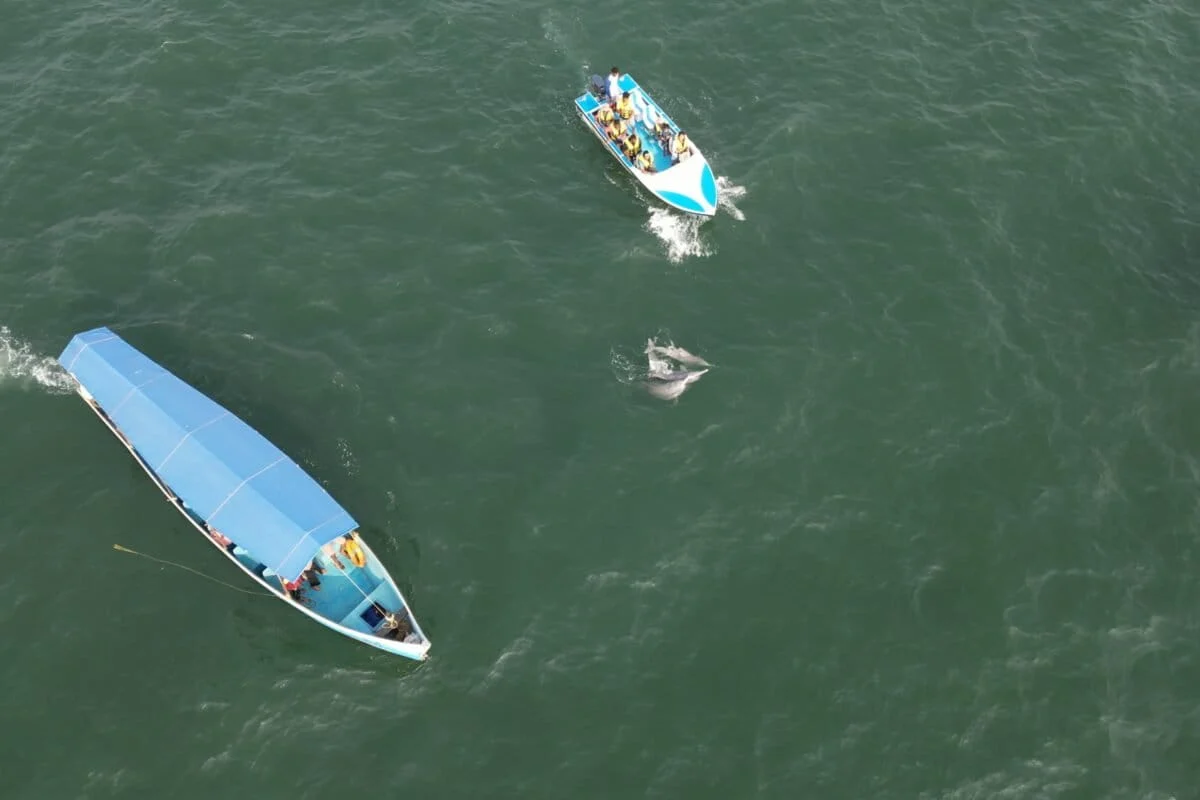
The azure waters off the coast of North Goa, a region synonymous with sun-drenched tourism and a thriving seafood industry, serve as a critical theater for a complex ecological drama. At the center of this narrative is the Indian Ocean humpback dolphin (Sousa plumbea), an endangered marine mammal that finds itself caught between the competing pressures of human economic activity.
A groundbreaking study, recently published in the prestigious journal Marine Ecology Progress Series, has shed new light on how these resilient cetaceans manage a delicate "risk-reward" trade-off. For the humpback dolphin, the heavy presence of fishing nets offers a high-calorie reward through easier foraging, while the relentless pursuit of tourist boats presents a significant disturbance that disrupts vital social and feeding behaviors.
Main Facts: The Behavioral Trade-offs of an Endangered Species
The Indian Ocean humpback dolphin is currently listed as "Endangered" on the IUCN Red List, primarily due to habitat degradation, entanglement in fishing gear, and noise pollution. In Goa, their habitat directly overlaps with two of the state’s primary economic pillars: mechanized fishing and dolphin-watching tourism.
The study, led by Imran Samad of the Centre for Ecological Sciences at the Indian Institute of Science (IISc), reveals a stark dichotomy in dolphin behavior based on human presence. Under undisturbed conditions, these dolphins spend the majority of their time traveling, followed by socializing and foraging. However, the introduction of human variables shifts these patterns significantly:
- The Tourism Impact: When tourist boats are present, the probability of dolphins engaging in social behavior drops by 35%, and foraging—the act of seeking and consuming food—plummets by 50%.
- The Fishery Incentive: Conversely, the presence of fishing nets acts as a powerful attractant. The probability of foraging increases by a staggering 330% when dolphins are near fishing gear, as they take advantage of the concentrated schools of fish targeted by commercial vessels.
- The Conflict of Interests: In scenarios where both tourist boats and fishing nets are present simultaneously, dolphins appear to prioritize food over peace. They are 86% less likely to flee the area compared to when only tourist boats are present, suggesting that the caloric benefit of the nets outweighs the perceived threat of the vessels—at least in the short term.
Chronology: A Season of Observation
The research was conducted over a six-month window between October 2023 and April 2024, a period that covers the peak of both the tourist season and the commercial fishing cycle in Goa.

Phase 1: Site Selection and Vantage Points
The team focused on the coastal waters of North Goa, an area known for high dolphin density. To minimize their own impact on the animals’ behavior, researchers initially monitored the pods from elevated vantage points along the rugged coastline. These natural "watchtowers" allowed for the identification of dolphin groups without the need for a research vessel to be in the immediate vicinity.
Phase 2: High-Tech Aerial Monitoring
Once a pod was sighted, the team deployed drones, flying them at altitudes of 60 to 100 meters. This methodology represents a significant shift from traditional cetacean research. Historically, scientists used theodolites (surveying instruments) from the shore or conducted "boat-follows," which can inadvertently alter the behavior of the animals being studied. The use of drones provided a "bird’s-eye" view, allowing for the recording of 19 hours of high-definition footage across 90 focal follows.
Phase 3: Data Analysis and Machine Learning
Following the field season, the footage was processed using advanced machine-learning algorithms. These tools were capable of tracking individual movements, estimating swimming speeds, and determining the direction of travel with a level of precision impossible to achieve through manual observation. By July 2024, the researchers had categorized the dolphins’ behaviors into four distinct states: traveling, socializing, foraging, and avoidance.
Supporting Data: The Mechanics of Disturbance and Attraction
The study’s findings provide a granular look at how specific human actions dictate dolphin responses.
The Aggressive Nature of Tourism
Field observations highlighted a troubling trend in the local tourism industry. Tourist boats frequently approached dolphin pods at high speeds, often surrounding them to provide passengers with a better view. The data showed that dolphins responded to these "high-pressure" encounters by diving and resurfacing at a distance.

However, this avoidance tactic is often futile. As soon as a pod resurfaces, the original boat—and often several others—immediately gives chase. The study noted that dolphin groups could be pursued for several hours as departing boats were replaced by a fresh wave of tourists. Smaller groups (one to four individuals) were found to be the most sensitive, showing a higher frequency of "state-switching"—constantly moving from one behavior to another in a desperate attempt to find peace.
The Seasonal Foraging Surge
The interaction with fisheries is more nuanced and heavily dependent on the "catch season." The researchers monitored fish landings from purse-seine and gillnet fisheries, focusing on Indian mackerel and Indian oil sardine—staples of both the dolphin diet and the local economy.
- High-Catch Season (October–November): When fish are abundant across the ocean, dolphins are less likely to risk approaching nets.
- Low-Catch Season (December–April): As fish densities decline in the summer months, both dolphins and fishers congregate in the same remaining "hotspots." During this period, the probability of dolphins foraging near nets was 40% higher than in the peak season. They also spent significantly longer durations lingering near the gear, effectively "raiding" the nets for a meal.
The "Shield" Effect of Fishing Nets
One of the most intriguing data points emerged from the overlap of tourism and fishing. While tourist boats generally cause dolphins to flee, the presence of a fishing net acts as an anchor. When nets were present, dolphins were 55% more likely to continue foraging even if tourist boats were hovering nearby. This suggests that the biological drive to feed can override the instinct to avoid human disturbance, potentially leading dolphins into "ecological traps" where they face higher risks of boat strikes or net entanglement.
Official Responses and Stakeholder Perspectives
The study has sparked a much-needed conversation among conservationists, government agencies, and the local community regarding the management of Goa’s coastal resources.
The Scientific Perspective
Imran Samad emphasizes that while the dolphins are currently adapting, the long-term sustainability of the population is at risk. "Behavioral changes can translate into population-level impacts through complex pathways," Samad explains. "If dolphins are spending less time socializing and more time avoiding boats, it could affect their reproductive success. If they are forced to forage near nets because of food scarcity, the risk of accidental death increases."

Samad also points out a critical policy gap: India currently lacks formal national guidelines for whale and dolphin watching. While some local NGOs have attempted to implement voluntary codes of conduct, there is no federal enforcement to regulate approach distances or the number of vessels allowed near a pod.
The Local Operator’s View
K. Vaz, a veteran boat operator in North Goa, acknowledges the mounting pressure on the ecosystem. "We depend on these dolphins for our livelihoods," Vaz says. "If the dolphins leave or their numbers drop, our business dies. The problem is that there is no coordination. Sometimes you have ten boats chasing one small group. We need clear rules that everyone follows so the tourists are happy and the dolphins are safe."
Vaz’s perspective highlights a willingness among some stakeholders to adopt more sustainable practices, provided those rules are applied universally and fairly.
Implications: The Path Toward Coexistence
The IISc study serves as a clarion call for a more integrated approach to marine conservation in India. The findings suggest that "siloed" management—where fisheries and tourism are governed by separate departments with no communication—is failing the environment.
Recommendations for Management
The authors of the study propose several immediate measures to mitigate the human impact on Indian Ocean humpback dolphins:

- Strict Approach Regulated Distances: Implementing a mandatory minimum distance (e.g., 50–100 meters) for all tourist vessels.
- No-Wake Zones: Requiring boats to maintain a slow, steady speed when within a certain radius of a sighted pod to prevent the "startle" response.
- Vessel Limits: Capping the number of boats allowed to observe a single pod at any given time.
- Foraging Sanctuaries: Prohibiting tourist boats from approaching dolphins when they are clearly foraging near fishing nets, as this is when the animals are most vulnerable and least likely to move away.
The Need for a Unified Platform
Perhaps the most significant implication of the research is the need for a "Common Stakeholder Platform." Currently, fishers see dolphins as competitors or a nuisance, and tourism operators see them as a commodity. A unified platform would allow these groups, along with government agencies and scientists, to develop shared management goals.
As Goa continues to grow as a global tourism destination, the fate of the Indian Ocean humpback dolphin will depend on whether the state can balance its economic ambitions with the biological needs of its most charismatic marine residents. The IISc study provides the data; the next step—policy and protection—rests in the hands of the authorities and the community. Without intervention, the very creatures that draw thousands of visitors to Goa’s shores may eventually be driven away by the very attention they attract.
