Main Facts: The Critical State of India’s Underwater Heritage
Coral reefs are frequently described as the "rainforests of the sea," a title justified by their staggering biological density. While these calcium carbonate structures occupy less than 1% of the global ocean floor, they provide a home, breeding ground, and hunting territory for more than 25% of all marine species. From the commercially vital lobster and snapper to the charismatic sea turtle and the delicate seahorse, the survival of the ocean’s biodiversity is inextricably linked to the health of its reefs.
However, this vital infrastructure is under unprecedented siege. Since the 1950s, the world’s living coral cover has plummeted by approximately 50%. In India, where reefs are spread across roughly 2,375 square kilometers, the situation reflects this global crisis. The primary drivers of this decline are a combination of global atmospheric changes—specifically rising ocean temperatures and acidification—and localized human pressures. In the Indian context, these pressures include destructive fishing practices, untreated sewage discharge, coastal industrialization, and unsustainable tourism.
![How are degraded coral reefs restored in India? [Explainer]](https://imgs.mongabay.com/wp-content/uploads/sites/30/2026/05/25140628/Coral-Garden-nursery-tables-at-Mithapur-1200x800.jpg)
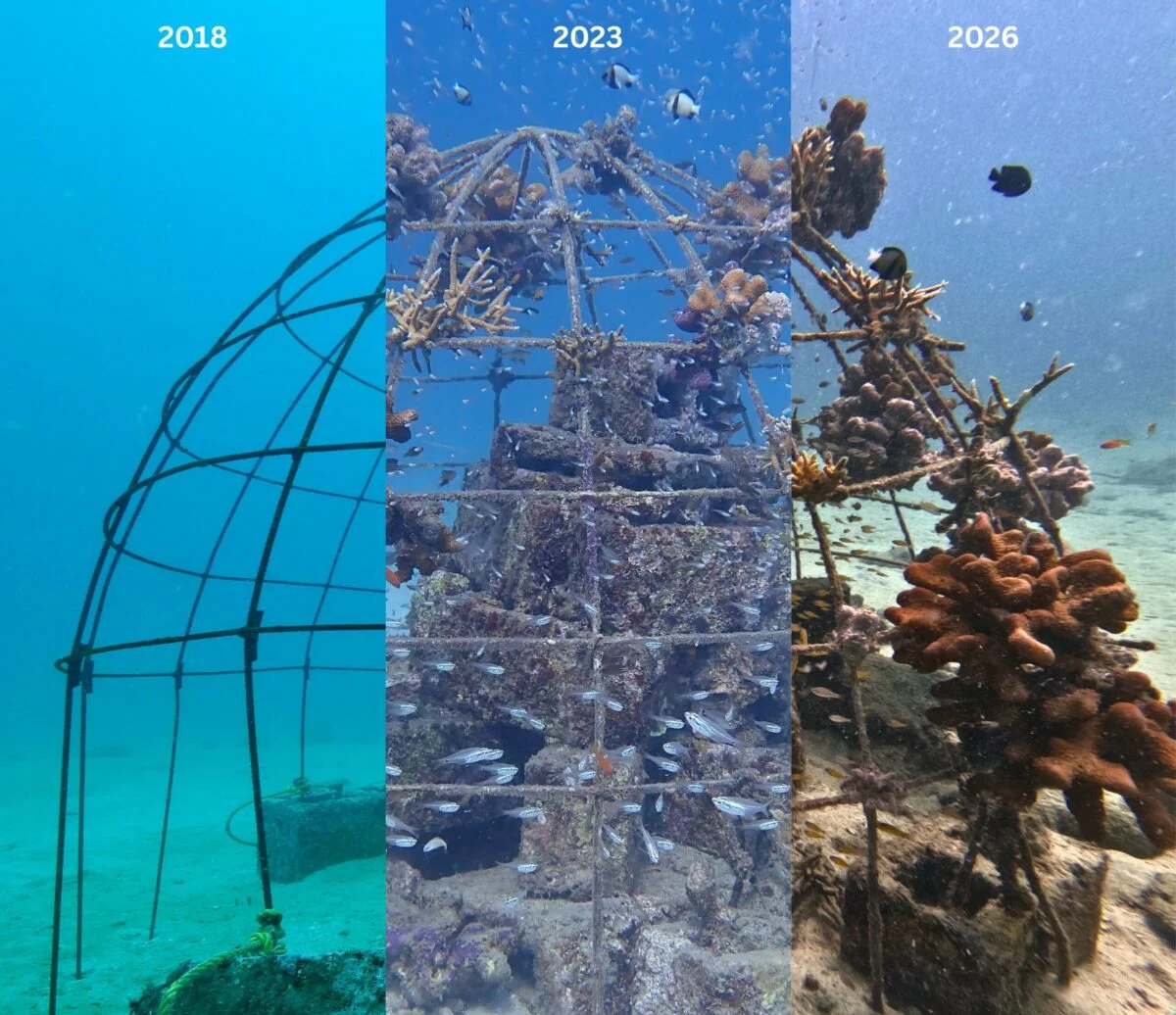
To combat this, a series of sophisticated, human-led restoration initiatives have taken root across India’s maritime zones. These projects, ranging from the Gulf of Mannar to the Lakshadweep atolls, represent a desperate but increasingly successful attempt to rebuild degraded ecosystems. By utilizing techniques such as underwater nurseries, "Biorock" mineral accretion, and artificial reef deployment, scientists are not merely planting coral; they are engineered resilience into the coastline.
Chronology: A Timeline of Restoration and Recovery
The history of coral restoration in India is one of evolving methodology and expanding scale, moving from small-scale academic experiments to large-scale ecological interventions.
![How are degraded coral reefs restored in India? [Explainer]](https://imgs.mongabay.com/wp-content/uploads/sites/30/2026/05/26090949/Creation-of-coral-garden_Mithapur-768x512.jpg)
- The 1970s: Global Foundations: While India’s major efforts began later, the global concept of active reef restoration emerged in the 1970s. This period established the baseline for "coral gardening"—the process of growing fragments in a protected environment before transplanting them.
- 2002: The Pioneering Gulf of Mannar Project: The Suganthi Devadason Marine Research Institute (SDMRI) launched India’s first significant restoration program in the fringing reefs of the Gulf of Mannar. This project focused on identifying suitable artificial substrates and testing the survival rates of native species.
- 2008: The Mithapur Coral Recovery Project: A public-private partnership between the Wildlife Trust of India (WTI), the Gujarat Forest Department, and Tata Chemicals Limited was established to restore the Mithapur Reef in the Gulf of Kachchh. This project introduced the use of limestone and basalt boulders to create stable artificial habitats.
- 2012–2016: Technological Expansion: In 2012, the Mithapur team began stacking boulders into conical shapes to maximize surface area for benthic colonization. By 2016, coral nurseries were being established in the Lakshadweep Archipelago, specifically within the Kavaratti atoll, focusing on fast-growing branching species.
- 2018–2020: Diversification of Methods: ReefWatch Marine Conservation began operations in the Andaman and Nicobar Islands in 2018, utilizing semi-spherical structures and heavy anchors to withstand the region’s unique current patterns. In 2020, the National Centre for Coastal Research (NCCR) initiated experimental sites in Palk Bay (Thonithurai and Munaikadu) and introduced "Biorock" technology in Gujarat.
- 2024–2026: Recent Milestones and Scaling: By 2024, the Gulf of Mannar program expanded into Palk Bay. Monitoring data from early 2026 suggests that these decades of work are yielding significant increases in fish biomass and coral cover, marking a transition from experimental phases to established ecological recovery.
Supporting Data: Regional Success Metrics and Biological Growth
The success of Indian coral restoration is measured through two primary metrics: the survival rate of transplanted fragments and the subsequent increase in associated biodiversity (fish and invertebrates).
The Gulf of Mannar and Palk Bay
In the Gulf of Mannar, the SDMRI has deployed over 5,550 artificial substrates and transplanted 51,000 coral fragments across 20 native species. Over a 20-year period, this has resulted in the restoration of 40,000 square meters of reef.
![How are degraded coral reefs restored in India? [Explainer]](https://imgs.mongabay.com/wp-content/uploads/sites/30/2026/05/26123127/Upputhanni-Island-Aerial-View-768x512.jpg)
- Survival Rates: Transplanted fragments show a survival rate ranging from 55% to 80%.
- Growth Performance: The Acropora genus (branching corals) has shown exceptional resilience, growing at an average of 10 cm per year in restored areas, compared to just 8 cm in natural, unrestored reefs.
- Biodiversity Impact: The most striking data point is the 21-fold increase in fish density observed in restored areas between 2006 and 2020.
The Mithapur Reef (Gujarat)
The Mithapur project stands out for its high survival rates and innovative use of "Biorock"—a technology that uses low-voltage electricity to accelerate the mineralisation of calcium carbonate on steel frames.
- Nursery Success: Rescued coral boulders in Mithapur nurseries have achieved a survival rate of 95% over seven years, one of the highest recorded figures globally.
- Fisheries Recovery: For local communities, the success is economic. The "catch per unit effort" for local fishermen surged tenfold between 2015 and the end of 2025, directly attributed to the artificial reefs acting as refugia for herbivorous fish.
Andaman, Nicobar, and Lakshadweep
In the Lakshadweep Islands, survival rates for nursery fragments ranged from 64% to 99%. In the Andaman and Nicobar Islands, despite the challenges of remote monitoring, transplanted corals on artificial reefs are growing at a rate of 9.4 cm per year. While the number of species fluctuated between 2025 and 2026, the total number of individual fish surged to over 3,100 in monitored areas, suggesting that the reefs are becoming highly efficient "hubs" for marine life.
![How are degraded coral reefs restored in India? [Explainer]](https://imgs.mongabay.com/wp-content/uploads/sites/30/2026/05/26125429/After-a-year-Acropora-muricata-768x512.jpg)
Official Responses: The Legal and Regulatory Framework
The Indian government has recognized that coral reefs are not just environmental assets but critical components of national security and food stability. Consequently, corals are afforded the highest level of legal protection in the country.
The Wildlife (Protection) Act, 1972
Under Schedule I of this Act, corals are categorized alongside the Bengal tiger and the Asian elephant. This status prohibits the collection, trade, or possession of both live and dead corals. Legal violations are met with severe penalties, including mandatory imprisonment for three to seven years. This stringent protection is designed to eliminate the once-common practice of mining coral for construction lime or the decorative trade.
![How are degraded coral reefs restored in India? [Explainer]](https://imgs.mongabay.com/wp-content/uploads/sites/30/2026/05/26091643/Creating-artificial-reefs-PC-Charan-Kumar-PaidiWTI-1200x900.jpg)
Coastal Regulation Zone (CRZ) Notification, 2019
The CRZ 2019 framework classifies coral reef areas as "CRZ-I," the most ecologically sensitive category. This designation effectively bans industrial development, waste disposal, and major construction within or near reef ecosystems.
Marine Protected Areas (MPAs)
The establishment of the Gulf of Mannar Marine National Park, covering 560 square kilometers and encompassing 21 islands, represents the pinnacle of Indian reef management. These areas are designated as "no-take" zones, where fishing and resource extraction are strictly prohibited to allow the ecosystem to regenerate without human interference.
![How are degraded coral reefs restored in India? [Explainer]](https://imgs.mongabay.com/wp-content/uploads/sites/30/2026/05/26130514/After-four-years-Acropora-spp-1200x900.jpg)
Implications: Resilience, Livelihoods, and the Future of Coastal Stability
The implications of India’s coral restoration efforts extend far beyond marine biology; they are a vital component of climate change adaptation.
Coastal Protection and Erosion Control
Coral reefs act as natural breakwaters, absorbing up to 97% of a wave’s energy before it reaches the shore. As sea levels rise and the intensity of cyclones in the Bay of Bengal and the Arabian Sea increases, restored reefs provide a "soft" engineering solution to coastal erosion. Dr. Edward Patterson, Director of SDMRI, notes that restored corals contribute significantly to sand production, which is essential for stabilizing the shorelines of low-lying islands.
![How are degraded coral reefs restored in India? [Explainer]](https://imgs.mongabay.com/wp-content/uploads/sites/30/2026/05/26130001/Palk-Bay-1d-768x512.jpg)
Economic Security for Artisanal Fisheries
The 21-fold increase in fish density in the Gulf of Mannar and the tenfold increase in catch rates in Gujarat highlight the "spillover effect." When a restored reef becomes a nursery for fish, the population eventually expands into surrounding fishing grounds, providing a sustainable source of income and protein for millions of coastal residents.
Evolutionary Resilience
One of the most significant implications of current restoration research is the focus on "genetic diversity." By transplanting a variety of species and monitoring their response to bleaching events (such as those in 2010 and 2016), scientists are identifying "super corals" that are naturally more heat-tolerant. Restoring reefs with these resilient genotypes ensures that the ecosystem can survive the projected temperature increases of the next century.
![How are degraded coral reefs restored in India? [Explainer]](https://imgs.mongabay.com/wp-content/uploads/sites/30/2026/05/26130418/Palk-Bay-12-months-post-transplantation-768x512.jpg)
The Algal Shift
A critical challenge in reef health is the shift from coral-dominated to algal-dominated systems, often caused by nutrient pollution and the overfishing of herbivorous species. The success in Mithapur demonstrates that by providing artificial structures for herbivorous fish to thrive, we can naturally control algal growth, allowing live coral cover to increase (from 11% to 19% in the Mithapur case). This suggests that restoration is not just about planting coral, but about recalibrating the entire trophic balance of the ocean.
In conclusion, while the threats to India’s coral reefs remain grave, the success of the last two decades provides a blueprint for recovery. Through a combination of rigorous legal protection, innovative technology like Biorock, and community-centric restoration, India is proving that the decline of the "rainforests of the sea" is not an inevitability, but a challenge that can be met with scientific resolve.