

BENGALURU, India — As our telescopes peer deeper into the cosmic dawn, capturing the faint glimmers of the first stars and the intricate dances of colliding galaxies, astronomers are faced with a humbling reality: everything we can see—every star, planet, nebula, and grain of cosmic dust—accounts for a mere fraction of the universe’s total composition. The rest is a silent, invisible scaffolding known as dark matter.
Recent syntheses of astrophysical data continue to affirm that we live in a "dark" universe. Despite decades of technological advancement, dark matter remains one of the most profound mysteries in modern science. It does not glow, it does not reflect, and it does not block light; yet, without its massive gravitational presence, the universe as we know it would fly apart.
The Main Facts: A Universe Built on Shadows
To understand dark matter, one must first understand what it is not. It is not made of atoms, quarks, or electrons—the building blocks of "normal" or baryonic matter. If it were, it would interact with electromagnetic radiation. We would see it glowing in infrared, or perhaps obscuring the light of distant stars. Instead, dark matter is entirely transparent.
The 27% Reality
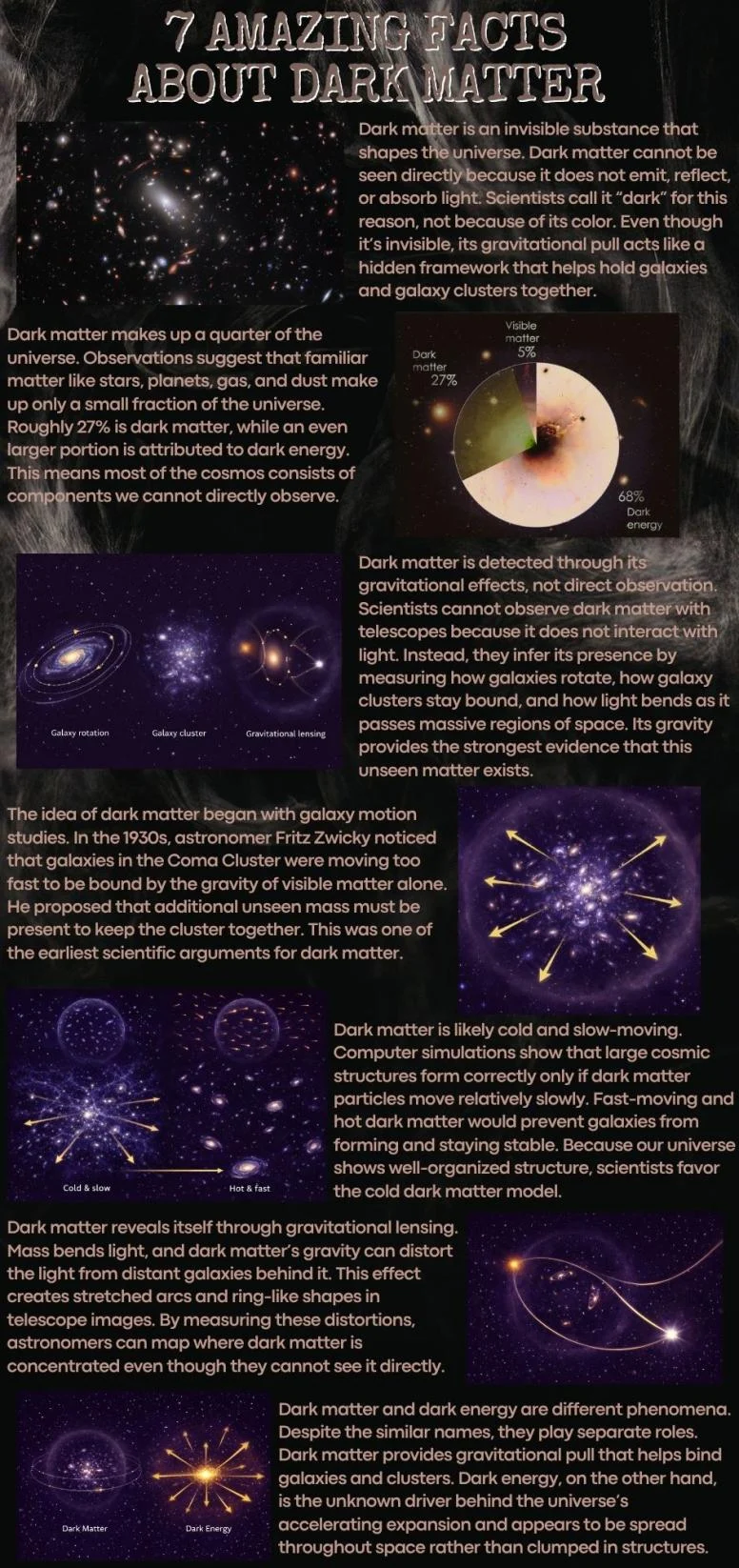
Current cosmological models, supported by data from missions like the Planck satellite and the James Webb Space Telescope (JWST), suggest a startling ratio. Normal matter—the stuff that makes up human beings, the Earth, and the Sun—comprises only about 5% of the universe. Roughly 27% is dark matter. The remaining 68% is dark energy, a distinct and even more mysterious force driving the universe’s expansion. This means that over a quarter of the cosmos is occupied by a substance that passes through us every second without a trace.
The Gravitational Glue
Dark matter acts as the "gravitational glue" of the cosmos. In the standard model of cosmology, galaxies are embedded within massive "halos" of dark matter. These halos provide the extra gravity needed to hold fast-moving stars in their orbits. Without this unseen mass, the centrifugal force of a rotating galaxy would overcome the gravity of its visible stars, causing the galaxy to shred itself and scatter its contents into intergalactic space.
The "Cold" Candidate
Scientists generally categorize the leading theory as "Cold Dark Matter" (CDM). In this context, "cold" refers to the speed of the particles. If dark matter were "hot" (moving at speeds near the velocity of light), it would have smoothed out the density fluctuations in the early universe, preventing the formation of small-scale structures like individual galaxies. Because we observe a universe filled with well-defined, clumpy structures, the evidence points toward slow-moving, massive particles that allowed gravity to build the cosmic web over billions of years.

A Chronology of Discovery: From "Missing Mass" to Modern Maps
The journey to identifying dark matter was not a single "eureka" moment but a century-long realization that our understanding of gravity and mass was incomplete.
1933: Zwicky’s "Dunkle Materie"
The story begins with Swiss-American astronomer Fritz Zwicky. While observing the Coma Cluster—a massive group of over 1,000 galaxies—Zwicky used the virial theorem to calculate the cluster’s mass based on the velocities of its member galaxies. He was shocked to find that the galaxies were moving nearly 400 times faster than the visible matter should allow. He coined the term dunkle Materie (dark matter), suggesting that some invisible "missing mass" was providing the necessary gravitational tether. At the time, his findings were largely dismissed as a measurement error.
1970s: Vera Rubin and the Rotation Curves
The mystery moved from the fringes to the mainstream thanks to the pioneering work of Vera Rubin and Kent Ford. They observed the rotation curves of spiral galaxies, expecting to find that stars at the outer edges moved slower than those near the center—much like how Pluto orbits the Sun slower than Mercury. Instead, they found that stars at the edges of galaxies moved just as fast as those in the interior. This "flat rotation curve" provided the smoking gun: galaxies must be surrounded by a massive, invisible sphere of matter that extends far beyond the visible starlight.
2006: The Bullet Cluster
One of the most definitive pieces of evidence came from the observation of the Bullet Cluster—two galaxy clusters that had recently collided. Using X-ray telescopes and gravitational lensing maps, astronomers saw that the visible gas (the normal matter) had slowed down due to friction during the collision. However, the mass (the dark matter) had passed right through, unfazed. This proved that dark matter was a physical substance that does not interact through any force other than gravity.
Supporting Data: How We "See" the Invisible
Since we cannot photograph dark matter directly, scientists rely on sophisticated indirect detection methods. These techniques turn the universe itself into a giant laboratory.
Gravitational Lensing
According to Einstein’s General Theory of Relativity, mass warps the fabric of spacetime. When light from a distant galaxy passes through a region thick with dark matter, its path is bent. This creates "gravitational lensing," where the background galaxy appears distorted, stretched into arcs, or even multiplied into several images (an "Einstein Cross"). By calculating the degree of distortion, astronomers can create "mass maps" of the universe, revealing exactly where the dark matter is concentrated.

The Cosmic Microwave Background (CMB)
The CMB is the "afterglow" of the Big Bang, a snapshot of the universe when it was only 380,000 years old. Tiny fluctuations in the temperature of this radiation reveal the density of matter at that time. Detailed analysis of the CMB power spectrum (specifically the "acoustic peaks") allows cosmologists to calculate the exact ratio of baryonic matter to dark matter in the early universe. The data consistently points to a 5-to-1 ratio in favor of dark matter.
Computer Simulations
Supercomputer simulations, such as the Illustris Project or the Millennium Simulation, attempt to recreate the evolution of the universe from the Big Bang to the present. These simulations only produce a universe that looks like ours—with the correct distribution of galaxies and filaments—if they include the presence of cold dark matter.
Official Responses and Scientific Consensus
The global scientific community is currently in a state of "urgent investigation." While the existence of dark matter is widely accepted, its identity remains the greatest "X-factor" in physics.
In a recent statement regarding the future of high-energy physics, representatives from CERN (the European Organization for Nuclear Research) emphasized the role of the Large Hadron Collider (LHC) in the search for dark matter particles. "Our current models of particle physics, while incredibly successful, are clearly incomplete," the statement noted. "We are looking for ‘supersymmetric’ particles or WIMPs (Weakly Interacting Massive Particles) that could explain the dark matter phenomenon. The discovery of such a particle would be the most significant breakthrough since the Higgs Boson."
Meanwhile, NASA’s Goddard Space Flight Center has highlighted the upcoming Nancy Grace Roman Space Telescope, set to launch in the late 2020s. "Roman will perform a wide-field survey that will map dark matter with unprecedented precision," NASA officials stated. "By observing how dark matter has clumped together over cosmic time, we can test whether our theories of gravity hold true or if we need a fundamental rewrite of physics."
In India, researchers at the Tata Institute of Fundamental Research (TIFR) and other institutions are contributing to underground experiments like the LUX-ZEPLIN (LZ) detector, which sits a mile underground in an old gold mine to shield it from cosmic rays, waiting for a single dark matter particle to bump into a xenon atom.

Implications: The Fate of the Universe
The study of dark matter is not merely an academic exercise; it determines the ultimate destiny of our reality.
The Structure of Reality
If dark matter did not exist, the universe would be a vastly different place. Stars might still form, but they would likely be scattered thinly across space rather than clustered into the "island universes" we call galaxies. Life, which requires the heavy elements forged in the hearts of stars and recycled through galactic cycles, might never have had the chance to arise in a disorganized cosmos.
Dark Matter vs. Dark Energy: The Tug-of-War
While dark matter provides the gravitational "pull" that builds structures, dark energy provides the "push" that expands the universe. We are currently living in an era where dark energy is winning. As the universe expands, dark matter becomes more diluted, while dark energy remains constant. Eventually, the expansion will become so rapid that even the gravitational grip of dark matter will be unable to hold galaxy clusters together.
The Search for New Physics
The failure to detect a dark matter particle so far has led some scientists to propose "Modified Newtonian Dynamics" (MOND). This theory suggests that we don’t need a new particle; rather, our understanding of gravity is wrong at very low accelerations. However, MOND struggles to explain observations like the Bullet Cluster or the CMB.
As we move toward the middle of the 21st century, the quest for dark matter remains the "Holy Grail" of cosmology. Whether it is a yet-undiscovered particle or a fundamental misunderstanding of spacetime, the answer will redefine our place in the stars. For now, we remain residents of a bright, visible world, floating on the surface of a vast, dark, and silent ocean that we are only just beginning to map.
