

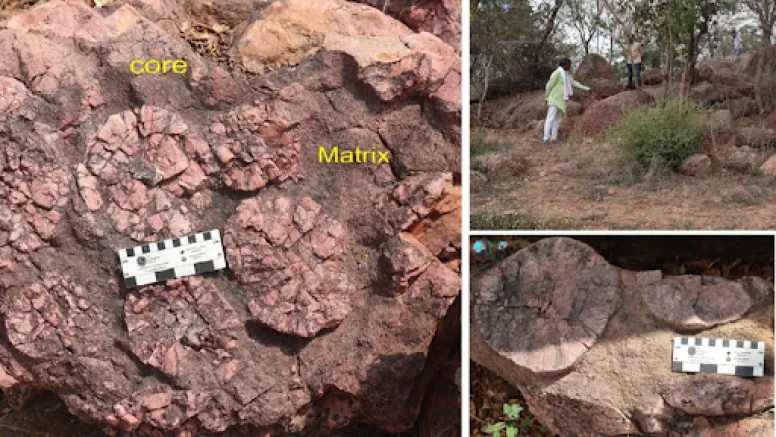
KUTAWALI, MADHYA PRADESH — In the quiet, unassuming landscape near the village of Kutawali, nestled within the Shivpuri district of Madhya Pradesh, lies a geological marvel that has remained largely silent for over two and a half billion years. Recent findings by an international consortium of geologists have transformed this small outcrop into a site of global significance. Known as the Pichhore orbicular granite, this rare rock formation has been confirmed to be approximately 2.56 billion years old, making it a high-resolution "time capsule" from the Earth’s infancy.
The study, which brings together expertise from India, Brazil, and Japan, reveals that the Pichhore granite is the second-oldest formation of its kind on the planet. Only a similar structure in Western Australia predates it. Beyond its age, the rock offers a rare glimpse into the Neoarchean era—a pivotal epoch when the Earth’s surface began the violent, chaotic transition from a molten state into the stable continental crust that supports life today.
Main Facts: A Rare Geological Masterpiece
The Pichhore granite is not merely a common rock; it is a visual and structural anomaly. Its defining feature is the presence of "orbicules"—mysterious, spherical structures embedded within the granite matrix. These orbicules, ranging in size from small pebbles to structures 30 centimeters in diameter, resemble concentric tree rings or petrified cricket balls.
The Anatomy of an Orbicule
Each orbicule is a complex arrangement of minerals. At its center lies a core, which is then enveloped by multiple shells of quartz and feldspar. These structures are the result of a rare magmatic phenomenon. According to the research team, these orbicules formed during a "thermal pulse"—a sudden, intense burst of heat energy within a prehistoric magma chamber.
This pulse was likely triggered by the injection of hotter, darker magma from deep within the Earth’s mantle into a shallower, water-rich, high-potassium magma reservoir. The resulting "undercooling"—a process where magma remains liquid below its normal freezing point before solidifying rapidly—triggered a rhythmic, outward crystallization. This frantic growth from central points created the layered shells before the surrounding molten rock could fully solidify, freezing a moment of extreme geological instability in stone forever.

International Collaboration
The discovery is the result of a multi-institutional effort involving:
- Banaras Hindu University (BHU), India
- University of Campinas (UNICAMP), Brazil
- Indian Institute of Technology (IIT) Kanpur
- Japan Advanced Institute of Science and Technology (JAIST)
- Indian Institute of Science Education and Research (IISER) Berhampur
- AllGeo Solutions Pvt. Ltd.
By combining global expertise in petrology and geochronology, the team was able to apply advanced isotopic analysis to solve a mystery that had persisted since the site was first documented in 2004.
Chronology: From the Neoarchean to the Modern Era
To understand the significance of the Pichhore granite, one must look back across a staggering expanse of time. The formation dates back to the Neoarchean era (2,800 to 2,500 million years ago).
The Earth at 2.56 Billion Years
During the Neoarchean, the Earth was a vastly different place. The atmosphere lacked significant oxygen, and the planet’s internal heat was much higher than it is today. This was the era of "cratonization"—the process by which the first stable continental blocks, or cratons, were formed. The Pichhore granite is a product of the Bundelkhand Craton, one of the oldest geological building blocks of the Indian subcontinent.
2004 – Present: Discovery and Designation
While the Pichhore rocks were documented by geologists as early as 2004, their exact age remained a matter of speculation for nearly two decades. The visual uniqueness of the site led to its designation as a National Geoheritage Site by the Geological Survey of India (GSI). However, it was not until this recent study that the true antiquity and global standing of the site were established using modern laboratory techniques.

The 3.5 Billion-Year-Old Ancestry
One of the most startling chronological findings of the study was that the Pichhore granite contains "inherited" zircon crystals. While the granite itself solidified 2.56 billion years ago, some of the crystals within it date back 3.5 billion years. This indicates that the magma which formed the Pichhore granite was created by melting even older crustal rocks. It proves that even in the Neoarchean, the Earth was already an efficient recycling machine, consuming its oldest surfaces to forge new landmasses.
Supporting Data: The Science of "Nature’s Clocks"
The researchers arrived at their conclusions through a rigorous application of U-Pb (Uranium-Lead) zircon dating and Neodymium (Nd) isotopic analysis.
Zircons: The Resilient Timekeepers
Zircons are tiny, incredibly durable crystals that form in cooling magma. They are prized by geologists because they trap uranium atoms but exclude lead atoms during their formation. Because uranium decays into lead at a known, constant rate, the ratio of lead to uranium inside a zircon acts as a precise clock.
The technical challenge for the team was significant. The Pichhore granite is "zircon-poor," meaning these crystals are exceptionally rare within the rock. The scientists had to process nearly six kilograms of rock material to extract just ten usable zircon grains. Despite the small sample size, the precision of modern mass spectrometry allowed them to establish a robust age of 2.56 billion years.
Neodymium Isotopes and Crustal Origin
To determine where the magma came from, the team analyzed Neodymium isotopes. This analysis provided a "chemical fingerprint" that revealed the magma did not rise directly from the Earth’s mantle. Instead, it was the product of "crustal reworking"—the melting of existing continental crust. This confirms that 2.5 billion years ago, the region that is now central India was a dynamic continental margin, similar to modern-day coastal regions where tectonic plates interact and recycle material.

Official Responses and Scientific Context
While official government statements regarding the new dating are pending, the scientific community has reacted with profound interest. The designation of Pichhore as a National Geoheritage Site by the GSI was a proactive step, but researchers argue that the new data elevates the site’s status from a regional curiosity to a global scientific treasure.
The Call for Preservation
The research team has been vocal about the vulnerability of the Kutawali site. Unlike many geological sites located in remote deserts or mountains, the Pichhore granite is situated in an area seeing increased human activity.
"The Pichhore site is currently vulnerable to human activity, particularly the expansion of local agriculture," the researchers noted. The encroachment of farming and potential quarrying for construction materials threaten to erase a record that has survived for billions of years. The team emphasizes that proving the site’s scientific uniqueness on a global scale provides the necessary leverage to demand stricter protection and the establishment of a formal geological park.
Implications: Why a 2.5 Billion-Year-Old Rock Matters
The study of the Pichhore orbicular granite is more than an exercise in dating old rocks; it has profound implications for our understanding of planetary evolution and the history of life.
1. Understanding Crustal Stability
The transition from a volatile, thin-crusted Earth to one with thick, stable continents was a prerequisite for the development of complex life. Stable continents provide the shallow seas and mineral-rich environments where life can flourish. By studying the Pichhore granite, scientists can better understand the thermal and chemical conditions that allowed the Earth’s crust to stabilize.

2. Plate Tectonics in the Archean
The evidence of "crustal recycling" found in the 3.5 billion-year-old inherited zircons suggests that plate tectonics—or a precursor to it—was active much earlier than some models suggest. It paints a picture of a dynamic, "living" planet that was constantly reshaping itself even in its earliest stages.
3. A Global Geological Benchmark
With its age now confirmed, the Pichhore site becomes a primary reference point for geologists worldwide. It allows for a direct comparison with the orbicular granites of Western Australia, helping scientists determine if the processes that formed these rare rocks were localized events or part of a global geological trend during the Neoarchean.
4. Educational and Heritage Value
Beyond the laboratory, the Pichhore granite serves as a powerful educational tool. It reminds us that the ground beneath our feet is the result of a multi-billion-year "recycling program." Sites like Kutawali are the only remaining witnesses to the violent and creative past of our world.
As the scientific community continues to analyze the data, the focus now shifts to the local and national government. The hope is that the Pichhore orbicular granite will be preserved not just as a "National Geoheritage Site" in name, but as a protected sanctuary where future generations can stand on a piece of the Earth that was formed when the world was young. In the grains of quartz and the concentric rings of its orbicules, the Pichhore granite holds the story of how our world became firm enough to walk upon—a story that, thanks to this international team of researchers, is finally being told.
