

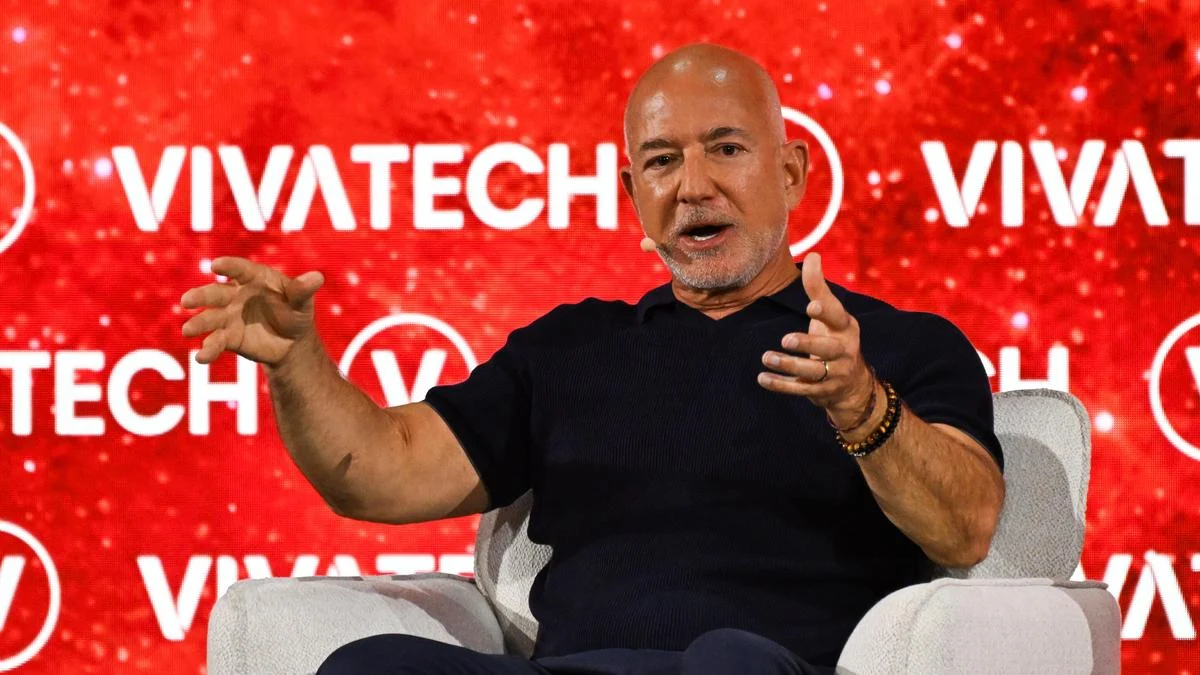
PARIS, France – June 18, 2026 – In a highly anticipated appearance at the prestigious VivaTech technology conference in Paris, Amazon founder Jeff Bezos offered a starkly optimistic vision for the future, asserting that Artificial Intelligence (AI) will ultimately lead to labor shortages rather than widespread human redundancy. His pronouncements, delivered with characteristic confidence, sought to reframe the burgeoning global anxieties surrounding AI’s impact on employment, painting a picture of technological advancement as a powerful catalyst for human flourishing and planetary preservation.
Bezos, the world’s fourth-richest individual with an estimated net worth around $250 billion, presented a "rosy vision" of how technology will serve humanity. He highlighted key projects from his diverse portfolio, including his ambitious space venture Blue Origin and his recently launched AI startup, Prometheus, which is specifically engineered to accelerate physical manufacturing processes. This dual focus on Earth-bound innovation and extraterrestrial ambition underscored his belief in technology’s boundless potential to reshape civilization.
The Central Thesis: AI as a Creator of Demand, Not Destroyer of Jobs
Bezos directly confronted the prevalent fears regarding AI-driven job displacement. "I know there’s a lot of concern that many people have, including many smart people, that AI is going to make humans redundant and so on," Bezos stated, addressing a packed auditorium. "I totally disagree with this point of view. And I think, in fact, AI is going to create a labor shortage."
He elaborated on this counter-intuitive perspective, arguing that human beings possess an "endless" capacity for innovation and engagement. Our current limitations, he posited, stem not from a lack of purpose or ingenuity, but from practical barriers that AI is uniquely positioned to dismantle. By automating repetitive or complex tasks, AI will free up human capital to pursue higher-order creative, strategic, and interpersonal endeavors, thereby opening up new avenues for work and enterprise that we cannot yet fully envision. This liberation of human potential, in Bezos’s view, will unleash an unprecedented demand for human skills in novel sectors, leading to a net increase in labor requirements across the economy.
A Contradictory Landscape: Job Cuts and Public Anxiety
Bezos’s optimistic forecast arrives at a moment of significant global apprehension regarding AI’s immediate impact on employment. The past year has seen a wave of corporate layoffs, particularly within the tech sector, with many companies explicitly citing increased efficiencies derived from AI adoption as a contributing factor.
A report from global outplacement firm Challenger, Gray and Christmas painted a sobering picture for the U.S. labor market. In May alone, American employers announced 97,006 job cuts, with a staggering 40% of these layoffs directly linked to AI-driven advancements. This data suggests a current reality that stands in stark contrast to Bezos’s long-term prediction of labor shortages.
Further underscoring the public’s unease, a Reuters/Ipsos poll conducted this month revealed that half of all Americans fear the rise of AI could directly impact their own employment or that of someone within their household. This widespread anxiety is not confined to the general public but resonates across various professional and demographic groups. From Gen Z, navigating their entry into an increasingly automated job market, to established unions representing workers in sectors like South Korean car manufacturing, and even Hollywood scriptwriters grappling with AI’s creative capabilities, there has been a notable and growing pushback against the unchecked implementation of AI. These groups voice concerns ranging from fair compensation for AI-generated content to the fundamental erosion of human roles and skills.

Amazon’s Internal Paradox: Efficiency Gains and Job Reductions
The dissonance between Bezos’s macro-level optimism and micro-level realities is perhaps most acutely observed within his own empire. Amazon, the e-commerce giant he founded, has shed approximately 30,000 corporate roles since late last year. While various factors contribute to such large-scale restructuring, the company itself has acknowledged that efficiency gains, partly attributable to AI tools, have played a role.
Andy Jassy, Bezos’s successor as Amazon CEO, had previously articulated a more pragmatic perspective on AI’s immediate impact, stating that increasing automation through AI tools would indeed result in corporate job losses. This difference in emphasis between the founder’s visionary outlook and the current CEO’s operational reality highlights the complex and often contradictory nature of integrating cutting-edge technology into established business models. While Bezos envisions a future where AI creates new types of human work, Amazon’s current trajectory suggests an initial phase of optimization that reduces existing human roles. This raises questions about the timeline for Bezos’s predicted labor shortage and the transitional challenges that societies and individuals will face in the interim.
Prometheus: AI to Revolutionize Manufacturing
Central to Bezos’s vision for AI on Earth is his new startup, Prometheus. While details remain somewhat under wraps, Bezos indicated that Prometheus is focused on "speeding up physical manufacturing." This suggests an ambitious endeavor to leverage AI, likely in conjunction with robotics and advanced automation, to fundamentally transform how goods are designed, produced, and delivered.
The implications of such a venture are profound. AI in manufacturing could lead to unprecedented levels of efficiency, precision, and customization. It could enable factories to operate with minimal human intervention, reducing costs, accelerating production cycles, and minimizing waste. For consumers, this might translate into faster access to innovative products and potentially lower prices. For the global economy, it could redefine supply chains, potentially leading to a reshoring of manufacturing to developed nations where labor costs become less of a competitive disadvantage. However, it also raises significant questions about the future of traditional manufacturing jobs and the need for a highly skilled workforce capable of designing, managing, and maintaining these advanced AI-driven systems. Prometheus embodies the very tension Bezos addresses: immense potential for progress alongside significant disruption to existing labor models.
Blue Origin and the Grand Vision for Space: Earth as a Garden Planet
Beyond terrestrial AI, Bezos used the VivaTech platform to reiterate his expansive vision for Blue Origin, his private spaceflight company. His ultimate goal for space exploration, he explained, is not merely to send tourists beyond the Kármán line or establish lunar outposts, but to fundamentally alter humanity’s relationship with Earth. The grand ambition is to relocate polluting industries and heavy manufacturing off our home planet.
"If space travel gets reliable enough and inexpensive enough, and we can get materials from asteroids and near-Earth objects and the moon, then this garden planet can be returned to its pre-Industrial Revolution state," Bezos declared. This ecological imperative underpins much of Blue Origin’s long-term strategy. By industrializing space – extracting resources, building power generation facilities, and establishing manufacturing hubs in orbit or on celestial bodies – humanity could theoretically alleviate the environmental pressures currently placed on Earth. This radical re-envisioning of industrialization would allow Earth to recover, becoming a pristine natural reserve, a "garden planet" dedicated to human habitation, culture, and biodiversity, rather than the site of heavy industry and its attendant pollution.
This vision aligns with the concept of O’Neill Cylinders and other large-scale space habitats designed to support millions, allowing for industrial processes to occur in an environment with abundant solar energy and raw materials, free from the constraints of Earth’s gravity and atmosphere. While a monumental undertaking, it offers a compelling long-term solution to the dual challenges of economic growth and environmental sustainability.

The Space Race: Bezos vs. Musk
Bezos’s space ambitions inevitably draw comparisons to those of fellow tech titan Elon Musk, whose SpaceX corporation remains a formidable competitor in the burgeoning private space industry. While both share a passion for space exploration and colonization, their immediate priorities and rhetorical styles often differ. Musk has articulated equally lofty visions, including plans for cities on the moon and Mars, and recently, in an interview with JPMorgan CEO Jamie Dimon, even discussed firing AI data centers into space and offering vacations on the moon.
The competitive dynamic between Blue Origin and SpaceX fuels rapid innovation in rocket technology, reusability, and launch frequency. Blue Origin’s New Shepard has already carried tourists to the edge of space, and its New Glenn heavy-lift rocket is under development to compete directly with SpaceX’s Falcon Heavy and Starship.
In a related update at VivaTech, Blue Origin CEO David Limp, appearing alongside Bezos, provided an update on the company’s progress. He confirmed that reconstruction of the firm’s launch pad for New Glenn rockets has commenced in Florida. This follows a "dramatic explosion" in May, an incident that underscored the inherent risks and complexities of advanced rocket development and testing. The rapid commencement of reconstruction signals Blue Origin’s determination to maintain its ambitious development schedule and compete effectively in the increasingly crowded commercial space sector.
Implications and the Road Ahead
Bezos’s optimistic stance on AI and his expansive vision for space exploration present a profound challenge to contemporary anxieties. If his prediction of AI-driven labor shortages proves accurate, societies will need to fundamentally rethink education, economic structures, and social safety nets. The emphasis would shift from job creation in traditional sectors to fostering human creativity, critical thinking, and adaptability in a world where routine tasks are increasingly automated. Universal Basic Income (UBI) and massive retraining initiatives might become not just desirable, but essential, to manage the transition and ensure equitable distribution of the benefits generated by AI.
Conversely, if the current trend of AI-linked job displacement continues or accelerates, the implications are equally profound. Governments, businesses, and educational institutions would face immense pressure to develop effective strategies for job creation, skills transformation, and social cohesion in the face of significant economic disruption.
The ongoing "space race" between Blue Origin and SpaceX also holds immense implications. The successful industrialization of space, as envisioned by Bezos, could fundamentally alter humanity’s long-term environmental trajectory on Earth. It promises a future where resource constraints and pollution might be mitigated through extraterrestrial operations, allowing for the restoration of Earth’s natural ecosystems. However, the immense capital, technological hurdles, and ethical considerations of space colonization and industrialization remain formidable.
Ultimately, Jeff Bezos’s appearance at VivaTech served as a powerful reminder of the divergent futures technology presents. His "rosy vision" offers a compelling narrative of progress and abundance, fueled by AI and enabled by space. Yet, it exists within a complex reality marked by economic anxieties, job displacement, and the pressing need for thoughtful governance and ethical development. The coming decades will determine whether humanity navigates these challenges to realize a future of shared prosperity, or succumbs to the disruptive forces unleashed by its own ingenuity.
