

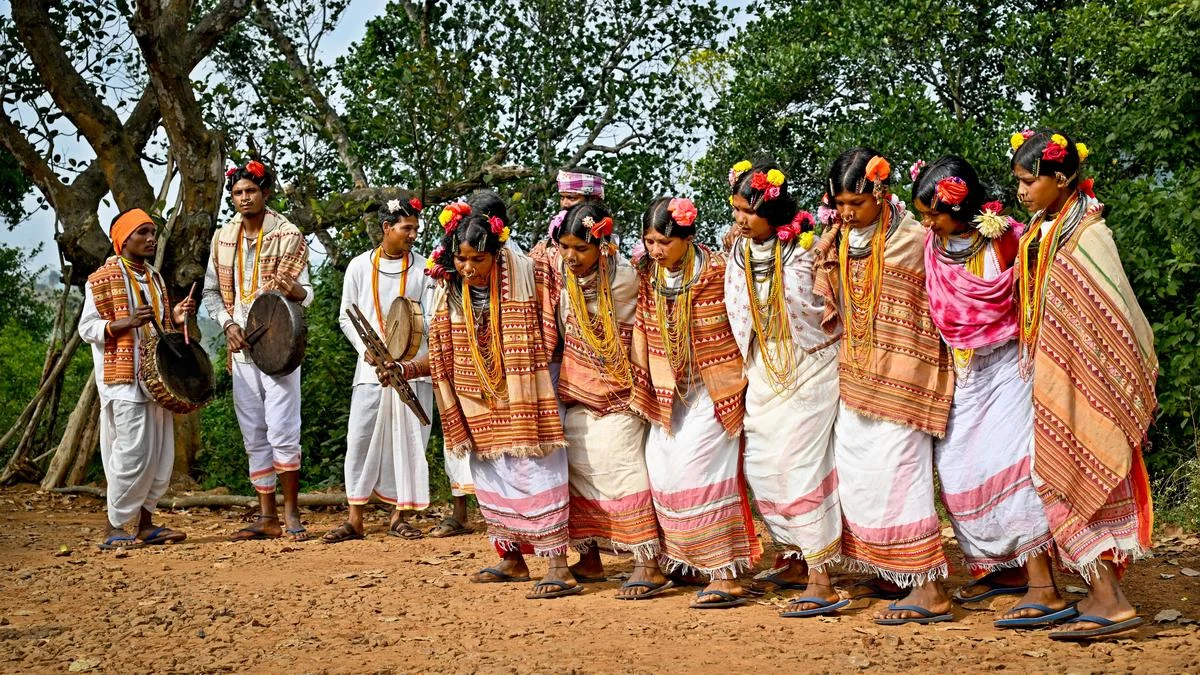
At the foothills of Odisha’s Niyamgiri mountain range, the air on a Monday morning is thick with the scent of sun-dried fruit and the low hum of a thousand negotiations. In the small town of Kalyansingpur, the weekly santha (market) is more than just a place of commerce; it is the heartbeat of an ancient civilization. Here, the Dongria Kondh, one of India’s most reclusive and culturally distinct Particularly Vulnerable Tribal Groups (PVTGs), descend from their hilltop hamlets to interface with the modern world.
The scene is a vibrant tableau of survival and tradition. Sacks of dried mangoes are piled high, scales swing rhythmically, and motorcycles weave through crowds of women adorned with colorful beads and traditional daggers. This market serves as the primary economic outlet for a community that famously defeated a global mining giant, proving that for the Dongria Kondh, the hills are not a resource to be extracted, but a deity to be defended.
Main Facts: A Microcosm of Tribal Economy and Culture
The Dongria Kondh reside in the Niyamgiri hill ranges across the Rayagada and Kalahandi districts of southwestern Odisha. Their name, Dongria, is derived from dongar, meaning ‘hill,’ reflecting their identity as highlanders. Numbering approximately 10,000, they have maintained a lifestyle that is intricately woven into the ecology of the Eastern Ghats.

The Monday Santha
The Kalyansingpur santha is the focal point of the region’s seasonal economy. For the Dongria Kondh, the market is the culmination of weeks of labor—gathering forest produce and tending to crops on steep, distant slopes. By 10:00 AM, the market is flooded with indigenous products:
- Wild Mangoes: Sliced and sun-dried, these are the season’s primary commodity.
- Native Grains: Ragi (finger millet), black gram, and native varieties of tur dal.
- Forest Produce: Tamarind, jackfruit, and wild berries.
The market operates on a delicate balance of supply and demand. This year, a bumper harvest has seen the price of dried mangoes drop to approximately ₹45 per kilogram, down from ₹85 the previous year. These goods do not stay local; they are bundled into consignments destined for major urban centers like Raipur, Andhra Pradesh, and Mumbai.
Cultural Markers
The Dongria Kondh are instantly recognizable by their distinct aesthetic, which serves as a badge of their ethnic pride. The women wear multiple strands of beads and metal earrings that frame their faces. Most striking is the small traditional dagger, or sipna, tucked discreetly into their tightly coiled hair buns. This tool is both a practical implement for forest life and a symbol of their protective relationship with their environment. Their hand-embroidered stoles, featuring intricate geometric motifs, represent a centuries-old craft tradition that remains vibrant today.

Chronology: From Ancestral Roots to Legal Landmarks
The history of the Dongria Kondh is a timeline of isolation followed by intense external pressure, leading to a historic legal victory that changed the landscape of indigenous rights in India.
Pre-2000s: Ancestral Stewardship
For generations, the Dongria Kondh lived in relative isolation, practicing podu (shifting cultivation) and horticulture. They established a complex spiritual system centered around Niyam Raja, the king of the hills, whom they believe resides on the tallest peak of the Niyamgiri range.
2003–2012: The Bauxite Conflict
The discovery of massive bauxite deposits—the raw material for aluminum—beneath the Niyamgiri Hills brought the community into direct conflict with industrial interests. Vedanta Resources sought to mine the hills to feed its nearby refinery. This period was marked by sustained protests, international advocacy, and a growing narrative of "David vs. Goliath," with the Dongria Kondh asserting that mining would destroy their water sources (over 100 perennial streams) and their sacred sites.

2013: The Landmark Supreme Court Judgment
In a watershed moment for environmental law, the Supreme Court of India ruled on April 18, 2013, that the local Gram Sabhas (village councils) must decide whether the mining project would infringe upon their religious and cultural rights.
2013 (July–August): The Rejection
In a series of 12 Gram Sabha meetings, the Dongria Kondh unanimously rejected the mining proposal. This was the first time an Indian court allowed a local community to exercise a "veto" over a major industrial project based on cultural and religious grounds.
2024: The Modern Synthesis
Today, the region exists in a state of "guarded modernization." While the threat of large-scale mining has receded, the community is integrating new technologies. Solar panels now dot the roofs of concrete homes provided under government schemes, and mobile phones are common. However, the core of their existence remains anchored in the traditional agricultural cycle and the worship of Niyam Raja.

Supporting Data: The Economics of the Hillside
The sustainability of the Dongria Kondh way of life is backed by a diverse horticultural portfolio. Unlike many tribal groups that rely solely on subsistence farming, the Dongria are skilled horticulturalists.
| Commodity | Market Period | Primary Destinations | Price Trend (Current) |
|---|---|---|---|
| Dried Wild Mango | June | Raipur, Mumbai, AP | ₹45/kg (Down from ₹85) |
| Pineapple | Seasonal | Local & Regional | Stable |
| Ragi (Millet) | Year-round | Local consumption/Santha | Increasing demand |
| Tur Dal (Native) | Post-harvest | Regional | High (Niche organic) |
The nutritional profile of the Dongria Kondh diet is another point of data-driven interest. A typical meal in a village like Phakeri consists of:
- Millet Porridge: A slow-release carbohydrate ideal for high-altitude labor.
- Mixed Dal with Vegetables: Using native brinjal and plantains.
- Wild Fruits: High in antioxidants and vitamins, including kala jamun and wild berries.
This diet, served on stitched leaf plates, represents a zero-waste, hyper-local food system that environmentalists cite as a model for sustainable living.

Official Responses and Legal Frameworks
The status of the Dongria Kondh as a PVTG entitles them to specific protections under the Indian Constitution and various state-level initiatives.
The Role of the Dongria Kondh Development Agency (DKDA)
The DKDA is the primary government body tasked with the welfare of the tribe. Official responses from the agency emphasize a balance between development and cultural preservation. "The goal is to provide infrastructure like roads and healthcare without eroding the social fabric that makes the Dongria Kondh unique," a regional official noted. However, the community often views government intervention with a degree of skepticism, prioritizing their autonomy.
The Forest Rights Act (FRA)
The 2013 judgment was a significant application of the Scheduled Tribes and Other Traditional Forest Dwellers (Recognition of Forest Rights) Act, 2006. Legally, the Dongria Kondh have been recognized not just as residents, but as owners and protectors of their ancestral lands. This legal standing continues to be the primary barrier against any future attempts at industrial exploitation of the Niyamgiri range.

Judicial Perspective
The Supreme Court’s 2013 stance emphasized that "the right to worship is a fundamental right" and that the "sacredness of the mountain" for the Dongria Kondh was a legitimate legal claim. This established a precedent that has since been used by other indigenous groups across India to protect their lands.
Implications: The Future of Indigenous Autonomy
The story of the Dongria Kondh and the Kalyansingpur market carries profound implications for the future of indigenous rights, environmental conservation, and the global economy.
Environmental Stewardship
The Niyamgiri Hills remain a lush, biodiverse "water tower" for Odisha because of the Dongria Kondh’s refusal to allow mining. Their presence ensures the protection of the forest canopy, which in turn regulates the regional climate and maintains the water table. The implication is clear: indigenous management is often the most effective form of environmental conservation.

Cultural Resilience vs. Globalization
The Dongria Kondh are not frozen in time. They use motorcycles to bring their produce to the santha and use mobile phones to check market prices. However, they have successfully avoided the "cultural flattening" that often accompanies modernization. The persistence of their dress, language, and spiritual beliefs suggests that "development" does not have to mean the loss of identity.
Economic Vulnerability
The fluctuation in mango prices (from ₹85 to ₹45) highlights the vulnerability of the tribal economy to market forces. As they become more integrated into national supply chains, there is a growing need for fair-trade mechanisms and cooperatives that can protect tribal farmers from the volatility of wholesale markets.
A Model for the Future
As the world grapples with climate change and the depletion of natural resources, the Dongria Kondh offer an alternative narrative. They demonstrate that a community can thrive by treating nature as a sacred entity rather than a commodity. As Babula of Phakeri village succinctly puts it: “Our fields, streams, and forests give us everything we need. Why would we exchange that for something that could damage the hills?”

The Monday santha at Kalyansingpur eventually winds down as the sun climbs higher. The sacks of mangoes are loaded onto trucks, and the families begin the long trek back up the winding trails of Niyamgiri. They return to a home that is, for now, safe—a mountain of bauxite that remains a mountain of trees, guarded by a people who know the true value of the earth beneath their feet.
