

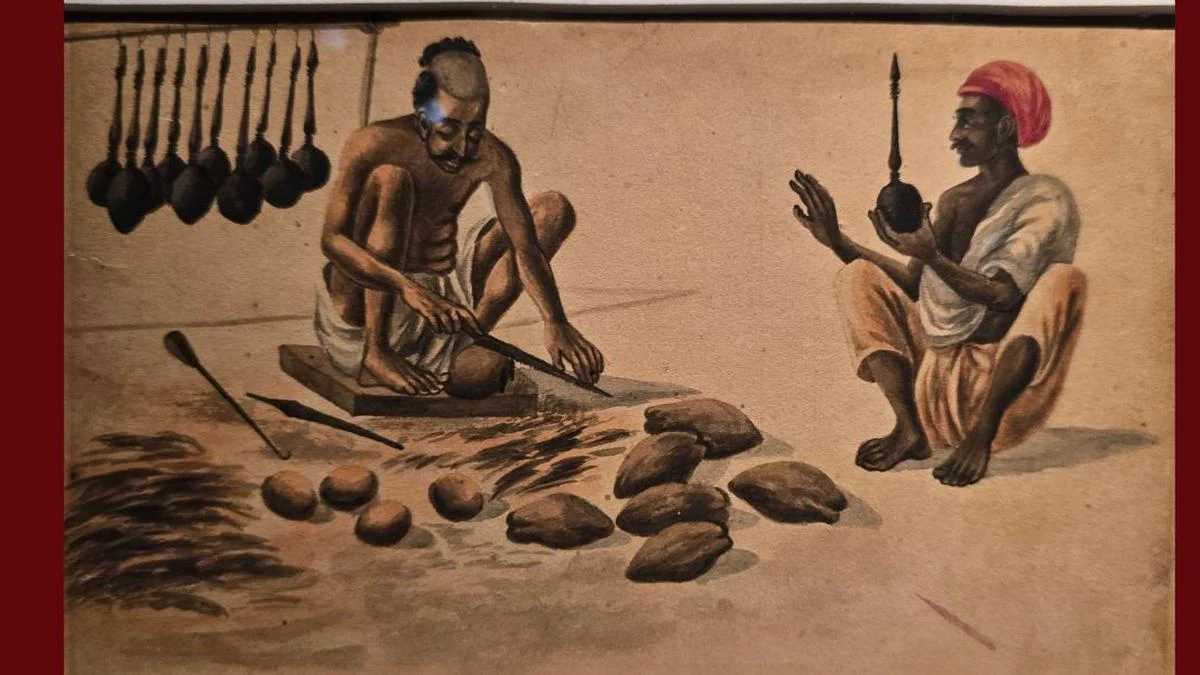
In the quiet, climate-controlled galleries of the Bihar Museum, a world long forgotten is flickering back to life. It is a world rendered in delicate watercolors on imported paper and translucent mica—a world where the subjects are not the grand emperors of the Mughal court or the high-ranking officers of the British Raj, but the everyday citizens of 18th-century Patna. Here, two men in simple dhotis toil within the pungent confines of a distillery; there, a woman in a vibrant blue-and-yellow ghaghra dances in a palace hall, her movements captured in a pre-photographic stillness.
These artworks belong to the Patna Kalam tradition, a unique school of painting that served as the primary visual documentation of Bihar’s social fabric before the advent of the camera. After decades of being relegated to dusty archives and private trunks, the art form is witnessing a significant resurgence. Following a high-profile showcase at the Bihar Museum Biennale 2025 and a dedicated exhibition titled Patna Kalam: Ek Virasat, the tradition is stepping out from behind the glass of history and into the hands of a new generation of artists.

Main Facts: The Aesthetic of the Common Man
Patna Kalam is often categorized under the broader umbrella of the "Company School" of painting, yet it possesses a soul and technical DNA that is entirely its own. Emerging in the mid-18th century, it was the first school of Indian painting to shift its gaze from the divine and the royal to the mundane and the manual.
Technical Characteristics and Style
The hallmark of Patna Kalam is its "pale, bare backgrounds" and a startling lack of ornamentation. Unlike the lush, gold-leafed landscapes of Mughal miniatures or the dramatic light-and-shadow play of European oil paintings, Patna Kalam focuses on the stark reality of the subject.

"The regional art style employed the technique of the Company School of Painting, but with characteristics intrinsic to Patna city—its people, culture, and day-to-day life," explains Bhairav Lal Das, the Patna chapter convenor for the Indian National Trust for Art and Cultural Heritage (INTACH).
Key features include:

- Medium: Watercolors and gouache applied to imported European paper or abrak (mica).
- Kajli Syahi: A specialized technique where the artist uses the brush directly to create the image without a preliminary pencil or charcoal sketch.
- Subject Matter: The "firka" sets—series of snapshots depicting various professions, such as vegetable sellers, blacksmiths, grocers (baniyas), and servants fetching groceries.
- Naturalism: A blend of Mughal precision in detailing and European naturalism in anatomy and perspective.
The Mica Tradition
One of the most distinctive aspects of Patna Kalam is its use of mica. These small, shimmering sheets provided a unique canvas for artists to paint "purdah-nasheen" women peeking from red palanquin curtains or musicians lost in their craft. These were often sold as souvenirs to European travelers and officials, serving as the 18th-century equivalent of a postcard.
Chronology: From Imperial Courts to the Streets of Patna
The trajectory of Patna Kalam is a story of migration, adaptation, and eventual decline. It tracks the shifting centers of power in colonial India.

1720–1750: The Early Seeds
While many historians link the school strictly to the British East India Company, Ashok Kumar Sinha of the Bihar Museum notes that Patna Kalam’s roots may go back as far as 1720. As the Mughal Empire began to fracture under the successors of Aurangzeb, imperial artists lost their royal patronage in Delhi.
1750–1760: The Murshidabad Migration
Artists first migrated to Murshidabad in West Bengal, finding work under the Nawabs. However, the political instability following the Battle of Plassey in 1757 forced them to move once more. They traveled in waves toward Patna, which was then a burgeoning hub of trade and administration for the British East India Company.

1760–1840: The Golden Age
By 1760, the seeds of Patna Kalam had firmly taken root. The city’s unique environment—a melting pot of Indian merchants, European administrators, and a diverse working class—provided endless inspiration. Famous pioneers like Sewak Ram and Hulas Lal began producing "firka" sets that gained immense popularity. By the mid-19th century, cousins Shiva Lal and Shiva Dayal Lal led a thriving workshop tradition, capturing the "Company Art" or "Bazaar Art" that defined the era.
1840–1947: The Long Decline
The decline of Patna Kalam was precipitated by two major factors: the invention of photography and the mass production of cheap lithographs. British officials like Charles D’Oyly established lithographic presses in Patna, producing standardized images that were far cheaper than the hand-painted, labor-intensive Kalam works. By the time of India’s independence, the tradition had largely vanished from public life, surviving only in private family collections and British archives.

Supporting Data: A Heritage Preserved in Trunks and Museums
For much of the 20th century, if an art lover wanted to see Patna Kalam, they had to visit the British Museum or the Victoria & Albert Museum in London. In India, the heritage remained largely hidden.
The Jalan Collection
A significant portion of the surviving Patna Kalam works is held by the Jalan family. Aditya Jalan, the great-grandson of the legendary art connoisseur Dewan Bahadur Radha Krishna Jalan, recently opened "Planet Patna," a private museum that provides public access to these treasures.
"My great-grandfather was passionate about objects of historical significance," Aditya notes. The collection was so renowned that even the British art historian Mildred Archer relied on it for her seminal 1948 book, Patna Painting. Interestingly, the collection was expanded by Aditya’s father, Bal Manohar, who famously exchanged rare colonial-era stamps for Patna Kalam paintings.

The Academic Gap
At Patna University’s College of Arts and Crafts, the situation remains a paradox. While students attend workshops to learn the style, many original paintings remain locked in administrative trunks, inaccessible due to security and preservation concerns. This lack of visibility has been the primary hurdle in sustaining the art form’s relevance.
Comparison with Tikuli Art
Unlike Patna Kalam, the 800-year-old Tikuli art of Bihar has managed to survive and flourish. While Patna Kalam was "lost" after independence, Tikuli was revived in the mid-20th century by adapting to modern needs—appearing on coasters, trays, and home decor. Padma Shri awardee Ashok Kumar Biswas notes that while Tikuli is influenced by Patna Kalam, its ability to utilize enamel paint on hard surfaces helped it transition into a commercial craft, a leap Patna Kalam is only now beginning to make.

Official Responses: Government and Institutional Initiatives
The recent revival is not accidental; it is the result of a concerted effort by the Bihar State Government and cultural heritage organizations.
The Bihar Museum Strategy
Anjani Kumar Singh, the Director General of the Bihar Museum, has expressed a commitment to moving beyond static displays. "We have plans for dedicating a gallery to exhibit Patna Kalam paintings permanently," Singh stated. Encouraged by the success of the Vaidehi Sita exhibition, the museum aims to take Patna Kalam on a traveling tour across Indian states and overseas. Furthermore, the museum is actively seeking "art trainers" to bridge the gap between historical study and contemporary practice.

INTACH’s Grassroots Efforts
INTACH’s Patna Chapter has been the engine behind the technical revival. Since 2023, the organization has conducted 11 intensive workshops. These sessions are not merely about copying old works; they encourage students to observe modern architecture and people through the lens of the Kalam tradition. Bhairav Lal Das has announced that INTACH will provide incentives for budding artists and build a "bank" of paintings to promote and sell, creating a sustainable economic ecosystem for the art.
Implications: Can a 18th-Century Style Survive the 21st Century?
The resurgence of Patna Kalam raises a fundamental question: Can an art form built on the "nuanced peace" of the 18th century survive in the chaotic, fast-paced environment of modern Patna?

The Challenge of Modernity
Aditya Kumar Singh, an architect and urban sketcher, highlights the difficulty of the medium. While a modern sketch might take 30 minutes, a true Patna Kalam painting requires three days of dedicated, meticulous labor. The "street painting" aspect of the original tradition is also hampered by the noise and congestion of the modern city.
Contemporary Adaptations
However, there are signs of successful adaptation. Textile designer Sunita Prakash has begun incorporating Patna Kalam motifs into block-printing and fabric design through her company, Bandhani. By training women to paint these traditional scenes on wearable fabrics, she is moving the art from the museum wall to the wardrobe.

The Educational Impact
For students like Anurag Kumar Verma, who recently joined the Faculty of Fine Arts at Maharaja Sayajirao University, Baroda, Patna Kalam was a gateway to professional art. The workshops have proven that young artists, often performing better than traditional folk artists in human anatomy and measurement, are eager to adopt this style if given the resources.
Conclusion
The survival of Patna Kalam depends on its transition from a "relic" to a "living language." While the efforts of the Bihar Museum and the Jalan family ensure that the past is preserved, the work of INTACH and contemporary designers ensures that the style remains relevant. As Patna Kalam finds its way onto textiles, into university curriculums, and across international galleries, it finally answers the question of its own survival. It is no longer just an art form behind glass; it is once again a tool for documenting the daily lives of ordinary people—this time, in a new century.
