

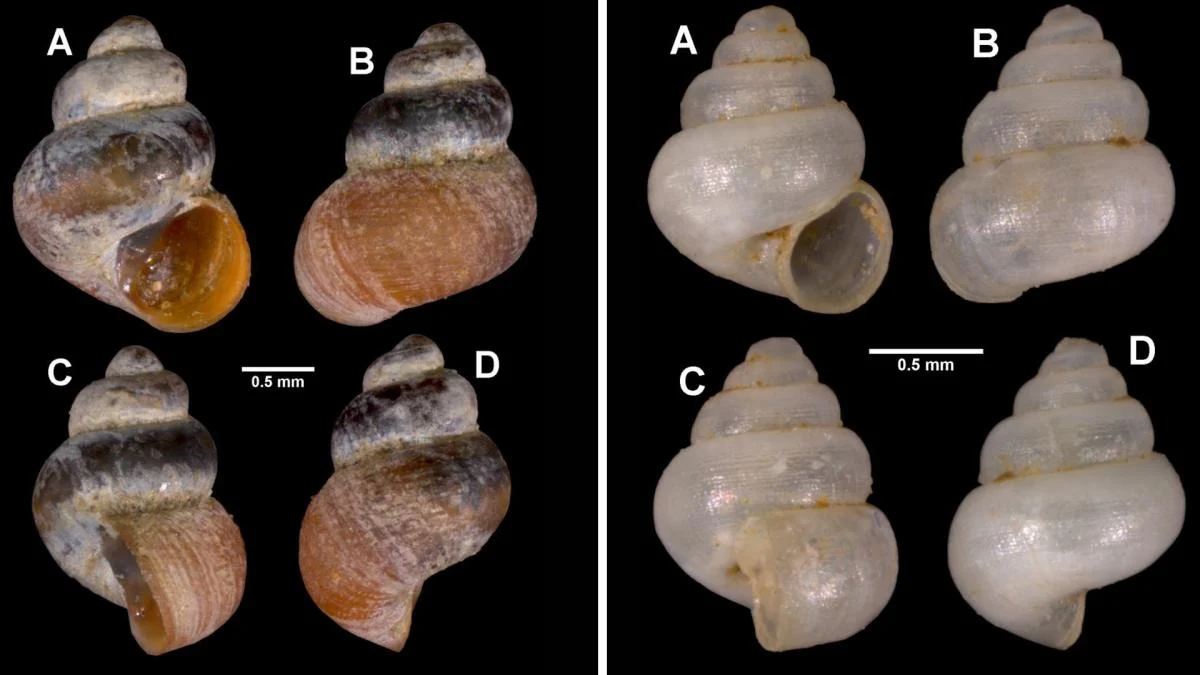
MEGHALAYA — In the labyrinthine depths of Northeast India’s subterranean world, where sunlight never reaches and humidity clings to every surface, a significant biological discovery has come to light. Researchers from the Ashoka Trust for Research in Ecology and the Environment (ATREE) have identified two previously unknown species of micro-snails within the limestone cave systems of Meghalaya.
The discovery of Georissa meghalayaensis and Acmella bensoni, recently detailed in the European Journal of Taxonomy, underscores the immense, yet largely unexplored, biodiversity of the Indo-Burma hotspot. These miniature mollusks, some no larger than a grain of sand, represent a triumph of modern malacology and a sobering reminder of the fragile ecosystems hidden beneath the Earth’s surface.
Main Facts: A Miniature Breakthrough in the Indo-Burma Hotspot
The discovery was led by scientists Nipu Kumar Das and Neelavar Ananthram Aravind, who ventured into the Krem Puri and Arwah cave systems of Meghalaya. Their findings have added two distinct names to the global catalog of gastropods:
- Georissa meghalayaensis: A vibrant, orangish-red snail found near the cave thresholds. Its defining characteristic is a sophisticated, mesh-like pattern of ridges on its shell, a feature that distinguishes it from its more common yellowish relatives.
- Acmella bensoni: A deep-cave dweller with a translucent, whitish shell. It is characterized by its smooth appearance, created by exceptionally fine, densely packed ribs and deep grooves between its spiral whorls.
Meghalaya, often referred to as the "Abode of Clouds," is world-renowned for its extensive karst topography. With over 1,200 documented caves, the region provides a unique evolutionary laboratory. The high calcium carbonate content of the limestone is essential for shell-building organisms, making these caves a primary habitat for specialized mollusks. However, until this study, much of the microscopic life within these systems remained undocumented.

The researchers emphasize that while these creatures are small, their presence is a vital indicator of the health of subterranean ecosystems. The naming of Acmella bensoni serves as a tribute to William H. Benson, a 19th-century civil servant and naturalist who is widely regarded as the father of Indian malacology.
Chronology: From the Cave Floor to the Taxonomic Record
The journey to this discovery began with a series of field expeditions aimed at surveying the malacofauna (mollusk life) of Northeast India. The process of identifying new species in the world of micro-snails is a meticulous one, spanning several years of field and laboratory work.
- Field Collection: The research team focused on the East Khasi Hills district, home to some of the longest and deepest caves in the world. Using fine brushes and specialized collection kits, the scientists gathered sediment samples and hand-picked specimens from cave walls and entrance zones.
- Discovery of Georissa meghalayaensis: This species was first located near the entrance of the Krem Puri cave. Unlike many cave species that lose pigmentation (troglomorphism), this snail retained a vivid orange hue, suggesting it may occupy a niche that bridges the external environment and the deep cave interior.
- Discovery of Acmella bensoni: Deep within the dark zones of both Krem Puri and Arwah caves, the team found the more elusive Acmella bensoni. These snails were found clinging to damp limestone walls, thriving in an environment of constant temperature and high humidity.
- Laboratory Analysis: Back at the ATREE laboratories, the specimens underwent rigorous morphological analysis. Given their microscopic size—often less than 2mm to 3mm—the researchers utilized high-magnification stereomicroscopes and Scanning Electron Microscopy (SEM) to document the intricate shell patterns that define the species.
- Publication (June 2026): After comparing the specimens with historical records and existing museum collections, the findings were peer-reviewed and published in the European Journal of Taxonomy, officially entering the species into the scientific record.
Supporting Data: The Morphology of the "Invisible"
To the untrained eye, these snails appear as mere specks of dust. However, the supporting data provided by Das and Aravind reveals a world of complex architecture at a microscopic scale.
The Intricacies of Georissa meghalayaensis
- Coloration: Unlike the pale or translucent shells typical of many subterranean species, G. meghalayaensis displays a striking reddish-orange tint.
- Sculpturing: The shell surface is covered in a "reticulated" or mesh-like pattern. This consists of vertical and horizontal ridges that intersect, providing structural integrity to the tiny shell.
- Comparison: Its closest relative, Georissa pyxis, found in other parts of Southeast Asia, lacks this mesh pattern, featuring instead widely spaced spiral lines and a more yellowish hue.
The Refinement of Acmella bensoni
- Translucency: The shell of A. bensoni is nearly transparent, a common trait in deep-cave dwellers that helps conserve energy by reducing the need for heavy pigmentation.
- Ribbing: The species is noted for "fine, dense radial ribs." These are so closely packed that the shell appears polished or smooth to the naked eye, only revealing its texture under high-power magnification.
- Size: Acmella species are among the smallest land snails in the world, with some species measuring less than 1.5mm in height.
Regional Context
The study also expanded the known range of other micro-snail species, documenting new records in the states of Manipur and Mizoram. This suggests that the entire Indo-Burma biodiversity hotspot may hold hundreds of undiscovered micro-endemic species, each restricted to specific cave systems or mountain ranges.

Official Responses: A Call for Scientific Conservation
While the scientific community has celebrated the discovery, the researchers and conservationists at ATREE have paired their announcement with a stern warning regarding the future of these habitats.
Dr. Neelavar Ananthram Aravind, a senior fellow at ATREE and co-author of the study, noted that the "hidden" nature of these species often leads to them being overlooked in conservation policies. Unlike the "charismatic megafauna" (such as tigers or elephants) that receive the bulk of Indian conservation funding, micro-snails are often the first victims of habitat degradation.
"Meghalaya’s caves are geological wonders, but they are also biological repositories," a spokesperson for the research team stated. "The discovery of G. meghalayaensis and A. bensoni proves that we are only scratching the surface of what exists in our subterranean landscapes. Every cave system we lose to unmanaged tourism or mining is a potential loss of a species found nowhere else on Earth."
Experts in the field of malacology have lauded the decision to name the second species after William H. Benson. By honoring the 19th-century pioneer, the researchers have highlighted the long history of mollusk study in India, while also pointing out how much work remains to be done in the 21st century.

Implications: The High Cost of Cave Tourism
The discovery of these micro-snails brings to the forefront a growing conflict between economic development through tourism and the preservation of unique biological life. Meghalaya has seen a surge in "cave tourism," with sites like Arwah and Krem Puri becoming major attractions.
The Threats of Human Intrusion
- Artificial Lighting: The installation of permanent LED lights in tourist caves facilitates the growth of "lampenflora" (algae and moss that grow around light sources). This disrupts the natural nutrient cycle of the cave and can displace native micro-flora and fauna.
- Infrastructure Development: The construction of concrete staircases, railings, and pathways directly destroys the micro-habitats on cave floors and walls where snails like Acmella bensoni reside.
- Micro-Climate Alteration: Large numbers of human visitors can change the temperature and CO2 levels within a cave. For a creature as sensitive as a micro-snail, even a one-degree shift in temperature can be fatal.
- Physical Damage: Because these snails are so small, they are frequently crushed by tourists or covered by dust stirred up by foot traffic.
Future Research and Policy
The study suggests that the "protected area" status usually reserved for forests must be extended to subterranean systems. The researchers are advocating for "low-impact tourism" models where certain "core zones" of caves are kept strictly off-limits to the public to serve as biological refuges.
Furthermore, the discovery emphasizes the need for a more robust taxonomic framework in India. With Northeast India being a gateway for species migration between Southeast Asia and the Indian subcontinent, the region is a "speciation engine." Continued investment in microscopic research is required to understand the full scope of India’s natural heritage before it is lost to the rapid pace of modernization.
As Meghalaya continues to develop its tourism infrastructure, the tiny Georissa meghalayaensis and Acmella bensoni stand as silent sentinels, reminding us that the most significant discoveries are often the ones we can barely see.
