

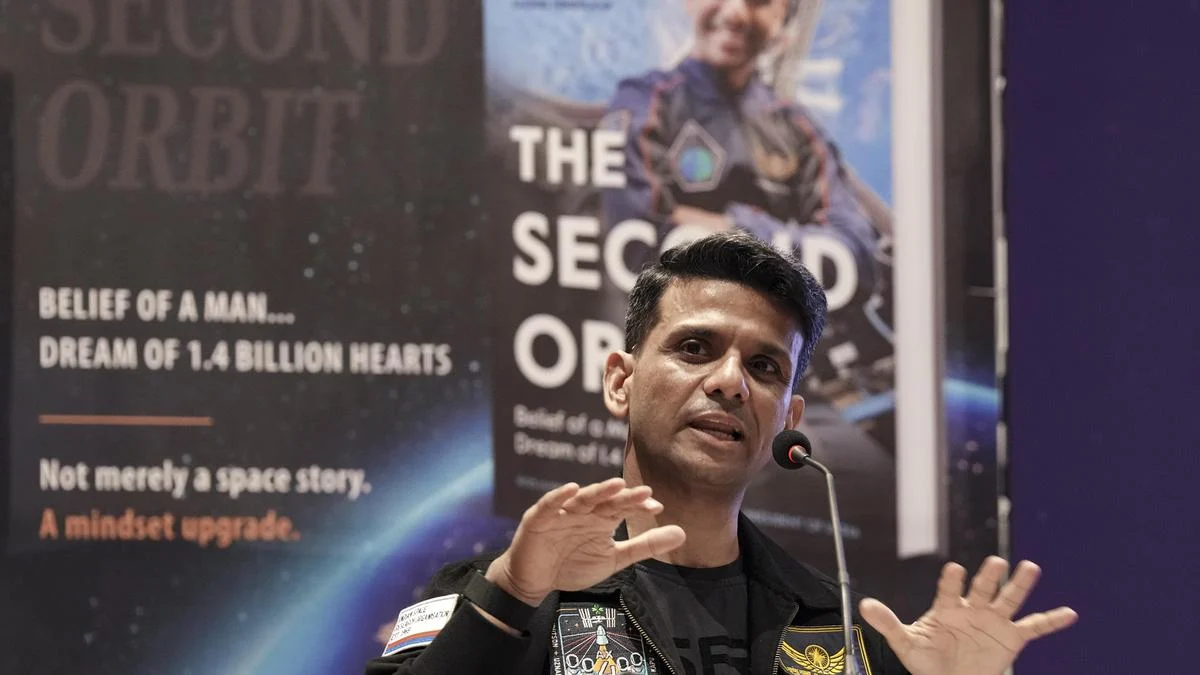
NEW DELHI — On a poignant Saturday that bridged the gap between Earthly celebrations and celestial memories, Indian Air Force (IAF) Group Captain Shubhanshu Shukla stood before a packed audience to launch his memoir, The Second Orbit: Belief of a Man… Dreams of 1.4 Billion Hearts. The date, July 4, 2026, carried profound weight; exactly one year prior, Shukla was not standing on a podium in New Delhi, but was suspended in the microgravity of the International Space Station (ISS), staring through the Cupola window at the curvature of the Earth.
The event served as more than a book launch; it was a retrospective on a mission that reignited India’s human spaceflight ambitions after a four-decade hiatus. Shukla, who became the first Indian to visit the ISS and the 634th human to reach space, shared intimate details of his 18-day odyssey, the technical rigors of orbital science, and the humorous "human" moments that occur when one lives in an environment where "life should not exist."
Main Facts: A Milestone in Indian Space Exploration
Group Captain Shubhanshu Shukla’s journey aboard the ISS was part of NASA’s Axiom-4 mission, a private astronaut mission that saw a four-member international crew conduct high-level research and technology demonstrations. For India, the mission represented a bridge between its storied past—the 1984 flight of Wing Commander Rakesh Sharma—and its future indigenous aspirations under the Gaganyaan program.
During his 18 days in orbit, Shukla completed a staggering 320 revolutions around the Earth, covering a distance of approximately 1.4 crore (14 million) kilometers. In a moving tribute to his fellow citizens, Shukla noted that his travel distance equated to roughly 100 meters for every one of India’s 1.4 billion people. "In some sense, all of you have been a part of this journey," he told the audience, framing his individual achievement as a collective national triumph.
The primary focus of his memoir, however, is not the solitary glory of the astronaut but the invisible machinery of teamwork. Shukla emphasized that the success of Axiom-4 was the result of thousands of ground engineers, scientists, and support staff. "When we launch someone to space, every single person on that ground team matters. That is what this book is about—how teamwork defines the limits of our accomplishments," he remarked.
Chronology: From Training to the "Triple Bubble" Triumph
The path to the ISS was one of intense preparation and rapid adaptation. After being selected as one of the four prime astronauts for India’s human spaceflight program, Shukla underwent rigorous training at ISRO’s Astronaut Training Facility in Bengaluru and subsequently with Axiom Space and NASA in the United States.

The Mission Launch and Orbital Life
In June 2025, the Axiom-4 crew launched from the Kennedy Space Center. Upon reaching orbit, the crew spent 22 hours in their capsule before docking with the ISS. It was during this transit period that one of the mission’s most light-hearted moments occurred. Lacking traditional beds, the crew utilized the cramped quarters of the spacecraft to rest. Shukla, seeking warmth and a secure spot, squeezed himself into a large black bag intended for storing spacesuits.
"I slept comfortably, tucked away," Shukla recalled. "But in zero gravity, you drift. When my crewmates woke up, they saw four bags and only three people. For a moment, there was genuine confusion—how do you lose a man in a capsule the size of a small room?" This anecdote, he explained, was included in his book to highlight the human side of space—a place where even the most elite pilots can find themselves "lost" in a storage bag.
The July 4th Breakthrough
The technical centerpiece of Shukla’s mission was a complex STEM (Science, Technology, Engineering, and Mathematics) demonstration assigned by ISRO. The task involved a delicate manipulation of fluid dynamics: creating a large water bubble, injecting an air bubble inside it, and finally, injecting a coffee-colored liquid bubble inside that air bubble.
For five days, Shukla struggled with the demonstration. In the absence of gravity, surface tension and fluid behavior are notoriously unpredictable. "It was incredibly difficult to just capture the initial water bubble without it shattering or drifting away," he said. On July 4, 2025, after nearly a week of failed attempts, Shukla successfully stabilized the "triple bubble" structure. The timing was symbolic, occurring on a day of global celebration, marking his personal victory over the physics of the void.
Supporting Data: The Physics and Logistics of Axiom-4
The Axiom-4 mission was not merely a symbolic flight; it was a data-intensive expedition. Shukla’s presence allowed ISRO to gather critical information on how Indian-designed experiments and Indian personnel perform in long-duration microgravity.
- Distance Traveled: 1.4 crore kilometers.
- Orbits Completed: 320.
- Duration: 18 days aboard the ISS.
- Photography: Shukla captured the first high-resolution photograph of the entire Earth by an Indian from the ISS cupola using specialized lenses, providing ISRO with unique perspectives on atmospheric phenomena.
- STEM Impact: The "Triple Bubble" experiment provided data on fluid interface stability, which is crucial for developing life-support systems and fuel management in future spacecraft.
Shukla’s book, The Second Orbit, serves as a qualitative data set, documenting the psychological and physiological sensations of re-entry and the transition from the silence of space to the cacophony of Earth. He admitted that he initially had no intention of writing a book, but realized that he could not physically reach every corner of India to share his story. "The book became the vessel to carry the experience to the 1.4 billion people who couldn’t be there with me," he said.

Official Responses: ISRO’s Strategic Vision
The book launch was attended by several luminaries of the Indian scientific community, most notably former ISRO Chairman S. Somanath. His presence underscored the official weight behind Shukla’s mission and its role in the larger Gaganyaan architecture.
Responding to queries about the differences between Shukla’s flight and the upcoming Gaganyaan mission, Somanath was candid about the challenges ahead. "Gaganyaan is a much tougher journey," Somanath stated. "While Axiom-4 provided invaluable experience on an existing platform (the ISS), Gaganyaan requires us to build the entire ecosystem from scratch—the crew module, the life support systems, and the heavy-lift launch vehicle."
Somanath emphasized that Shukla’s mission was a "learning laboratory." The insights gained from Shukla’s 18 days in orbit—ranging from how he slept to how he managed complex experiments—are currently being integrated into the design of the Gaganyaan spacecraft. "We need to understand how the system needs to be designed to suit the human requirement. Experience from people who actually fly these missions is the only way to gain that knowledge," Somanath added.
The former ISRO chief also reiterated the agency’s "safety-first" protocol, noting that multiple uncrewed test flights (using the ‘Vyommitra’ humanoid robot) would precede any crewed Gaganyaan launch.
Implications: A New Era for Indian Spacefaring
The reflections of Group Captain Shubhanshu Shukla mark a turning point in India’s national identity as a spacefaring nation. For forty years, the story of an Indian in space was a singular chapter written by Rakesh Sharma in 1984. With Shukla’s mission and the publication of The Second Orbit, India has officially entered its "Second Orbit."
Geopolitical and Scientific Standing
Shukla’s successful mission positions India as a key player in the "New Space" economy, where government agencies like ISRO collaborate with private entities like Axiom and NASA. This hybrid model is expected to be the standard for future lunar and Martian exploration.

Inspiring the Next Generation
The primary implication of Shukla’s journey is cultural. By detailing his struggles with the STEM demonstration and the "funnier" aspects of space life, he has humanized the figure of the astronaut. This accessibility is intended to inspire a surge in interest in basic sciences and aerospace engineering among Indian youth.
The Road to Gaganyaan and Beyond
As India prepares for its first indigenous crewed mission, Shukla’s experience serves as a proof-of-concept. The data collected during his 320 orbits will directly influence the ergonomics and safety protocols of the Gaganyaan module. Furthermore, his mission has paved the way for a permanent Indian presence in space, potentially leading to an Indian Space Station (Bharatiya Antariksh Station) by 2035.
As the event concluded, Shukla’s message remained focused on the horizon. He reminded the audience that while he may have been the one in the suit, the "dreams of 1.4 billion hearts" were the fuel that propelled him. With The Second Orbit, the story of India’s space journey is no longer a memory of the 1980s, but a living, breathing blueprint for the future.
