

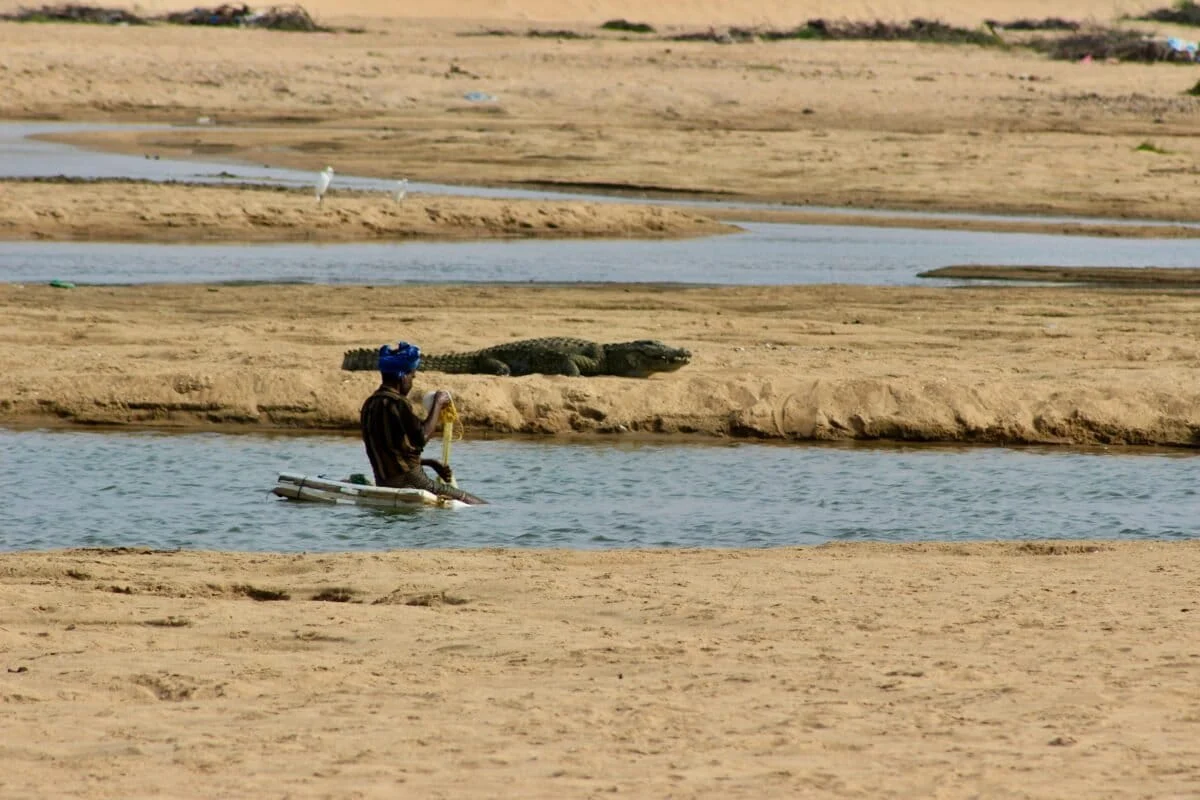
From the thunderous, rocky gorges of Hogenakkal to the silent, salt-kissed coastal marshes of Muthupet, the mugger crocodile (Crocodylus palustris) has been a silent witness to the evolution of southern India’s most iconic waterway. For millennia, this apex predator has navigated the rivers, reservoirs, and wetlands of the Kaveri (Cauvery) river basin. However, a groundbreaking study has revealed a stark reality for the species: while the basin still holds vast stretches of viable habitat, the vast majority of these lands lie outside the safety of India’s protected area network, leaving the prehistoric reptiles vulnerable to the relentless march of human expansion.
The research, published in the prestigious journal Ecological Applications, provides the first comprehensive, basin-wide assessment of mugger habitat across a landscape spanning 81,155 square kilometers. Covering parts of Karnataka, Kerala, and Tamil Nadu, the study highlights a precarious conservation gap. Of the approximately 2,209 square kilometers identified as potentially suitable habitat, a mere 38% falls within existing national parks or wildlife sanctuaries.
This finding suggests that nearly two-thirds of the mugger’s home in the Kaveri basin is unmanaged, unmonitored, and directly exposed to the pressures of sand mining, agricultural runoff, and human-crocodile conflict.
Main Facts: A Landscape Divided
The mugger crocodile is one of three crocodilian species native to India, alongside the gharial and the saltwater crocodile. Unlike its more specialized cousins, the mugger is a generalist, capable of thriving in a variety of freshwater habitats, including rivers, lakes, and even man-made reservoirs. Yet, this adaptability has not shielded it from the dramatic reshaping of the Kaveri River Basin (CRB).
The study, led by researchers including Rahul Gour of the Kenneth Anderson Nature Society and Nikhil Whitaker of the Madras Crocodile Bank Trust and Centre for Herpetology, utilized advanced multiscale habitat modeling to pinpoint where crocodiles persist and where they are most at risk.

Key Findings Include:
- The 38% Protection Gap: Only 840 sq. km of the 2,209 sq. km of suitable habitat is currently protected.
- Scale of Fragmentation: Nearly 62% of the basin’s land is now covered by agriculture, with urban expansion and road networks further dissecting riverine corridors.
- Priority Zones: The study identified 990 sq. km of "priority habitat," with 244 sq. km classified as high or very high priority for immediate conservation intervention.
- Micro vs. Macro Habitat: The research highlights that a crocodile’s survival depends as much on local sandbanks (microhabitat) as it does on 50km of uninterrupted river flow (macrohabitat).
Chronology: From Scattered Data to a Unified Vision
For decades, knowledge of the mugger population in the Kaveri was fragmented. Conservationists had access to localized surveys from specific hotspots like the Moyar River, the Kabini Reservoir, and the Amaravati Dam. However, these "islands of data" failed to provide a cohesive picture of the species’ health across the entire 800-kilometer length of the Kaveri.
"The CRB has been reshaped dramatically," explains corresponding author Rahul Gour. "We had scattered sightings and historical records, but no basin-wide picture of where they actually persist today, and more importantly, where they could persist if given the chance."
To bridge this gap, the research team embarked on an ambitious data-collection phase. They compiled mugger records from decades of field surveys, published literature, biodiversity databases, and community-sourced observations. After rigorous filtering, they focused on 82 distinct occurrence locations.
The next phase involved layering this biological data against a complex set of environmental variables. Between 2022 and 2024, the researchers analyzed how crocodile presence correlated with hydrology, climate stability, topography, land use, and human infrastructure. Unlike previous studies that looked at these factors through a single lens, this study evaluated variables across multiple scales—ranging from a 500-meter local radius to an 8-kilometer landscape radius. This approach allowed the team to see the "big picture" of how a dam 100 kilometers away might affect a nesting site in a local village.

Supporting Data: The Science of Suitability
The study’s habitat model debunked several myths about what makes a "perfect" home for a crocodile. While one might assume that the largest, deepest bodies of water are always best, the data suggested a more nuanced reality.
The Importance of Isothermality
One of the strongest predictors of mugger presence was "isothermality"—a measure of temperature stability. As ectotherms, crocodiles rely entirely on their environment to regulate body temperature. "Consistent, predictable temperatures are not a luxury for them; they are a physiological requirement," says Gour. The model showed that areas with high temperature fluctuations were less suitable, regardless of water availability.
The "Small Wetland" Paradox
In a surprising twist, the model found that muggers were more strongly associated with smaller, concentrated wetland patches than with massive, continuous water bodies. Researchers believe this is driven by "prey dynamics." Smaller wetlands and seasonal marshes concentrate fish and other prey into manageable areas, reducing the energy a crocodile must expend to hunt. Furthermore, shallow river margins are essential for juveniles, providing cover from both predators and the heavy currents of the main river.
Hydrological Connectivity and Human Disturbance
The study used "flow accumulation" to determine the permanence of water. Areas that remained perennial and well-connected to the larger river network scored significantly higher than isolated, seasonal stretches. Conversely, proximity to roads was a major negative predictor. Roads bring noise, pollution, and, most importantly, increased human activity, which pushes crocodiles into more marginal, less-optimal habitats.
Official Responses: Expert Perspectives on "Accidental Protection"
Nikhil Whitaker, Research Director at the Madras Crocodile Bank Trust, argues that the current conservation model for muggers is largely passive.

"The number that stays with me is 38%," Whitaker says. "That means roughly six in every ten hectares of meaningful mugger habitat is outside any formal protection. The mugger is, in a sense, a species that has been protected by accident in places where the habitat happened to fall inside reserves established for charismatic megafauna like tigers or elephants."
Whitaker and his colleagues argue that this "accidental" approach is no longer sufficient. As the Kaveri basin faces increasing water scarcity and infrastructure development, crocodiles living in the "gaps" between tiger reserves are the first to suffer.
"This study makes the case that we need deliberate, mugger-specific conservation attention in the stretches of river that sit between those formal islands of protection," Whitaker adds.
The researchers emphasize that the goal is not necessarily to lock away more land from human use. Instead, they advocate for a "coexistence-based management" model. In many parts of the Kaveri, such as the Kollidam River, fishermen and crocodiles have shared the water for generations. The challenge lies in managing this contact to prevent conflict while ensuring the crocodile’s biological needs—such as undisturbed nesting—are met.
Implications: A Roadmap for Future Conservation
The study identifies five specific regions that require urgent conservation priority outside the existing protected area network:

- The Krishna Raja Sagar (KRS) Backwaters: A critical corridor extending toward the Ranganathittu Bird Sanctuary in Karnataka.
- The Pennagaram-Mettur Corridor: A stretch in Tamil Nadu leading to the southeastern flank of the Stanley Reservoir.
- The Lower Kaveri-Amaravati Confluence: Stretches of the river downstream of where the Amaravati joins the Kaveri.
- The Kollidam River: Specifically the sections in the Mayiladuthurai district.
- Muthupet and Kodiyakarai: The coastal wetlands that represent the river’s end.
The Threat of Sand Mining
A major implication of the study concerns the physical structure of the riverbanks. Successful mugger reproduction depends on the availability of sandy banks with specific thermal properties. "Sand extraction from riverbeds is a particular concern," the researchers noted. Even if the water remains, the loss of these nesting sites can lead to a "ghost population"—where adult crocodiles are present, but no new generations are being born.
Climate Refugia
As global temperatures rise, the importance of "thermal refugia"—stretches of river that remain cool and stable—will grow. The study suggests that the forested gorge systems of the central Kaveri basin may become the species’ last stand against climate change. Conservation planning must begin identifying and protecting these thermal havens now.
The Path Forward
The researchers conclude that the window for action in the Kaveri is still open, but it is closing. The next steps involve:
- Community-Led Monitoring: Engaging local communities in tracking crocodile movements and protecting nests.
- Restoration of Oxbow Lakes: Revitalizing small, disconnected wetlands that serve as nurseries for the species.
- Conflict Mitigation: Improving rapid-response teams to handle crocodiles that wander into human settlements, ensuring they are relocated safely rather than harmed.
"The mugger is resilient. It has survived millions of years of change," Gour concludes. "But it is not infinitely resilient to losing the pockets of stable, connected, low-disturbance habitat that remain. We have the data; now we need the will to act."
