

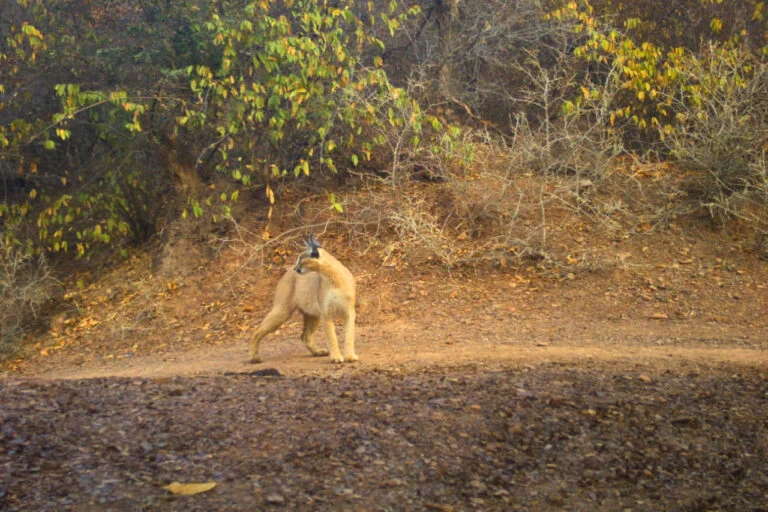
RAJASTHAN, INDIA — In the sun-drenched, rugged expanses of southeastern Rajasthan, a "ghost" is being tracked. The caracal (Caracal caracal schmitzi), one of India’s rarest and most enigmatic felids, has long existed in the shadows of conservation priorities, often eclipsed by its more charismatic cousins, the tiger and the leopard. However, a comprehensive new study is shedding light on this elusive predator, revealing both a surprising resilience in human-dominated landscapes and a precarious future tied to habitats often dismissed as "wastelands."
The research, conducted across the Greater Ranthambhore landscape, represents a pivotal shift from anecdotal sightings to systematic, data-driven science. By utilizing extensive camera-trap arrays and sophisticated habitat modeling, researchers have identified over 14,000 square kilometers of potential habitat, while simultaneously issuing a stark warning: nearly three-quarters of the caracal’s world lies outside the safety of protected national parks.
Main Facts: A Landscape-Level Revelation
The caracal is a medium-sized wild cat, instantly recognizable by its sandy-tawny coat and the long, elegant black tufts adorning its ears. In India, the species is currently on the brink, listed as "Critically Endangered" by the Ministry of Environment, Forest and Climate Change’s recovery program. Despite its dire status, the caracal remains one of the least-studied carnivores in the subcontinent.
The recent study, led by scientists from the Wildlife Institute of India (WII) and the National Tiger Conservation Authority (NTCA), focused on the Kailadevi Wildlife Sanctuary and the broader Greater Ranthambhore ecosystem. The findings provide the first high-resolution map of where the caracal persists and, more importantly, where it could potentially thrive.
Key Findings at a Glance:
- Identified Habitat: Approximately 14,284 sq. km. of suitable habitat was modeled across eastern Rajasthan and western Madhya Pradesh.
- The Protection Gap: Only 26% of suitable caracal habitat falls within Protected Areas (PAs). The remaining 74% exists in "multiple-use landscapes" where wildlife must navigate human settlements, agriculture, and industry.
- The "Ravine" Factor: The study identified rugged terrain and deeply dissected ravines—particularly those associated with the Chambal River—as the most critical environmental predictors for caracal presence.
- Population Capacity: The Ranthambhore-Kailadevi-Dholpur cluster alone is estimated to have the capacity to support approximately 55 caracal home ranges.
Chronology: From Scattered Records to Systematic Survey
For decades, knowledge of the caracal in India was a mosaic of historical colonial records, occasional photographs from tourists, and "opportunistic" sightings by forest guards. There was no baseline to determine if the population was stable, declining, or localized.

January 2020 – March 2022: The Field Phase
The research team initiated an intensive field survey in the Kailadevi landscape, the northern extension of the Ranthambhore Tiger Reserve. This area was chosen for its unique semi-arid characteristics, situated between the Banas and Chambal rivers.
Over two years, researchers deployed camera traps at 177 strategic locations. This was not a random placement; scientists worked closely with local residents and forest guards to identify "promising sites"—animal trails, water holes, and ridgelines where carnivore signs (scat or tracks) had been spotted.
The Data Accumulation
The survey logged a total of 5,258 camera-trap days. Out of this massive effort, the team secured 92 independent photographs of caracals across 54 different locations. While 92 photos might seem modest compared to tiger monitoring, for the elusive caracal, this constitutes a goldmine of data.
2023 – 2024: Analysis and Modeling
Following the field phase, researchers used the "presence data" from the cameras to create a Maximum Entropy (MaxEnt) habitat suitability model. They layered this with environmental variables such as vegetation type, distance from water, terrain ruggedness, and human footprint. This allowed the team to project suitable habitats far beyond the immediate study area, covering the entire Greater Ranthambhore landscape.
Supporting Data: Mapping the "Multiple-Use" Reality
The data reveals a complex relationship between the caracal and its environment. Unlike tigers, which generally require core forest areas with low human disturbance, caracals appear capable of utilizing "scrub-mosaics"—areas where natural vegetation is interspersed with human activity.

The Geography of Suitability
The modeling identified the Ranthambhore-Kailadevi-Dholpur cluster as the largest contiguous patch of high-quality habitat. Within this 1,230 sq. km. "highly suitable" zone:
- Kailadevi emerged as the primary stronghold, with the potential to support 31 home ranges (8 male, 23 female).
- Ranthambhore followed with a capacity for 14 home ranges (4 male, 10 female).
- Dholpur showed potential for 10 home ranges (3 male, 7 female).
Environmental Predictors
The study utilized several metrics to determine what makes a "perfect" caracal home:
- Terrain Ruggedness: This was the strongest predictor. The caracal uses the folds and ridges of the earth to stalk prey and hide from larger predators like leopards.
- Proximity to Water: Despite being a dry-country cat, the caracal remains tethered to water sources, especially in the scorching pre-monsoon months of Rajasthan.
- Distance from Settlements: While they coexist in human-dominated landscapes, caracals show a clear "avoidance" of high-intensity human centers. They prefer the "buffer zones" where human activity is present but not overwhelming.
Official Responses: Challenging the "Wasteland" Narrative
Ayan Sadhu, a research scientist at the NTCA and WII and a corresponding author of the study, emphasizes that the caracal’s survival is inextricably linked to how India views its "Open Natural Ecosystems" (ONEs).
"Very little was known about its current distribution or habitat requirements," Sadhu noted. "Our study was motivated by the need to move beyond isolated records and develop a landscape-level understanding of where suitable habitats still exist."
Sadhu points out a significant policy hurdle: the classification of caracal habitats. "Many of the habitats preferred by caracals—scrublands, grasslands, ravines—are often perceived as degraded or unproductive lands," he explains. "As a result, they are frequently targeted for agricultural expansion, infrastructure development, mining, or plantation programs."

Conservationists argue that by labeling these areas as "wastelands," the government inadvertently facilitates their destruction. The study suggests that these "unproductive" lands are, in fact, high-value ecological corridors that support not just the caracal, but also the striped hyena, Indian wolf, and various rare raptors.
Implications: A Roadmap for Conservation
The implications of this study are twofold: it provides a beacon of hope that the caracal still has a home in India, but it also highlights the extreme vulnerability of that home.
1. The Necessity of Connectivity
The identification of suitable habitats in Mukundara Hills, Ramgarh Vishdhari, and Kuno National Park (where recent detections have occurred) underscores the need for "wildlife corridors." If these patches become islands, the caracal populations will face genetic bottlenecks and eventual localized extinction. Maintaining the "connective tissue" of scrub and ravine between these parks is now a top priority.
2. Beyond Protected Areas
With 74% of suitable habitat falling outside the PA network, the traditional "fortress conservation" model (fencing off a park) will not save the caracal. Conservation must move toward community-based management in multiple-use landscapes. This involves working with local pastoralists and villagers to ensure that ravine systems remain intact and that the caracal is not viewed as a pest.
3. Redefining "Productive" Land
There is an urgent need for the Indian government to re-evaluate the "Wasteland Atlas of India." The study proves that the rugged ravines of the Chambal and the scrublands of Dholpur are biologically productive powerhouses. Protecting these areas from heavy mining and industrial solar farms—often cited as "green" developments—is essential for the caracal’s persistence.

4. A Baseline for Recovery
While the estimate of 55 home ranges in the core cluster is not a direct population count, it provides a "carrying capacity" baseline. It allows wildlife managers to set goals. If the current population is below this capacity, researchers can investigate why—whether it is due to prey depletion, feral dog competition, or illegal poaching.
Conclusion: The Symbol of the Drylands
The caracal is more than just a rare cat; it is a sentinel for the health of India’s semi-arid ecosystems. As the country focuses heavily on tiger numbers and the reintroduction of the cheetah, the caracal represents a "middle path"—a native predator that has managed to survive in the cracks of human civilization, provided those cracks include the rugged ravines and thorny scrubs it calls home.
As Ayan Sadhu concludes, "The caracal is a symbol of India’s often-overlooked dryland and open natural ecosystems. Conserving the caracal will require recognizing the importance of scrublands, grasslands, ravines, and open forests."
The "Ghost of the Ravines" has been mapped. The question remains whether India will protect the map, or allow the landscape it describes to vanish.
