

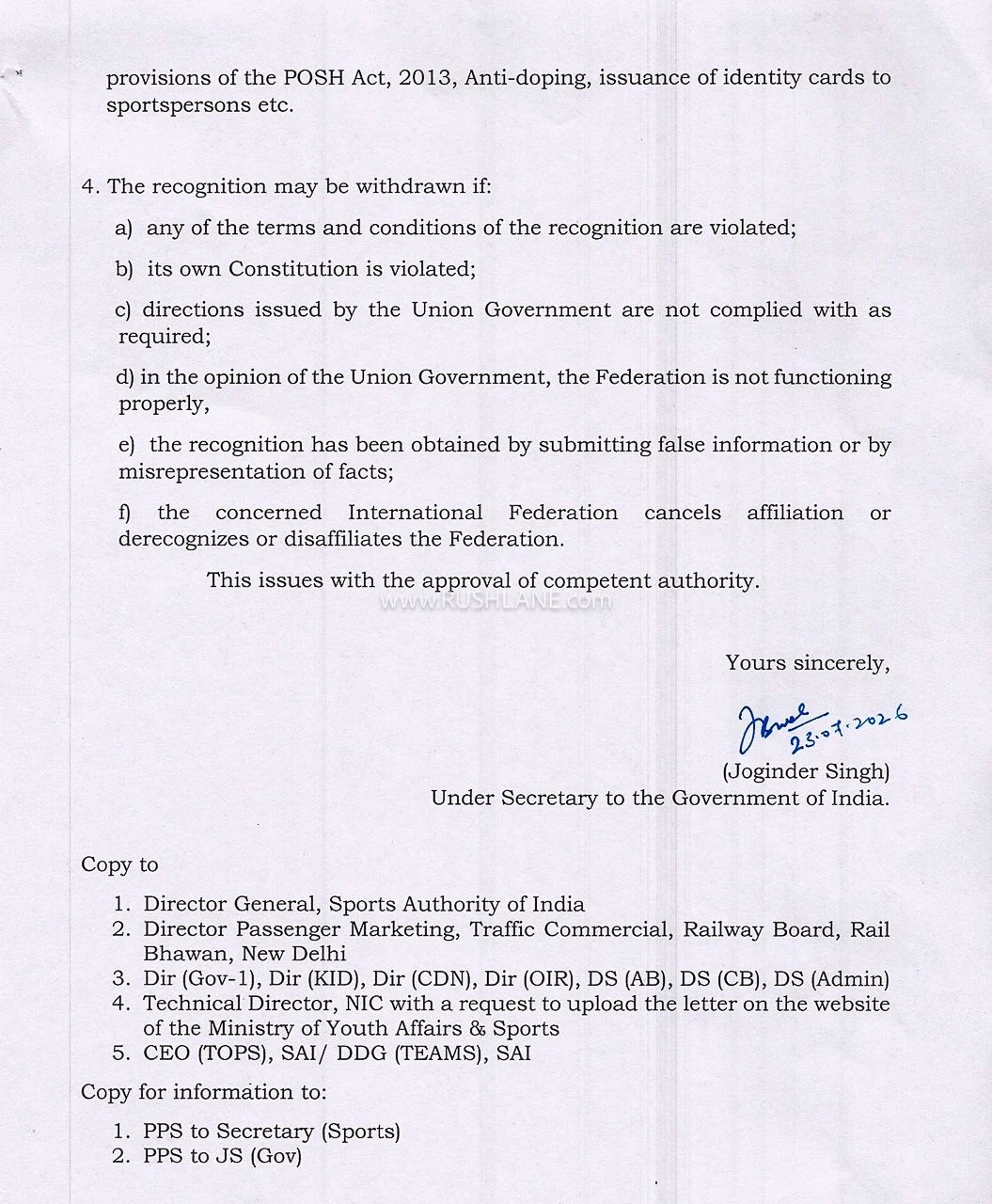
NEW DELHI – In a move set to redefine the landscape of high-performance racing in the Indian subcontinent, the Government of India has officially granted provisional recognition to the Federation of Motor Sports Clubs of India (FMSCI) as a National Sports Federation (NSF). This landmark decision, formalized by the Ministry of Youth Affairs & Sports (MYAS), marks a pivotal shift in how motorsport is governed, funded, and perceived within the country’s broader sporting ecosystem.
The recognition arrives at a critical juncture as India intensifies its efforts to revitalize its international racing profile, with whispers of a Formula 1 return and the expansion of the MotoGP Bharat initiative gaining significant momentum. By elevating the FMSCI to NSF status, the government has effectively transitioned motorsport from a niche, industry-led activity into a recognized national sporting discipline, aligning it with the likes of cricket, athletics, and hockey.
1. Main Facts: The Scope of the Recognition
The official communication, issued by the Ministry of Youth Affairs & Sports and dated July 23, 2026, confirms that the FMSCI is now the authorized body for the promotion and development of motorsport in India. This recognition is "provisional" and is subject to a series of stringent compliance measures designed to modernize the federation’s governance.
Key Highlights of the NSF Status:
- Official Mandate: The FMSCI is now the primary vehicle for implementing government-led sports policies within the racing sector.
- Regulatory Relaxation: To facilitate this transition, the government has exercised its power to relax specific provisions of the National Sports Development Code of India, 2011. This includes temporary waivers regarding the mandatory affiliation across two-thirds of India’s States and Union Territories.
- Institutional Alignment: The recognition requires the FMSCI to align its Constitution and Memorandum of Association with the National Sports Governance Act, 2025.
- Financial Oversight: The federation’s accounts are now subject to audits by Chartered Accountants empanelled with the Comptroller & Auditor General (CAG) of India, ensuring a level of transparency previously unseen in the sector.
2. Chronology: The Road to Recognition
The journey toward NSF status has been a decades-long pursuit for the FMSCI, often hampered by the historical classification of motorsport as an "entertainment" or "luxury" activity rather than a sport.

- 2011–2013: India hosts three successful Formula 1 Grands Prix at the Buddh International Circuit (BIC). However, a lack of NSF status leads to tax disputes, as the event is classified as "entertainment."
- 2015: The FMSCI was briefly recognized as an NSF, but the status was not consistently maintained or leveraged due to evolving government codes and internal governance challenges.
- 2023: The successful hosting of the inaugural MotoGP Bharat at the BIC reignites interest in federal support for motorsport.
- Early 2025: The introduction of the National Sports Governance Act, 2025, creates a new framework for sports bodies to seek government backing.
- June 11, 2026: The FMSCI formally submits its request for NSF recognition to the Ministry of Youth Affairs & Sports.
- July 23, 2026: The Ministry issues the official letter granting provisional NSF status, effective immediately.
3. Supporting Data and Compliance Framework
The granting of NSF status is not a blank check; it is a conditional agreement that places the FMSCI under the microscope of the Union Government. The Ministry has outlined specific data-driven and regulatory requirements that the federation must meet to retain its standing.
Relaxed Provisions
Under the National Sports Development Code of India, 2011, several requirements were waived to allow the FMSCI to qualify:
- State Affiliation: The requirement to have active, affiliated units in at least two-thirds of the states in India.
- District Units: The mandate for state-level units to have a specific number of affiliated district-level associations.
- Membership Restrictions: Certain restrictions regarding the composition of the federation’s membership were eased to accommodate the unique structure of motor clubs.
The Compliance Roadmap
To move from "provisional" to "permanent" status, the FMSCI must adhere to the following:
- Constitutional Amendments: Updating internal bylaws to match the 2025 Governance Act.
- Electoral Transparency: Adhering to government guidelines for the election of office bearers, including age and tenure limits.
- Anti-Doping and Ethics: Strict implementation of World Anti-Doping Agency (WADA) and National Anti-Doping Agency (NADA) regulations.
- RTI Compliance: The federation must now come under the ambit of the Right to Information (RTI) Act, ensuring public access to its decision-making processes.
4. Official Responses and Government Vision
The Ministry of Youth Affairs & Sports has characterized this move as a strategic investment in India’s "soft power" and industrial prowess.

The Ministry’s Perspective
In the official letter, the Ministry emphasized that the FMSCI now carries a "major role" in the promotion of the sport. Officials have indicated that this recognition is part of a larger vision to integrate motorsport into the "Khelo India" framework, potentially introducing karting at the grassroots level to identify young talent early.
The Task Force Initiative
Coinciding with the NSF recognition, the government recently announced a dedicated Motorsport Task Force. This body is tasked with:
- Infrastructure Assessment: Evaluating the current state of tracks like the BIC (Noida), MMRT (Chennai), and Kari Motor Speedway (Coimbatore).
- Investment Feasibility: Analyzing the potential for Foreign Direct Investment (FDI) in the automotive and racing sectors.
- Tourism Impact: Projecting the economic benefits of "Sports Tourism" through major international events.
FMSCI Leadership
While a formal press conference is expected in the coming days, sources within the FMSCI suggest the federation views this as a "redemption moment." The recognition provides the legal and political leverage required to negotiate with international bodies like the FIA (Federation Internationale de l’Automobile) and FIM (Federation Internationale de Motocyclisme) with the full weight of the Indian state behind them.
5. Implications: What This Means for the Future
The implications of NSF status for the FMSCI extend far beyond administrative paperwork. It fundamentally changes the economics and logistics of racing in India.

The Return of Formula 1
Perhaps the most significant implication is the paved way for Formula 1’s return, potentially by 2028. One of the primary hurdles for the original Indian Grand Prix was the lack of government recognition, which led to astronomical customs duties on equipment and tax liabilities for teams. As an NSF-recognized sport, the FMSCI can now facilitate smoother customs clearances and potentially secure tax exemptions for international events, categorizing them as "national importance" rather than commercial entertainment.
Grassroots and Athlete Development
For aspiring Indian racers, NSF status is a game-changer.
- Funding: Athletes may now be eligible for government grants, scholarships, and inclusion in the Target Olympic Podium Scheme (TOPS) if motorsport disciplines (like electric karting) gain Olympic traction.
- Licensing: The process of obtaining international competition licenses will be more streamlined, with better coordination between the FMSCI and the Ministry of External Affairs for athlete visas.
Infrastructure and Industry
With government backing, private developers are more likely to invest in Grade 1 and Grade 2 racing circuits across the country. This also ties into the "Make in India" initiative, encouraging automotive giants like Tata, Mahindra, and Hero to further invest in racing technologies that can eventually trickle down to consumer vehicles.
Risks of Non-Compliance
The government has been clear that this recognition can be withdrawn at any moment. Grounds for withdrawal include:

- Violation of the National Sports Code.
- Financial mismanagement or failure to audit accounts via CAG-empanelled firms.
- Loss of affiliation with the FIA or FIM.
- Misrepresentation of facts during the application process.
Conclusion
The provisional recognition of the FMSCI as a National Sports Federation is more than a bureaucratic milestone; it is a declaration of intent. It signals that India is ready to stop being a spectator in the global motorsport arena and start being a powerhouse. By bringing the FMSCI into the fold of the Ministry of Youth Affairs & Sports, the government has provided the sport with the legitimacy it has craved for decades.
As the FMSCI begins the arduous task of amending its constitution and aligning with the 2025 Act, the eyes of the racing world will be on India. If successful, this transition could ensure that the roar of engines at the Buddh International Circuit becomes a permanent fixture on the global calendar, fostering a new generation of Indian speedsters on the world stage.
