

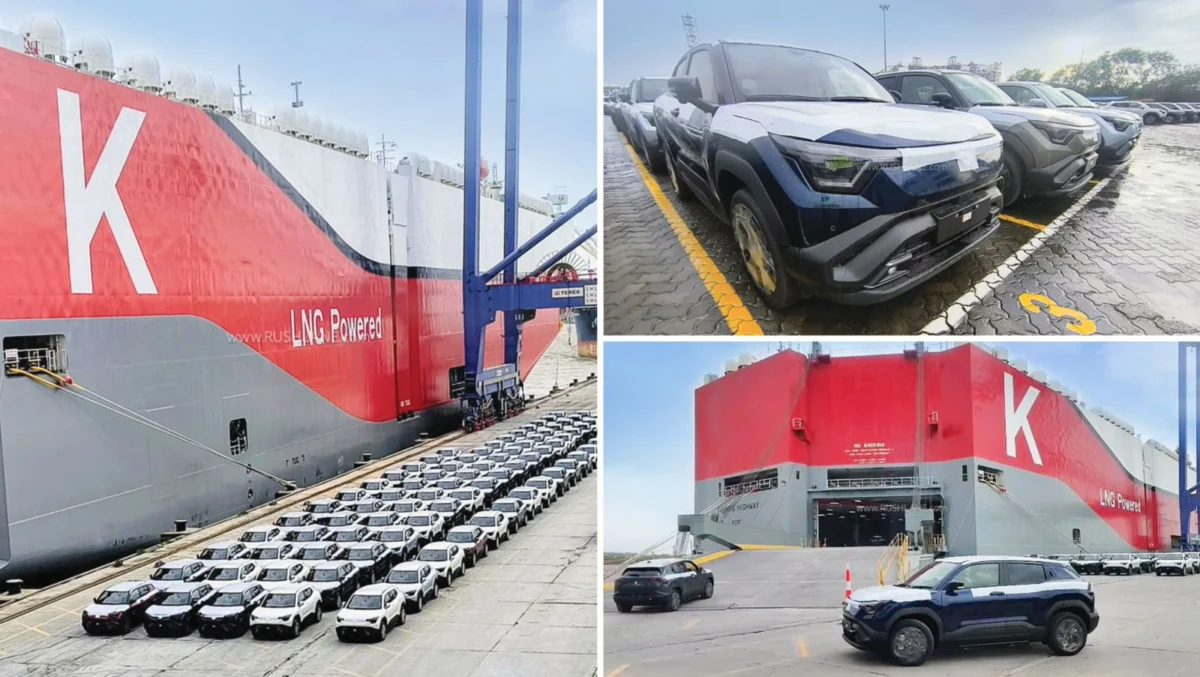
The landscape of the Indian automotive industry is undergoing a profound transformation, evolving from a domestic-centric market into a formidable global manufacturing hub. The export data for the second quarter (Q2) of the 2026 calendar year (spanning April to June) underscores this shift, revealing a sector that is not only growing in volume but also diversifying in technology and global reach. With a total of 2,22,368 passenger vehicles shipped to international shores, the quarter marks a pivotal moment in India’s journey toward becoming the "world’s garage."
Main Facts: A Quarter of Robust Growth and EV Milestones
In Q2 2026, India’s passenger vehicle exports reached a significant milestone, totaling 2,22,368 units. This represents an 8.86% year-on-year (YoY) increase compared to the 2,04,265 units exported during the same period in 2025. The growth was even more pronounced among the "Top 40" exported models, which collectively accounted for 2,19,262 units—an 11.20% jump from the 1,97,177 units recorded in Q2 2025.
The Dominance of the Top 40
The concentration of export volume is striking. The top 40 models represent a staggering 98.6% of India’s total passenger vehicle exports. This suggests that while the industry is broad, a select group of high-demand models from a handful of manufacturers is driving the bulk of the foreign exchange earnings.
Maruti Suzuki’s Unrivaled Leadership
Maruti Suzuki continues to be the locomotive of Indian car exports. In Q2 2026, the company exported 1,22,967 units among the top 40 models, commanding a 55.3% market share of the export pie. The Maruti Suzuki Fronx retained its crown as India’s most exported car, with 23,803 units finding homes in international markets like Latin America, the Middle East, and Southeast Asia.
The Electric Revolution: The eVitara Debut
Perhaps the most significant development of the quarter was the entry of the Maruti eVitara into the export charts. Debuting at the number three spot with 15,210 units, the eVitara represents Suzuki’s strategic pivot toward making India a primary manufacturing base for global Electric Vehicles (EVs). This is the first time a Made-in-India electric SUV has entered the top three of the export rankings, signaling a new era for the "Make in India" initiative.
Chronology: The Evolution of India’s Export Strategy
To understand the success of Q2 2026, one must look at the timeline of India’s automotive evolution over the last few years.
- 2020–2022: The Resilient Recovery. Following the global supply chain disruptions of the pandemic, Indian OEMs (Original Equipment Manufacturers) began diversifying their supply chains and de-risking from single-source dependencies.
- 2023–2024: The SUV Pivot. Manufacturers realized that global demand was shifting decisively toward SUVs and crossovers. Maruti Suzuki launched the Fronx and the Jimny 5-door, specifically eyeing international markets.
- 2025: Infrastructure and Policy Alignment. The Indian government’s Production Linked Incentive (PLI) scheme for the automotive sector began to bear fruit, encouraging manufacturers to produce advanced technology components and EVs locally.
- Q2 2026: The Global Harvest. The current quarter represents the "harvest period" of these strategies. The massive volume of eVitara exports is the result of years of R&D and factory retooling at Suzuki’s Gujarat plant, aimed specifically at European and Japanese standards.
Supporting Data: Winners, Losers, and the "Low Base" Phenomena
The Q2 2026 data provides a granular look at how individual models and brands are performing on the world stage.

The High Flyers
Beyond the Fronx and eVitara, several models posted exceptional growth:
- Maruti Jimny: Secured second place with 21,840 units, a 46.45% increase. Its niche appeal as a rugged, compact off-roader continues to resonate in markets with challenging terrains.
- Maruti Dzire: Despite being an older nameplate, the Dzire saw a 30.84% rise to 10,798 units, proving that the demand for reliable, fuel-efficient sedans remains strong in developing economies.
- Honda City & Elevate: Honda has successfully repositioned its Indian operations as an export hub. The City surged by 171.08% (3,234 units), while the Elevate SUV grew by 36.26% (3,649 units), with a significant portion of these units likely headed to the Japanese market.
- Tata Tiago: Recorded a jaw-dropping 1,473.98% growth. However, analysts note this is due to a "low base effect," as the model had very low export volumes (123 units) in the previous year.
Notable Declines
The quarter was not without its casualties. Several erstwhile popular models saw their export volumes contract:
- Maruti Grand Vitara: Witnessed a massive 80.40% decline (dropping from 4,841 to 949 units). This is likely due to the production shift toward the eVitara and internal competition within the Suzuki global lineup.
- Nissan Sunny: Once an export stalwart, it plummeted by 69.48%.
- Hyundai Verna & Creta: Hyundai, while remaining the second-largest exporter, saw a 19.24% overall decline. The Verna fell by 39.39% and the Creta by 43.11%, suggesting a shift in Hyundai’s global sourcing strategy or a temporary cooling of demand in its primary export destinations.
OEM Performance Breakdown
| Manufacturer | Q2 2026 Units (Top 40) | Growth Sentiment |
|---|---|---|
| Maruti Suzuki | 1,22,967 | Dominant / Expanding |
| Hyundai | 38,401 | Declining / Consolidation |
| Renault | 6,289 | High Growth (+131%) |
| Honda | 6,883 | Strong Growth (+77%) |
| Kia | 7,467 | Moderate Growth (+24%) |
Official Responses and Industry Perspectives
While specific executive quotes were not released in the raw data, industry analysts and trade bodies like the Society of Indian Automobile Manufacturers (SIAM) have previously hinted at the drivers behind these trends.
On the EV Shift:
Industry experts suggest that the eVitara’s success is a "litmus test" for India. "The fact that over 15,000 units were shipped in a single quarter suggests that international markets now perceive Indian-made EVs as meeting global quality and safety benchmarks," noted a senior automotive consultant.
On Trade Agreements:
The Ministry of Commerce and Industry has frequently pointed to the benefits of Free Trade Agreements (FTAs) and the ‘Made in India’ branding. Officials have expressed that the goal is to increase the automotive sector’s contribution to India’s GDP from the current 7% to 12% by 2030, with exports playing a critical role.
On the SUV Trend:
OEM spokespeople have consistently emphasized a "premiumization" of the export portfolio. Instead of exporting only entry-level hatchbacks, the focus has shifted to high-margin SUVs like the Fronx, XUV 3XO, and Seltos, which offer better realizations per unit.
Implications: What This Means for the Future
The Q2 2026 export data carries several long-term implications for the Indian economy and the global automotive landscape.

1. India as a Global EV Hub
The debut of the eVitara is a watershed moment. If Maruti Suzuki can maintain this momentum, other manufacturers like Hyundai, Tata, and Mahindra are likely to accelerate their export-oriented EV programs. This positions India as a direct competitor to China in the affordable electric vehicle segment for global markets.
2. Economic Resilience through Diversification
The growth in exports provides a crucial buffer for Indian automakers. When domestic demand fluctuates due to local economic factors or monsoon variations, a robust export channel ensures that manufacturing plants continue to operate at high capacity, maintaining employment and economies of scale.
3. Quality Perception Shift
For decades, Indian exports were synonymous with "budget" vehicles. The success of sophisticated models like the Kia Seltos, Honda Elevate, and VW Virtus (despite its quarterly dip) indicates that the "Made in India" tag is now associated with global engineering standards.
4. The Challenges Ahead: Logistics and Protectionism
Despite the positive trajectory, challenges remain. Rising freight costs and geopolitical tensions in key shipping lanes (like the Red Sea) could impact the cost-competitiveness of Indian exports. Furthermore, as Indian exports grow, they may face protectionist hurdles or stricter "Rules of Origin" in certain trade blocs.
Conclusion
The Q2 2026 export figures paint a picture of an industry in ascendancy. Driven by Maruti Suzuki’s strategic foresight and a national push toward electrification, India is no longer just a large consumer market—it is a critical cog in the global automotive supply chain. The coming quarters will be vital to see if the eVitara can maintain its podium finish and if other manufacturers can reverse their declines to join the growth surge. For now, the "wheels of India" are turning faster than ever on the global stage.
