

Introduction: The New Standard in Modern Flooring
In the rapidly evolving world of Indian interior design, a new contender has emerged to challenge the long-standing dominance of vitrified tiles and natural marble. If you have stepped into a modern apartment renovation or browsed architectural digests in the last year, the term "SPC Flooring" has likely surfaced. Stone Plastic Composite (SPC) flooring is no longer just a niche alternative; it has become the centerpiece of discussions among architects, interior designers, and homeowners alike.
As India moves toward more efficient, aesthetic, and durable housing solutions, SPC flooring represents a technological leap in "resilient flooring." It promises the warmth of hardwood and the elegance of stone without the prohibitive costs or high-maintenance requirements traditionally associated with premium materials. This report explores the technical composition, market dynamics, and the practical implications of adopting SPC flooring in the Indian context.
1. Technical Composition: What Makes SPC "Rigid"?
The primary confusion among consumers is the assumption that SPC is merely a renamed version of traditional vinyl or PVC flooring. However, the "Stone" in Stone Plastic Composite is the defining factor. Unlike traditional vinyl, which is flexible and soft, SPC is a rigid core luxury vinyl.
A single plank of SPC is an engineered marvel, typically consisting of five distinct layers fused together under high pressure:
- UV Coating: The topmost layer provides a shield against fading from sunlight and prevents stains. In the Indian climate, where large windows often expose floors to harsh UV rays, this layer is critical for longevity.
- The Wear Layer: This transparent layer determines the floor’s resistance to scratches and scuffs. For residential use, a 0.3mm layer is standard, while high-traffic commercial spaces often utilize a 0.5mm layer.
- Decorative Vinyl Film: This is where the aesthetics live. High-definition printing technology allows this layer to mimic the textures and grains of oak, walnut, teak, or even industrial concrete with startling realism.
- The SPC Core: The heart of the plank. It is created by combining natural limestone powder, polyvinyl chloride, and stabilizers. This core is incredibly dense, providing the "rigid" feel and ensuring the plank does not expand or contract significantly with temperature changes.
- Attached Underlayment (IXPE/EVA): Most premium SPC planks come with a pre-attached foam or rubber backing. This provides acoustic insulation, making the floor "quiet" to walk on, and offers a slight cushioning effect.
2. Chronology: The Evolution of Resilient Flooring in India
To understand the current SPC boom, one must look at the timeline of flooring preferences in urban India:
- The Era of Natural Stone (Pre-2000s): Indian homes were dominated by marble, granite, and mosaic (terrazzo). While durable, these materials required heavy masonry work, polishing, and were susceptible to staining.
- The Ceramic & Vitrified Revolution (2000s–2015): The market shifted toward factory-made tiles. They offered consistency and lower prices but remained "cold" underfoot and required messy cement-based installation.
- The Laminate and PVC Phase (2010–2020): Homeowners seeking a "wooden look" turned to laminate flooring. However, laminate’s Achilles’ heel was water; a single pipe leak could ruin an entire floor. Traditional PVC (Vinyl) rolls were also popular but were often seen as "cheap" or "temporary" due to their thinness and tendency to dent.
- The SPC Emergence (2020–Present): With the post-pandemic surge in home renovations and a DIY-friendly mindset, SPC entered the market as the "perfect" hybrid—waterproof like tile, but warm and easy to install like wood.
3. Supporting Data: The Economics of SPC Flooring in India (2025-2026)
The financial viability of SPC flooring is a major driver of its adoption. While the initial material cost might be higher than basic ceramic tiles, the "total cost of ownership" tells a different story.
Projected Cost Breakdown for 2026 (INR per Square Foot)
| Expense Head | Cost Range (Rs./sq. ft.) | Key Price Drivers |
|---|---|---|
| SPC Material | Rs. 95 – Rs. 250 | Thickness (4mm to 6.5mm), Wear layer microns, Brand. |
| Labor for Fitting | Rs. 15 – Rs. 35 | City tier, complexity of the layout (herringbone vs. straight). |
| Skirting & Profiles | Rs. 25 – Rs. 45 | Matching wood-finish accessories vs. standard PVC. |
| Floor Levelling | Rs. 10 – Rs. 30 | Condition of the existing subfloor (screeding requirements). |
| Total Installed Cost | Rs. 130 – Rs. 320 | Final all-inclusive estimate. |
Comparative Perspective:
A standard 300 sq. ft. master bedroom renovation using SPC flooring would cost approximately Rs. 45,000 to Rs. 85,000. In comparison, high-end Italian marble would cost three times as much when factoring in polishing and specialized labor, while traditional hardwood would require significant long-term maintenance costs that SPC avoids entirely.
4. Official Responses and Industry Perspectives
Industry experts suggest that the shift toward SPC is driven by the "Resilient Flooring" trend.
Architectural Insights:
"We are seeing a 40% increase in client requests for SPC flooring over the last two years," says Neha Kapoor, a Mumbai-based interior architect. "The primary reason is the ‘Zero-Downtime’ factor. In a city like Mumbai, where renovation time is at a premium, being able to floor a 2BHK in 48 hours without dust or debris is a massive selling point."
Manufacturing Trends:
Leading Indian flooring distributors note that while early SPC stock was largely imported from China and Vietnam, domestic manufacturing is ramping up. This shift is expected to stabilize prices and provide more designs tailored to Indian tastes, such as patterns that mimic local stone or traditional Indian hardwoods like Sheesham.
The Sustainability Argument:
Environmental consultants point out that SPC is often more eco-friendly than laminate. "Because SPC is formaldehyde-free and the core is largely made of limestone, it has a lower chemical footprint," notes an environmental compliance officer from a leading building materials firm. "Furthermore, the fact that it can be uninstalled and reused in a different location makes it a favorite for the ‘circular economy’ in the rental market."
5. Installation Nuances: The Click-Lock Revolution
The "Official Response" from the labor market suggests that SPC is solving a massive skilled-labor shortage. Traditional tiling requires a skilled mason, a helper, and days of curing time.
SPC utilizes a Click-Lock System (often Uniclic or Valinge systems). This tongue-and-groove mechanism allows planks to snap together securely.
The Professional Installation Process:
- Site Preparation: The existing floor (tiles, concrete, or stone) must be "level." If there is a variation of more than 2-3mm, a self-levelling compound is applied.
- Acclimatization: Planks are usually kept in the room for 24-48 hours to adjust to the room’s temperature and humidity.
- The Layout: An expansion gap of 5-8mm is left at the edges to allow for natural movement.
- Snapping: Planks are clicked together. No adhesive is used, meaning the floor is "floating."
- Finishing: Skirting boards and "T-offsets" are installed to cover the expansion gaps.
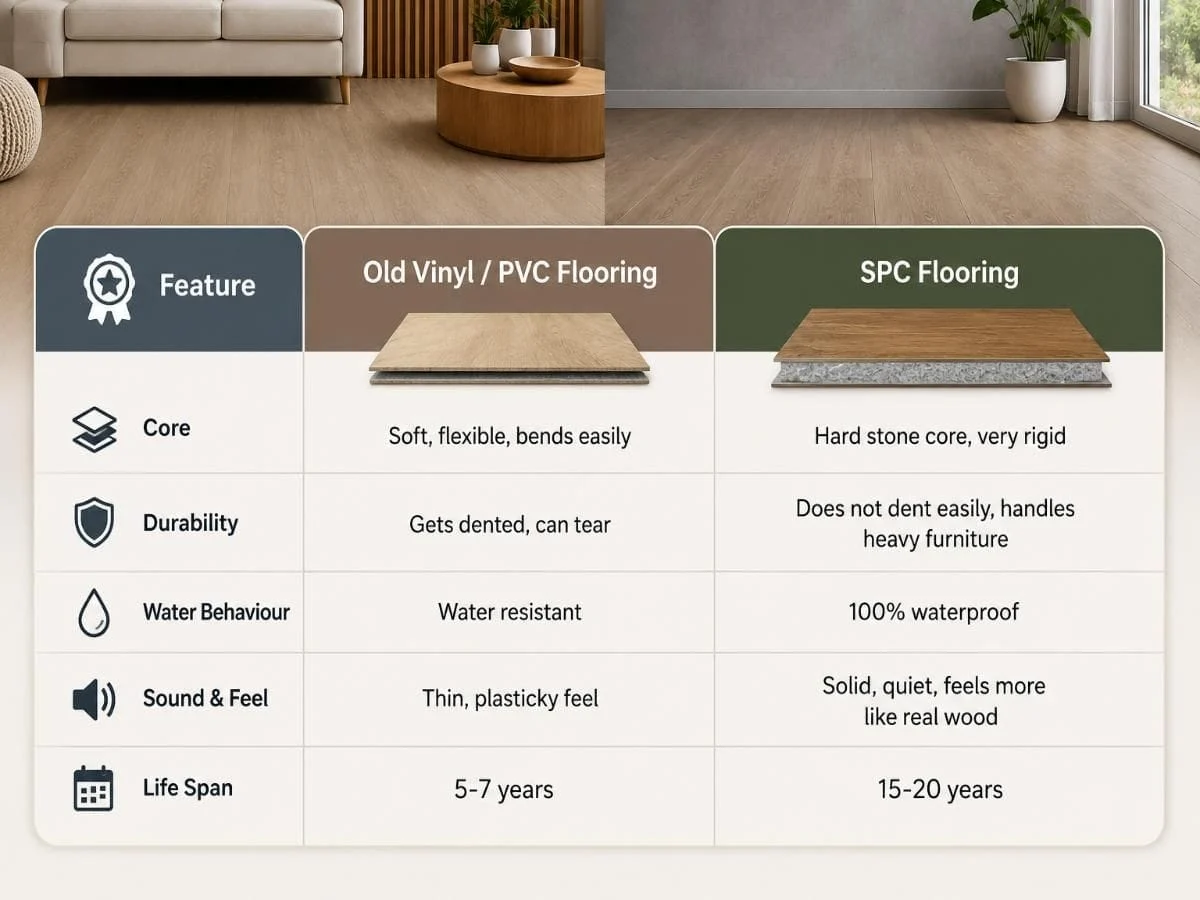
6. SPC vs. Traditional Vinyl: A Critical Comparison
For the consumer, the choice often boils down to: "Why pay more for SPC than standard Vinyl?"
- Dimensional Stability: In the intense Indian summer, standard vinyl can expand and "bubble." SPC’s stone core remains rigid and stable up to 50-60 degrees Celsius.
- Indentation Resistance: Heavy furniture—like a solid teak wardrobe or a piano—will leave permanent dents in soft vinyl. SPC is virtually dent-proof due to its high-density core.
- Waterproof Nature: While both are water-resistant, SPC is 100% waterproof. It can be installed in kitchens and even laundry areas without the risk of the core swelling.
- Lifespan: A standard vinyl floor in a high-traffic Indian household lasts 5-7 years. An SPC floor is rated for 15-25 years in residential settings.
7. Implications for the Future of Indian Real Estate
The rise of SPC flooring has broader implications for the Indian property market:
1. The Rental Market Transformation:
Landlords are increasingly opting for SPC. It allows them to upgrade the "premium feel" of an apartment between tenants quickly. If a tenant damages a single plank, that specific plank can be replaced without tearing up the entire floor—a feat impossible with marble or vitrified tiles.
2. The "Acoustic" Apartment:
As high-rise living becomes the norm in cities like Bangalore, Delhi-NCR, and Hyderabad, floor-to-floor noise is a common complaint. The IXPE backing on SPC planks significantly reduces "impact noise" (footsteps, objects dropping), leading to quieter residential complexes.
3. Health and Hygiene:
Post-pandemic, the "easy-to-clean" factor is paramount. SPC’s non-porous surface does not harbor dust mites or allergens, and its resistance to harsh floor cleaners makes it a more hygienic choice for families with toddlers or pets.
Final Verdict
SPC flooring represents the democratization of luxury. It has successfully bridged the gap between the high-end aesthetic of natural wood and the rugged practicality required for the Indian household. As costs stabilize and domestic production increases, SPC is poised to move from a "trendy alternative" to the "standard specification" for modern Indian homes. For the homeowner of 2026, the choice is no longer just about color or price; it is about choosing a floor that survives the realities of life while maintaining the elegance of a showroom.
