

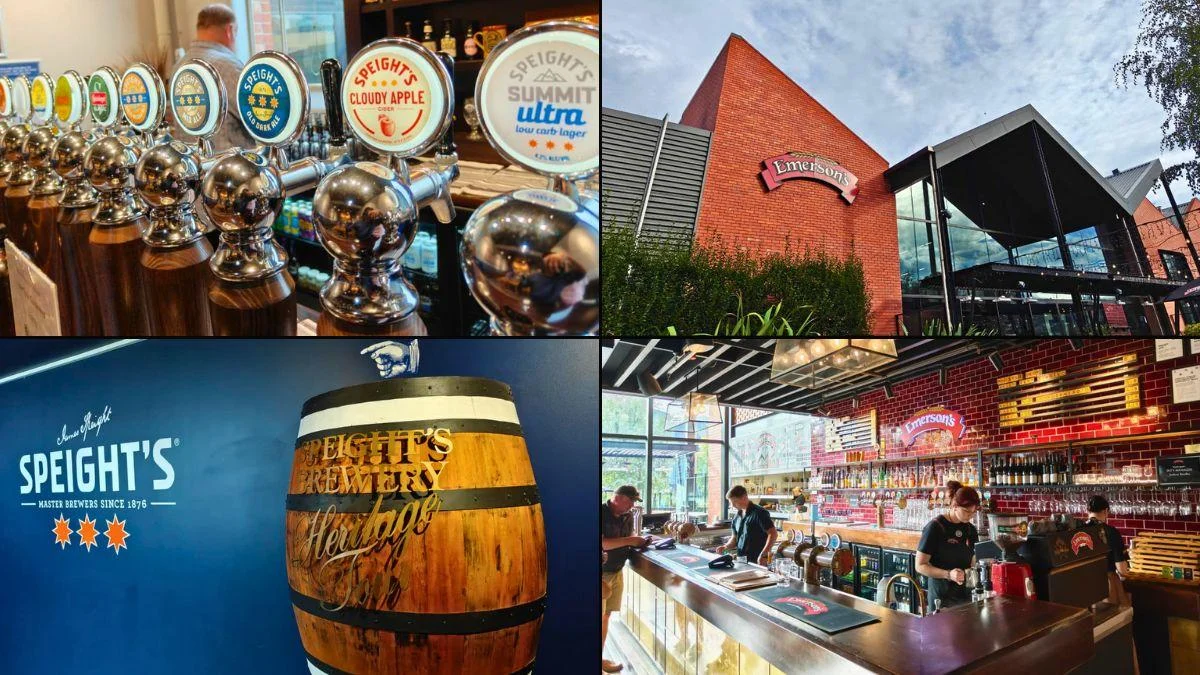
In the heart of Dunedin, on New Zealand’s rugged South Island, a peculiar sight greets passersby on Rattray Street. Drivers pull their vehicles to the curb, not for a parking spot, but to approach a unassuming public tap situated outside a massive brick edifice. This is no ordinary utility; it is a direct conduit to an underground aquifer, pumping untreated, non-chlorinated, and non-fluoridated spring water straight from the earth. For the residents of Dunedin, this free resource is more than just hydration—it is the raw, elemental soul of the city’s most famous export: beer.
This tap is siphoned through the historic Speight’s Brewery, an institution that has occupied the same site since 1876. In Dunedin, a city often called the "Edinburgh of the South" due to its Scottish heritage and Gaelic name (Dùn Éideann), beer is not merely a commodity. It is a cultural anchor, a historical record, and a social glue that binds the university students, the rugby fans, and the working class into a singular regional identity.
Main Facts: The Dual Pillars of Dunedin Brewing
Dunedin’s brewing landscape is dominated by two distinct but interconnected forces: Speight’s Brewery and Emerson’s Brewery. While they represent different eras and philosophies of beer making, they share a geographical and corporate reality that defines the city’s modern economy.

Speight’s Brewery: The Institutional Giant
Founded nearly 150 years ago, Speight’s is the "Pride of the South." It is the largest selling beer brand in New Zealand, with its Gold Medal Ale serving as a staple in pubs from the tip of the North Island to the bottom of the South. Speight’s is characterized by its massive scale, producing 164,000 liters of product in a single day’s brew. Its identity is inextricably linked to the "Southern Man"—a stoic, hyper-masculine archetype of the South Island high country.
Emerson’s Brewery: The Craft Pioneer
Founded in 1992 by Richard Emerson, this brewery represents the "new frontier" of New Zealand’s craft beer revolution. Emerson’s focuses on European-style ales, pilsners, and stouts, often produced in smaller, flavor-focused batches. Despite its smaller scale compared to Speight’s, it produces roughly 2.7 million liters annually and serves as a vital social hub for the city’s university district.
The Lion Connection
In a twist of corporate irony, both breweries—the mainstream giant and the craft insurgent—operate under the umbrella of Lion, an Australasian beverage giant owned by the Japanese conglomerate Kirin. This allows them to share distribution networks and supply chains while maintaining fiercely independent brand identities and "healthy rivalries" within the local market.

Chronology: From Gold Rushes to Craft Revolutions
The history of brewing in Dunedin is a reflection of the city’s own evolution from a colonial outpost to a prosperous Victorian center, and finally to a modern educational and cultural hub.
1876: The Great Gamble
The story of Speight’s began with a moment of professional rebellion. James Speight (a salesman), Charles Greenslade (a maltster), and William Dawson (a brewer) walked out of their jobs at Dunedin’s Well Park Brewery to strike out on their own. They secured a disused bottling house on Rattray Street and began brewing their first batch weeks before they even had a lease or a license.
This "reckless" beginning coincided with the tail end of the Otago Gold Rush, which had transformed Dunedin into New Zealand’s wealthiest city. By the 1890s, Speight’s had outpaced all local competitors to become the largest brewery in the country, even commissioning its own merchant ship to transport barrels to the North Island.

1992: The Kitchen Stove Catalyst
Over a century later, the brewing scene had become stagnant and dominated by mass-produced lagers. Richard Emerson, having traveled to Scotland and experienced the depth of European ales, returned to Dunedin frustrated by the lack of variety. He began experimenting on a kitchen stove, later graduating to repurposed dairy equipment.
Emerson’s Brewery was born out of this desire for "real" beer. Much like the founders of Speight’s, Emerson’s operation was nomadic at first, moving through various sites in Dunedin as demand grew, but always remaining within the city limits. This commitment ensured that as the "craft" movement took off globally, Dunedin was already at the forefront.
Supporting Data: The Mechanics of Scale
The disparity and synergy between these two operations can be seen in the raw data of their production cycles.

Production and Automation at Speight’s
Marty McPate, a long-time representative at Speight’s, highlights the sheer volume required to maintain their market dominance. "A day’s brew is 164,000 liters of product, which is 1,250-liter kegs per brew," McPate notes. To achieve this, the brewery operates 24/7 on three overlapping shifts.
While the old brew floor required manual cleaning and could only handle a few batches a day, the modern facility is highly automated. This allows for 6 to 8 brews in a 24-hour period. Despite this automation, the brewery retains a "human" element, with many staff members having worked on-site for decades, preserving traditional techniques within a high-tech environment.
The Craft Volume of Emerson’s
At Emerson’s, the scale is different but no less impressive for a craft operation. Tour guide Ella Walker notes that the brewery produces approximately 2.7 million liters of beer annually. Their flagship Pilsner accounts for nearly half of that total, with weekly volumes reaching 20,000 to 30,000 liters.

The ingredients are a point of data-driven pride. Emerson’s utilizes New Zealand-grown hops to produce signature citrus notes, while importing American hops for more tropical flavor profiles. This blend of local and global sourcing allows them to compete in a niche that values complexity over sheer volume.
Official Responses: Voices from the Brewhouse
The people who represent these breweries provide the clearest insight into how these brands function as cultural signifiers.
Marty McPate on Brand Dominance
According to McPate, Speight’s currently holds approximately 75% of the market share against its primary competitors in the region. He explains the strategic decision to remain domestic: "We don’t export our beer at all. One of the reasons is we own a lot of other breweries in Australia, so we don’t want to be competing against that market."

This focus on the domestic market has allowed Speight’s to lean heavily into cultural marketing. The "Southern Man" campaign, which featured posters and television ads of rugged men in the wilderness, embedded the beer into the national psyche. Furthermore, their sponsorship of the Highlanders rugby team and the Otago Rugby Football Union has made a pint of Speight’s the "official" post-match ritual for generations.
Ella Walker on Niche Loyalty
At Emerson’s, Ella Walker emphasizes that their brand is built on stories and community. "It’s good for these beers to have that bit of backstory," she says. She points to labels like the ‘Bookbinder,’ named after a local artisan, and the ‘Bird Dog,’ a tribute to a song by the legendary Dunedin band The Verlaines.
Walker acknowledges the relationship with Speight’s with professional nuance. "We definitely do see them as competition at times, but we sell different styles of beer. Speight’s is more mainstream and this is definitely niche, but we are both sister breweries." This "sisterhood" under the Lion corporate structure allows for occasional collaborations and shared supply chains, even as they fight for different "shares of throat" in the city’s pubs.

Implications: Beer as the Texture of the City
The coexistence of Speight’s and Emerson’s in a city of only 130,000 people has profound implications for Dunedin’s social and economic fabric.
1. The Localization of Global Brands
The Dunedin brewing scene serves as a counter-narrative to globalization. While brands like Guinness are brewed under license in dozens of countries, losing some of their "terroir" in the process, Dunedin’s breweries have done the opposite. They have rooted themselves so deeply in the local texture—using the local spring water, sponsoring the local teams, and naming beers after local musicians—that the product feels inseparable from the place.
2. Social Hubs and Urban Planning
The breweries act as "social nodes" that dictate the flow of the city. Emerson’s proximity to the Forsyth Barr Stadium and the University of Otago makes it a primary destination for a diverse demographic. On game days or during the Dunedin Marathon, the brewery becomes the finish line for the city’s collective energy.

3. Cultural Preservation
In a world of rapidly shifting consumer tastes, Speight’s has managed to preserve a specific version of New Zealand identity. While the "Southern Man" archetype is often debated in modern contexts, it remains a powerful piece of pop-culture history that keeps the brewery relevant. Meanwhile, Emerson’s ensures that the city remains forward-looking, attracting younger generations who value artisanal craft and experimental flavors.
Ultimately, the act of drinking a beer in Dunedin is an act of engaging with the city’s history. Whether it is the free spring water from the Rattray Street tap or a ‘London Porter’ in a crowded taproom, the liquid heritage of the "Edinburgh of the South" remains its most potent and enduring legacy. As the locals say, whichever pint you choose, it is bound to be a "jolly good pour."
