

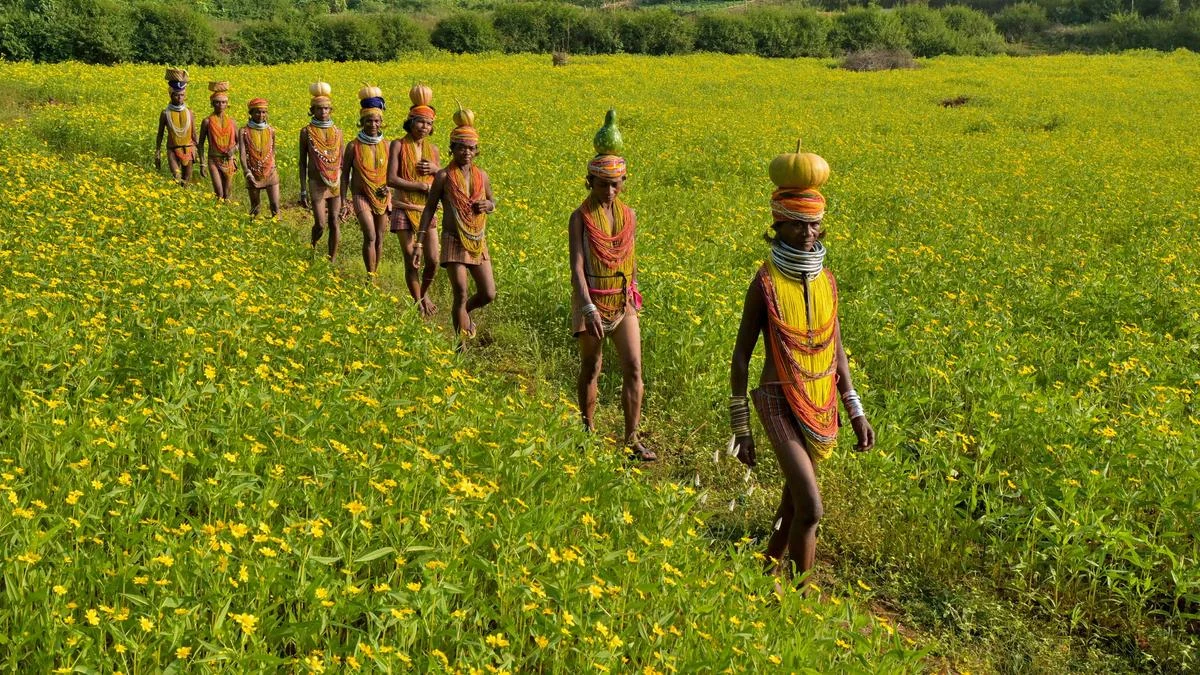
MALKANGIRI, ODISHA — In the mist-shrouded heights of the Bonda Hills, where the Eastern Ghats roll through the Malkangiri district of Odisha, an ancient rhythm persists. It is the rhythmic thrum of the indigenous loom, a sound that has echoed through these valleys for millennia. For Muduli, a weaver in the village of Gokharipada, the act of weaving is not merely a chore; it is an act of historical preservation.
“Every Ringa we weave carries our family’s story,” Muduli says, her weathered hands moving with practiced grace over a freshly completed textile. The Ringa, a striking wraparound skirt characterized by bold horizontal stripes of red, maroon, black, white, and blue, is the quintessential emblem of the Bonda people.
As one of India’s 75 Particularly Vulnerable Tribal Groups (PVTGs), the Bondas represent one of the world’s most secluded and culturally distinct communities. Yet, as the modern world edges closer to their remote highlands, the Ringa—and the ancient weaving tradition it represents—stands at a critical crossroads between cultural survival and the relentless tide of globalization.
Main Facts: The Identity of the Ringa
The Ringa is more than a garment; it is a visual language. Historically, Bonda women were known for wearing only these handwoven strips of cloth, complemented by voluminous layers of colorful bead necklaces and heavy aluminum neck rings. While modern influences have introduced shawls and other attire, the Ringa remains the core of their sartorial identity.
A Matriarchal Heritage
The Bonda society is notably matriarchal, a rarity in the broader Indian social landscape. In this community, women are the primary custodians of cultural memory. They are the farmers, the gatherers of forest produce, the shrewd negotiators at the weekly markets (shandies), and, most importantly, the sole practitioners of the weaving arts.

The weaving process is inextricably linked to the Bonda woman’s life cycle. Knowledge is passed down through "muscle memory"—a silent pedagogy where grandmothers and mothers guide the hands of young girls until the complex patterns of the loom become second nature.
The Geographic and Linguistic Fortress
Living at an elevation of roughly 3,000 feet, the Bondas have remained geographically isolated for centuries. This isolation has allowed them to preserve Remo, a language belonging to the Austroasiatic family, which bears little resemblance to the Odia spoken in the plains below. This linguistic and geographic "fortress" has been the primary shield for their weaving traditions.
Chronology: From African Migration to the Cotton Era
To understand the Ringa, one must look back tens of thousands of years. Anthropologists and geneticists often cite the Bonda tribe as descendants of the first wave of modern humans to migrate out of Africa approximately 60,000 years ago. While research continues, their distinct physical features, unique customs, and Neolithic-style tool use suggest a lineage that has remained largely unchanged since the dawn of human history.
The Evolution of Material
For centuries, the Ringa was a product of the forest. The primary raw material was Kerang, a fiber extracted from a wild shrub native to the Eastern Ghats. The process was arduous: the bark had to be harvested, soaked, beaten, and spun into tough, durable yarn.
However, the mid-20th century brought increased contact with the outside world. As the government established more accessible roads and markets, the labor-intensive Kerang fiber began to be replaced by cotton yarn purchased from the plains.

- Ancient Era – 1950s: Dominance of Kerang fiber; weaving remains purely for internal community use.
- 1960s – 1990s: Introduction of commercial cotton yarn; the visual aesthetic of the Ringa remains identical, but the texture becomes softer.
- 2000s – Present: The arrival of "fast fashion" and ready-made garments in local markets; younger Bondas begin to adopt modern dress for daily use, reserving the Ringa for festivals and ceremonial occasions.
Supporting Data: The Technicality of the Loom
Unlike the complex jacquard looms of Western Odisha or the silver-filigree-inspired weaves of Cuttack, the Bonda loom is a marvel of primitive engineering. It is a simple back-strap or body-tension loom, often set up in the courtyards of their mud-and-thatch homes.
The Weaving Process
- Timeframe: A single Ringa typically takes two to three days to complete. This timeframe accounts for the fact that weaving is never a full-time profession but is squeezed between agricultural labor and household management.
- Durability: The fabric is exceptionally tight and dense. Unlike ceremonial saris meant for delicate wear, the Ringa was designed to withstand the rigors of hill climbing, forest trekking, and manual labor.
- Color Palette: The colors are not arbitrary. Red and maroon dominate, symbolizing vitality and the earth, while black and blue stripes provide a stark contrast that makes the Bonda attire recognizable from a distance.
The Economic Shift
Traditionally, the Ringa had zero commercial value because it was never for sale. It was a utility item made by the family, for the family. However, in the last decade, a niche market has emerged.
- Current Market Value: A handwoven Ringa can now fetch between ₹800 to ₹1,500 when sold to collectors or tourists, providing a vital, albeit irregular, source of supplementary income for Bonda households.
Official Responses and Expert Perspectives
Navaldeep Thareja, a textile engineer and founder of Behrupiaa Arts, has spent years documenting these vanishing clusters. His perspective highlights the unique nature of the Bonda tradition compared to other Indian handlooms.
“What makes the Bonda weaving tradition unique is that it has always been closely tied to the community’s identity rather than to commerce,” Thareja explains. “Unlike many handloom traditions in Odisha that evolved around royal patronage or export markets, the Bondas wove the Ringa primarily for personal use. It is one of the few textile traditions where a single garment has remained central to the community’s identity for generations.”
Ethical Tourism as a Preservation Tool
Thareja’s initiative focuses on "curated tours" that emphasize respect over spectacle. He notes that the Bonda people are fiercely private. To mitigate the "zoo-ification" of tribal life, his tours utilize locally managed homestays where weavers bring their work to show visitors, rather than having tourists trample through private homes.

“The purpose is to create understanding while respecting the community’s privacy,” Thareja says. This approach ensures that the interaction is transactional on the weaver’s terms, fostering a sense of pride in their craft that might otherwise be seen as "old-fashioned" by the younger generation.
Implications: The Fragile Future of the Ringa
Despite its ancient roots, the future of the Ringa is far from certain. The challenges are multifaceted, ranging from economic pressures to the changing aspirations of Bonda youth.
The Education Gap
As the Odisha government pushes for higher literacy rates among PVTGs, many Bonda children are moving to residential schools in towns like Khairput or Malkangiri. While education is a tool for empowerment, it often creates a cultural rift. Young women spending most of the year in hostels do not learn the "muscle memory" of the loom from their mothers.
The Incursion of Synthetics
At the weekly Onukudelli shandy, stalls selling cheap, polyester saris and t-shirts are becoming more numerous. These garments are easier to wash, require no weaving time, and are seen by some as symbols of modernity.
“The biggest challenge is that weaving alone does not provide a steady income,” Muduli admits. “Many young people are choosing education and other jobs. Everyday clothing has also changed over time, so fewer young women are learning weaving regularly.”

Cultural Resilience
However, the Ringa is not yet a museum piece. It remains the mandatory attire for the Patkhanda Yatra and other major festivals. In these moments, the Bonda Hills transform into a sea of red and maroon stripes, a testament to the community’s refusal to let their identity be entirely swallowed by the 21st century.
The growing appreciation from textile scholars and international collectors provides a glimmer of hope. When a weaver like Muduli sees her work being treated as "textile art"—framed in a gallery or displayed in a high-end home—it reinforces the value of her heritage.
“It makes us happy that people appreciate our weaving,” Muduli concludes, her hand again grazing the stripes of the Ringa. “When someone values the Ringa, it encourages us to continue this craft and pass it on.”
As the sun sets over the Malkangiri peaks, the looms are packed away for the night. Whether the next generation will unpack them remains a question of balance—between the need for modern progress and the preservation of a thread that has remained unbroken for 60,000 years.
Journalist’s Note: For those interested in the preservation of indigenous Indian textiles, Behrupiaa Arts conducts ethical textile tours to Malkangiri. Such initiatives are often the only bridge between these isolated artisans and the global appreciation necessary for their craft’s survival.
