

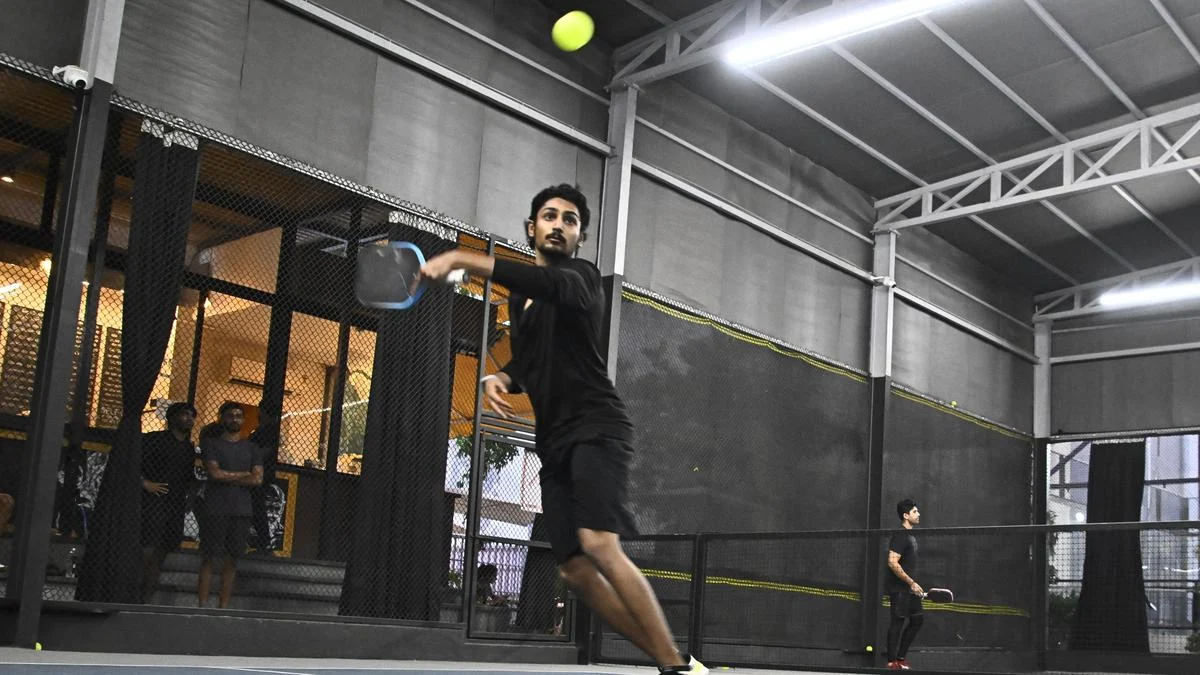
Hyderabad, a city renowned for its IT prowess and burgeoning culinary scene, is experiencing a new kind of surge – one driven by the satisfying thwack of a plastic ball and the swift movement of paddles. Pickleball, a sport that playfully blends elements of tennis, badminton, and table tennis, has rapidly transitioned from a niche social activity to a bona fide phenomenon, captivating residents across various demographics. Weekday evenings at popular venues are no longer defined by quietude but by the energetic hum of this dynamic paddle sport, with courts consistently occupied from late afternoon onwards. This surge in popularity has led to a significant expansion of pickleball infrastructure across the city, transforming its accessibility and appeal.
The Rapid Rise of Pickleball Courts
The transformation of Hyderabad’s sporting landscape is most evident in the proliferation of pickleball courts. Dorlodhu Pradeep, a part-time coach at Hyderabad Paddle Park, recalls a time when dedicated pickleball facilities were a rarity. "Earlier, there were only 8 to 10 courts in the city," he states. "Now you can find courts in different localities." This dramatic increase signifies a robust demand that has spurred investment and entrepreneurial spirit in the sport.
Several key hubs have emerged as epicenters of this pickleball craze. Jubilee Hills has solidified its position as a premier destination, boasting the Hyderabad Paddle Park and The Kitchen, both drawing consistent evening crowds. These venues offer a premium experience, often featuring air-conditioned indoor courts that provide a welcome respite from Hyderabad’s often-intense heat, thereby extending playing hours and attracting a more discerning clientele. In contrast, Madhapur’s Ayyappa Society has become a favoured spot for IT professionals, with Pickle Yard catering to this tech-savvy demographic. For those seeking a more expansive sporting environment, Gandipet’s Cross Court Sports provides a larger campus feel. Beyond these prominent locations, other frequently visited spots like Dink N Dash and the Pullela Gopichand Academy are further cementing pickleball’s presence across the city’s diverse neighborhoods. This widespread availability has made it easier for enthusiasts to find a game, fostering a sense of community and accessibility.
Understanding the Allure: What Exactly is Pickleball?
At its core, pickleball is a paddle sport designed for accessibility and engagement. It is played on a court that mirrors the dimensions of a badminton doubles court, making it considerably smaller than a standard tennis court. This compact size contributes to its faster pace and the emphasis on quick reflexes. Players wield solid paddles, distinct from the strung rackets of tennis or badminton, which offer a different feel and control over the ball. The game utilizes a perforated plastic ball, often referred to as a "wiffle ball," which exhibits a unique trajectory and bounce, adding a layer of unpredictability that newcomers often find surprisingly challenging.
A fundamental rule, particularly in most formats played in Hyderabad, is the "double bounce rule," which dictates that the ball must bounce once on each side before players can volley (hit the ball out of the air). This rule encourages rallies and strategic play, preventing players from simply smashing the ball at every opportunity. Points are typically scored only by the serving side, adding a tactical element to service and return strategies.

The most prevalent format in Hyderabad is doubles, where four players share a court. This social structure is a significant draw, as it allows for easy integration and fosters a convivial atmosphere. The relative simplicity of the game’s initial rules makes it highly conducive to social gatherings and casual play, a stark contrast to the more intimidating learning curves of some other racket sports.
The origin of the name "pickleball" itself is shrouded in a touch of playful mystery, with competing theories adding to its lore. One popular anecdote attributes the name to a dog named Pickles, whose owner would include him in their games. Another widely circulated explanation links it to the "pickle boat" in rowing, a team formed from leftover crew members of other boats. Both narratives, though unconfirmed, contribute to the sport’s engaging backstory and are frequently discussed within the growing pickleball community.
From Viral Videos to Active Engagement: How Hyderabad Embraced Pickleball
The initial spark for Hyderabad’s pickleball adoption can be largely attributed to the pervasive influence of social media. Short-form video platforms played a crucial role in showcasing the sport’s dynamic nature and accessible appeal. These viral clips provided a tantalizing glimpse into the game, piquing the curiosity of many. Furthermore, corporate groups, constantly seeking innovative team-building activities and avenues for employee engagement, quickly identified pickleball as an ideal candidate. The ease of organization and the inherently social aspect of the sport made it a perfect fit for corporate outings and wellness initiatives.
Many players confess to being initially drawn in by the sport’s seemingly effortless presentation online. Darla Jyotirmayi, a finance professional from Nanakramguda who makes the commute to Jubilee Hills to play, shared her initial impression: "We kept seeing it online and finally decided to try it. Though it seemed simple at first, we discovered it wasn’t." This sentiment is echoed by Garikapati Madhavi, an engineer from Kukatpally, who experienced a similar disconnect. "Online videos never show how hard it is to judge the bounce," she commented. "You think you know where it will go, and then you miss it completely." This perceived discrepancy between the effortless grace seen online and the actual challenges of mastering the game has, paradoxically, become a catalyst for the sport’s growth. The inherent difficulty, coupled with the satisfaction of improvement, compels players to return, refine their skills, and delve deeper into the sport’s intricacies.
A Diverse Spectrum of Players: Who is Hitting the Courts?
The vibrant tapestry of pickleball players in Hyderabad is one of its most striking features. Evenings across the city’s courts reveal a dynamic mix of individuals united by their shared passion for the sport. Corporate teams, embarking on their initial pickleball adventures, mingle with seasoned IT professionals who often transition directly from their demanding workdays to the court. Alongside them, teenagers with a background in tennis bring a competitive edge, demonstrating a sharp focus and a natural aptitude for the game.

Gaurav Jha, a digital marketer from Ayyappa Society, Madhapur, exemplifies the journey many IT professionals undertake. He first encountered pickleball during a corporate outing. "My boss explained the rules and I just joined," he recalls. However, the reality of the game soon presented itself. "I struggled to connect with it," he admits, referring to the initial difficulty in mastering the ball’s unpredictable bounce. It took him "five to six matches to get comfortable," a testament to the learning curve involved.
Chandravela Yash, a competitive tennis player from KPHB, makes a dedicated commute of 30 to 50 minutes to The Kitchen in Jubilee Hills. While his tennis background provided a faster adaptation, he remains grounded. "Tennis helped me adjust," he acknowledges, "but the ‘dink’ is the hardest shot and consistency matters." The "dink" refers to a soft, short shot played into the opponent’s non-volley zone, a crucial tactical element that requires precision and finesse.
At the more committed end of the spectrum is Kannur Gopi from Begumpet. A regular at The Kitchen, Gopi has rapidly progressed from casual play to participating in competitive tournaments within a year. His dedication comes with a significant financial commitment. He estimates spending upwards of ₹40,000 annually on court bookings, equipment, and shared costs. His high-performance carbon fibre paddles, priced at around ₹6,000, require replacement every three to four months due to the intensity of his play. "Most other sports are cheaper," he concedes, "but once you start, it is hard to stop." This sentiment encapsulates the addictive nature of pickleball, where the challenge and enjoyment outweigh the cost for dedicated enthusiasts.
The Investment in the Game: Understanding the Costs
The burgeoning popularity of pickleball has also illuminated its economic landscape. The cost of participating in the sport can vary significantly, influenced by venue choice and playing time. Smaller, more casual facilities may charge around ₹700 per hour for court rental. However, at premium indoor venues, the rates are considerably higher. Hyderabad Paddle Park, for instance, charges approximately ₹1,500 per hour, while The Kitchen commands a similar rate of ₹1,600 per hour.
Beyond court fees, equipment represents another significant expenditure. Entry-level paddles typically range from ₹1,500 to ₹2,000, offering a viable starting point for beginners. For those who become more serious about the game, advanced carbon fibre paddles can cost considerably more, reflecting their enhanced performance and durability. The common practice of playing doubles means that court costs are usually split among four players, effectively reducing the individual financial burden. However, this also necessitates coordination among players or a willingness to join rotating groups to secure court time.

Navigating the Learning Curve: Skills, Strategy, and Safety
The intricacies of pickleball extend beyond its initial, deceptively simple rules. Experienced players often highlight the subtle differences between indoor and outdoor balls. Indoor balls are generally lighter and slower, while outdoor balls are heavier and faster, each demanding a different adaptation from players. Mastering wrist control is identified as a primary hurdle for newcomers, as small technical errors can significantly impact consistency, often more so than sheer power.
Beyond the technical aspects, safety is paramount. The constant lateral movement inherent in pickleball necessitates appropriate footwear. Court shoes are strongly recommended as they are designed to support side-to-side movements and reduce the risk of ankle sprains. Running shoes, while providing cushioning, lack the lateral stability required for the sport.
Dorlodhu Pradeep, the coach at Hyderabad Paddle Park, emphasizes a universal truth applicable to all sports and fitness routines: "Most injuries happen when players skip warm-ups. People only take it seriously after they get hurt." A proper warm-up prepares the body for the physical demands of the game, reducing the likelihood of strains and other injuries. He also points out that correcting wrist movement alone can dramatically transform a beginner’s game, leading to improved accuracy and control.
For newcomers, the learning trajectory varies. Those with prior experience in racket sports typically find themselves comfortable with the game within two to three sessions. Individuals without such a background may require a longer period to adapt. A deeper understanding of the game’s nuances, strategies, and tactical nuances develops over weeks of consistent play.
For now, pickleball sessions in Hyderabad are evolving into more than just sporting activities; they are transforming into vibrant community gatherings, centered around the shared experience of playing on the court. The camaraderie, the shared challenges, and the collective pursuit of improvement are forging strong bonds among players, solidifying pickleball’s place as a significant and cherished addition to Hyderabad’s sporting and social fabric.
