

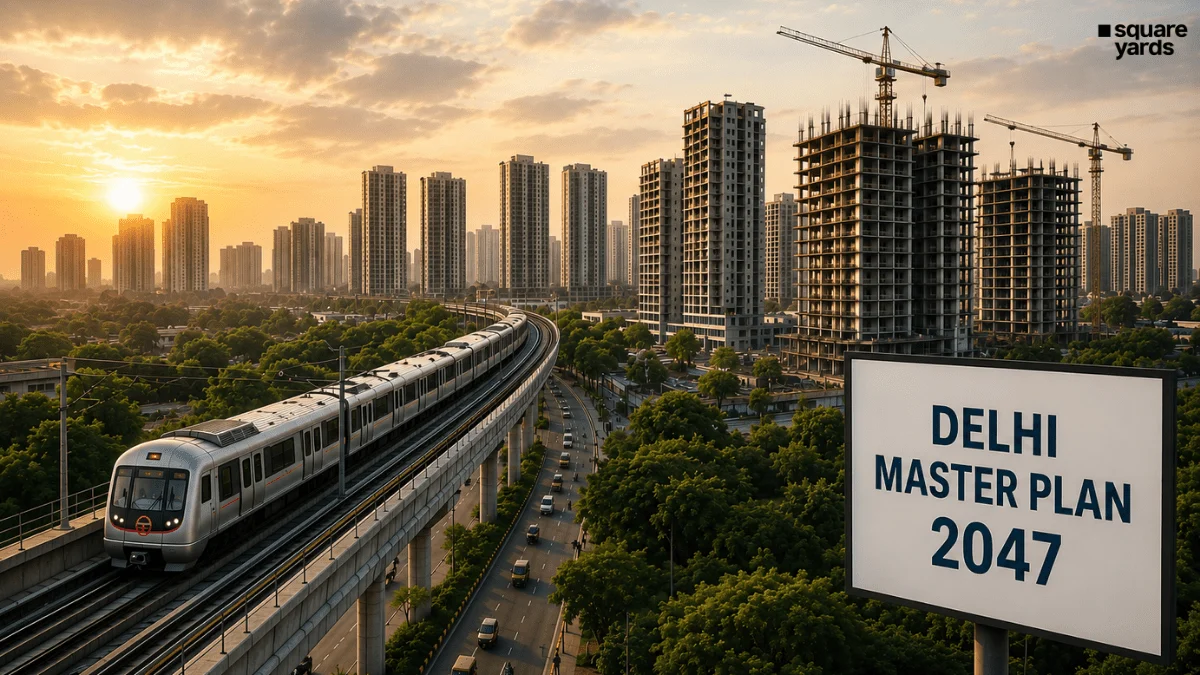
Introduction: A Strategic Vision for the National Capital
In a landmark move aimed at redefining the urban landscape of India’s capital, the Delhi Development Authority (DDA) officially approved the Master Plan for Delhi-2047 (MPD-2047) on August 12. This comprehensive statutory document serves as the strategic blueprint for the city’s growth over the next quarter-century, fundamentally altering the frameworks for housing, land use, transport, and environmental conservation.
The transition from the previously envisioned MPD-2041 to the current 2047 iteration is not merely a change in nomenclature; it represents a synchronized alignment with the Union Government’s "Viksit Bharat 2047" vision. As Delhi prepares to accommodate a projected population of 3.2 crore by 2047—up from the current estimate of 2.4 crore—the plan introduces radical shifts toward high-density transit-oriented development, a more flexible land-pooling ecosystem, and a robust framework for urban regeneration.
By prioritizing vertical growth and the formalization of peripheral lands, MPD-2047 seeks to address the chronic supply-demand mismatch that has long characterized Delhi’s real estate market, potentially curbing the proliferation of unauthorized colonies and reducing the capital’s reliance on satellite cities like Gurugram and Noida.
Chronology: The Evolution of Delhi’s Planning Framework
The trajectory of Delhi’s planned development has been marked by several decade-long milestones, each reflecting the socio-economic priorities of its time.
- MPD-1962: The first formal Master Plan focused on decentralization and the creation of "ring towns" to manage the post-partition population surge.
- MPD-2001: This phase emphasized the development of sub-cities like Dwarka, Rohini, and Narela to accommodate the burgeoning middle class.
- MPD-2021: Introduced the concepts of mixed-land use and initial land-pooling policies, though many of its ambitious housing targets remained unfulfilled due to regulatory friction.
- The Shift to 2047: The drafting for the 2041 plan began in 2017-18. However, following the disruptions of the COVID-19 pandemic and the subsequent national focus on the 2047 centenary of independence, the DDA recalibrated the plan. The approval on August 12 marks the final internal hurdle before the document is sent to the Ministry of Housing and Urban Affairs (MoHUA) for final notification.
High-Density Revolution: Transit-Oriented Development (TOD)
Perhaps the most transformative element of MPD-2047 is the expansion of the Transit-Oriented Development (TOD) policy. This framework is designed to create compact, walkable, and high-density urban hubs centered around mass transit nodes.
Spatial Expansion and Thresholds
Under the revised policy, development is now permitted within a 500-meter radius of Metro corridors, Regional Rapid Transit System (RRTS) stations, and railway stations. This covers approximately 207 square kilometers of the city. Crucially, the plan integrates 80 square kilometers of land that were previously excluded, including land-pooling zones and certain unauthorized colonies.
To encourage participation, the DDA has significantly lowered the entry threshold. Plots as small as 2,000 square meters—down from previous higher requirements—now qualify for TOD benefits if they are situated along an 18-meter-wide road.
Intensity of Land Use
The plan permits a Floor Area Ratio (FAR) of up to 500. A base FAR of 400 is provided, with an additional 100 available upon payment of dynamic impact charges. This allows for significant vertical expansion, which is essential for meeting the housing needs of an additional 80 lakh residents. While the primary focus remains on residential high-rises, the policy mandates a mix of commercial amenities and essential services within these TOD hubs to ensure they remain self-sustaining "15-minute cities."
Land Pooling: Unlocking the Urban Fringe
For years, Delhi’s Land Pooling Policy (LPP) was stalled by a high participation threshold of 70% contiguous land and a minimum sector size of 100 acres. MPD-2047 introduces a pragmatic "regulatory reset" to break this deadlock.
- Lower Thresholds: The minimum sector size has been reduced to 20 hectares (approximately 50 acres). This shift is expected to allow smaller consortiums of landowners and developers to initiate projects without waiting for massive, often unattainable, land contiguity.
- DDA as an Anchor: The DDA will now play a more proactive role as a primary anchor, facilitating infrastructure development. Roads with a Right of Way (RoW) of 30 meters or more within pooling areas will be developed directly by the authority.
- Strategic Zones: The policy targets six specific zones: K-1, L, N, P-II, J, and P-I (including Narela). These areas are expected to eventually provide a massive inventory of nearly 17 lakh dwelling units, though this remains a long-term projection dependent on the pace of infrastructure rollout.
Urban Regeneration: Breathing New Life into Old Delhi
Recognizing that large swathes of "planned" Delhi are now aging and inefficient, MPD-2047 provides a formal route for the redevelopment of older DDA housing and private group housing societies.
DDA Housing Schemes
Many two-storey DDA-built units, such as those in Naraina Vihar, are now over 50 years old and structurally vulnerable. The new plan grants these units redevelopment rights on par with vacant residential plots. Owners can now leverage modern FAR, height, and ground coverage norms, provided they adhere to updated fire and structural safety codes.
Group Housing Societies
Existing Cooperative Group Housing Societies (CGHS) on plots of at least 3,000 square meters are now eligible for redevelopment. To accommodate smaller societies, the plan allows for the amalgamation of adjoining plots to meet the size threshold. With a permissible FAR of 1.5, this move is expected to trigger a wave of reconstruction in established neighborhoods, allowing for better amenities, more parking, and increased housing density.
The Yamuna O-Zone: A Dual-Track Approach
Environmental sustainability is a core pillar of the new master plan, particularly regarding the Yamuna River’s eco-sensitive floodplain, known as the O-Zone. The 9,934-hectare area has been divided into two distinct zones:
- Zone I (Core Riverbed): Covering 6,295 hectares, this zone is strictly protected. No permanent urban, residential, or commercial construction is permitted here.
- Zone II (Outer Floodplain): This area will be utilized for "soft" interventions. Plans include recreational spaces, green lungs, and a 52-km cycle track. This ensures that while the river is protected, the land remains accessible to citizens for eco-friendly public use.
Official Responses and Industry Perspectives
The real estate industry has largely welcomed the plan, viewing it as a necessary evolution to keep Delhi competitive.
Ankur Jalan, CEO of Golden Growth Fund, noted the strategic importance of these changes: “The evolving framework for land pooling, redevelopment of existing properties, and the planned approach towards farmhouse areas can bring more land into productive use. TOD can create compact, better-connected urban centres around mass transit.”
Jalan further emphasized the regional impact: “The creation of additional housing supply within Delhi can help moderate the pressure on surrounding NCR markets. For developers, the policy direction creates greater opportunities to invest in redevelopment, premium, and mid-income housing, while supporting a more efficient urban economy.”
From a regulatory standpoint, the DDA has also approved amendments to the Unified Building Bye-Laws (UBBL). In a bid to enhance the "Ease of Doing Business," building permits will now be de-linked from the requirement of prior No Objection Certificates (NOCs) from agencies like the Delhi Pollution Control Committee and the Forest Department. These will now be processed in parallel or through self-certification, significantly reducing the gestation period for new projects.
Implications: Addressing the Crisis of Unauthorized Growth
The urgency of MPD-2047 is underscored by a sobering statistic: internal DDA assessments indicate that over 3,500 hectares of land in Outer Delhi have succumbed to unauthorized construction in recent years. From Burari in the north to Najafgarh in the southwest, the lack of planned, affordable housing has forced thousands into unregulated settlements.
The Implications of MPD-2047 are manifold:
- Curtailing Sprawl: By allowing higher FAR and vertical growth within the city, the plan reduces the incentive for horizontal sprawl into agricultural fringes.
- Price Stabilization: Increased supply, particularly through land pooling and redevelopment, is expected to stabilize property prices which have seen an astronomical rise due to artificial scarcity.
- Infrastructure Synergy: By tying development rights to transit corridors (Metro/RRTS), the plan ensures that new housing does not lead to further traffic congestion, instead promoting public transport usage.
- Economic Competitiveness: A modernized Delhi with "Grade A" residential and commercial infrastructure is essential for attracting global investment and maintaining its status as a premier economic hub.
Conclusion
Master Plan Delhi-2047 represents a bold attempt to correct the planning failures of the past while preparing for a future defined by rapid urbanization and climate challenges. By shifting the focus from "expansion" to "regeneration" and "density," the DDA has provided a framework that could transform Delhi into a more sustainable, liveable, and economically vibrant metropolis. However, the success of this ambitious vision will ultimately hinge on the speed of notification by MoHUA and the efficiency of the DDA in executing the underlying infrastructure required to support a population of 32 million.
