

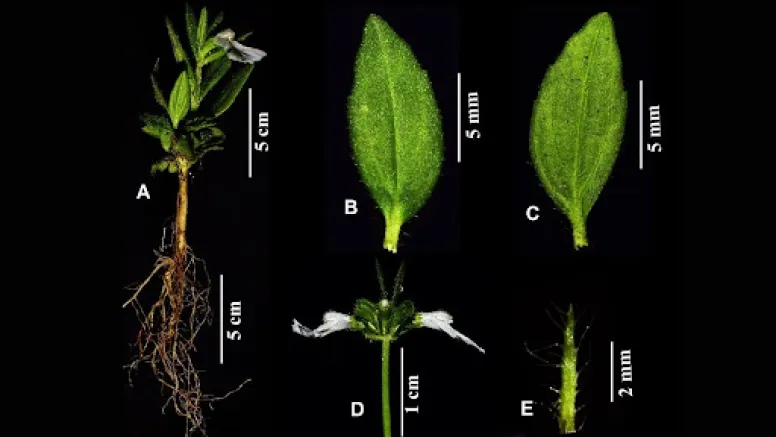
CUDDALORE, TAMIL NADU — In a significant contribution to India’s botanical map, researchers have identified a new species of herb thriving amidst the harsh, nutrient-poor sand dunes of the Coromandel Coast. The discovery, made by a collaborative team of scientists from Annamalai University and the Government Siddha Medical College, marks a milestone in the study of coastal flora. The species has been named Leucas droupadiae in honor of Smt. Droupadi Murmu, the 15th President of India, reflecting a symbolic bridge between national leadership and the preservation of the country’s natural heritage.
The discovery highlights the hidden biological wealth of India’s coastal ecosystems, which are often overlooked in favor of dense tropical forests. Leucas droupadiae stands as a testament to the resilience of life in extreme environments and serves as a reminder of the urgent need for conservation in the face of rapid industrial and agricultural expansion.
Main Facts: The Discovery of Leucas droupadiae
The identification of Leucas droupadiae occurred during an extensive floristic survey of the Cuddalore district in Tamil Nadu. The research team, led by experts in taxonomy and medicinal botany, encountered a small, unassuming herb that defied existing classifications within the Leucas genus.
The Leucas genus, part of the Lamiaceae (mint) family, is well-known in the Indian subcontinent, with many of its species used in traditional Ayurvedic and Siddha medicine for their anti-inflammatory and antimicrobial properties. However, this specific specimen exhibited morphological traits—physical characteristics—that were entirely distinct from the 155 previously recorded species in the genus.
Key Characteristics of the New Species:
- Scientific Name: Leucas droupadiae
- Location: Coastal sand dunes, Cuddalore District, Tamil Nadu.
- Height: Approximately 15 centimeters.
- Growth Habit: Erect, single unbranched stem (unlike the creeping or bushy habit of relatives).
- Root System: Shallow, fibrous root web tailored for sandy soil.
- Seed Morphology: Oblong "nutlets" of a brilliant golden-yellow color with irregular dark brown spots.
The naming of the plant after President Droupadi Murmu was a deliberate choice by the research team. As the first President of India from a tribal (Adivasi) community, her tenure represents a historic moment for marginalized groups who have traditionally been the primary stewards of India’s biodiversity.

Chronology: From Field Observation to Global Validation
The journey of Leucas droupadiae from a coastal "weed" to a recognized scientific discovery followed a rigorous multi-year process of verification and peer review.
Phase 1: Initial Discovery (Early 2024–2025)
During a routine survey of the Coromandel Coast’s sand dune vegetation, researchers from Annamalai University noticed a small herb that did not fit the local botanical keys. While most Leucas species in the region are known for their branched stems and deep taproots—adaptations for stability in various soils—this plant stood solitary and upright.
Phase 2: The Year-Long Observation
To ensure the plant wasn’t merely a seasonal variant or a mutation of an existing species, the team conducted a year-long study of its life cycle. They monitored its growth from germination through flowering and seed dispersal. This longitudinal study confirmed that its unique traits—specifically the unbranched stem and the specific color of its seeds—were consistent across generations and not influenced by temporary environmental factors.
Phase 3: International Comparison and Verification
Once the local data was collected, the researchers turned to global repositories. They compared their specimens against digital and physical records from:
- The Natural History Museum (NHM), London.
- The Royal Botanic Gardens, Kew.
- The Botanical Survey of India (BSI).
By cross-referencing the specimen with the 155 known species of Leucas, the team confirmed that the Cuddalore herb was indeed a "novelty to science." The results were subsequently published in a peer-reviewed botanical journal, formalizing the name Leucas droupadiae.

Supporting Data: Taxonomic Divergence and Ecological Niche
The scientific significance of Leucas droupadiae lies in its extreme adaptation to the "psammophytic" (sand-loving) environment. The Coromandel Coast is characterized by high salinity, low nutrient availability, and shifting substrates.
Morphological Comparison
The research paper detailing the discovery provides a comparative analysis between Leucas droupadiae and its closest morphological relatives.
| Feature | Typical Leucas Species | Leucas droupadiae |
|---|---|---|
| Stem Structure | Highly branched, often creeping or decumbent | Single, erect, unbranched stem |
| Height | Varies; often 30–60 cm | Compact, max 15 cm |
| Root Type | Deep taproot system | Shallow, fibrous web-like roots |
| Fruit (Nutlets) | Usually dull brown or grey, uniform color | Golden yellow with dark brown spots |
| Habitat | Wastelands, roadsides, forest edges | Specialized coastal sand dunes |
The Role of Fibrous Roots
The shallow, fibrous root system is of particular interest to ecologists. While taproots are designed to reach deep water tables, the web-like roots of Leucas droupadiae allow it to quickly absorb moisture from light coastal mists and brief rain showers before the water drains through the porous sand. This adaptation suggests a highly specialized evolutionary path.
Official Responses and the Significance of the Name
The decision to name the species after President Droupadi Murmu has resonated within both scientific and political circles.
Statement from the Research Team:
"The discovery of a new life form is a moment of national pride. By naming this species Leucas droupadiae, we pay tribute to the Honorable President’s journey and her roots in the tribal communities of India. These communities have always lived in harmony with nature, and this name serves as a symbol of that enduring connection."

Botanical Community Reaction:
Taxonomists have praised the discovery as a reminder that India’s coastal regions are under-explored. Dr. S. Rajendran, a veteran botanist (speaking generally on the discovery), noted: "Finding a new species in a genus as well-studied as Leucas is rare. It suggests that our coastal dunes, which are often dismissed as barren lands, are actually repositories of unique genetic material."
Socio-Political Context:
The naming is seen as part of a growing trend in "Ethno-botanical recognition," where scientific nomenclature is used to honor figures who represent conservation and indigenous rights. President Murmu’s background in Odisha, a state rich in forest biodiversity, further strengthens the thematic link between the President and this new botanical find.
Implications: Conservation Challenges and the "Data Deficient" Status
Despite the excitement surrounding its discovery, the future of Leucas droupadiae is precarious. The researchers have provisionally categorized the species as "Data Deficient" (DD) under the IUCN guidelines, but they warn that it likely faces an "Endangered" reality.
Threat 1: Invasive Eucalyptus Plantations
One of the primary threats identified in the Cuddalore district is the expansion of eucalyptus plantations. Eucalyptus trees are notorious for their high water consumption and their tendency to alter the soil chemistry (allelopathy), making it difficult for native herbs like Leucas to survive. As these plantations expand toward the shoreline, the specialized habitat of the new herb shrinks.
Threat 2: Local Grazing and Land Use
The coastal dunes are frequently used by local communities for cattle grazing. Because Leucas droupadiae is small and grows in isolation rather than in dense patches, it is highly susceptible to being trampled or consumed before it can reach the flowering stage and disperse its seeds.

Threat 3: Climate Change and Coastal Erosion
As a species confined to a specific narrow strip of the Coromandel Coast, Leucas droupadiae is at the frontline of climate change. Rising sea levels and increased frequency of cyclonic storms in the Bay of Bengal threaten to wash away the very sand dunes the plant calls home.
Conclusion: A Call for Coastal Protection
The discovery of Leucas droupadiae is more than just a new entry in a botanical catalog; it is a call to action. It highlights the biological complexity of the Tamil Nadu coastline and the necessity of protecting "wastelands" that are, in fact, vibrant ecosystems.
Moving forward, the researchers from Annamalai University and the Government Siddha Medical College are calling for a dedicated conservation strategy for the Cuddalore dunes. This includes:
- Habitat Mapping: Identifying other potential pockets where the herb might exist along the coast.
- Ex-situ Conservation: Attempting to grow the species in botanical gardens to ensure a backup gene pool.
- Community Awareness: Engaging local villages to protect the dunes from overgrazing and invasive species.
As India continues to modernize, the survival of Leucas droupadiae—a plant named after the nation’s highest official—will serve as a litmus test for the country’s commitment to preserving its smallest, yet most unique, citizens of the natural world.
