

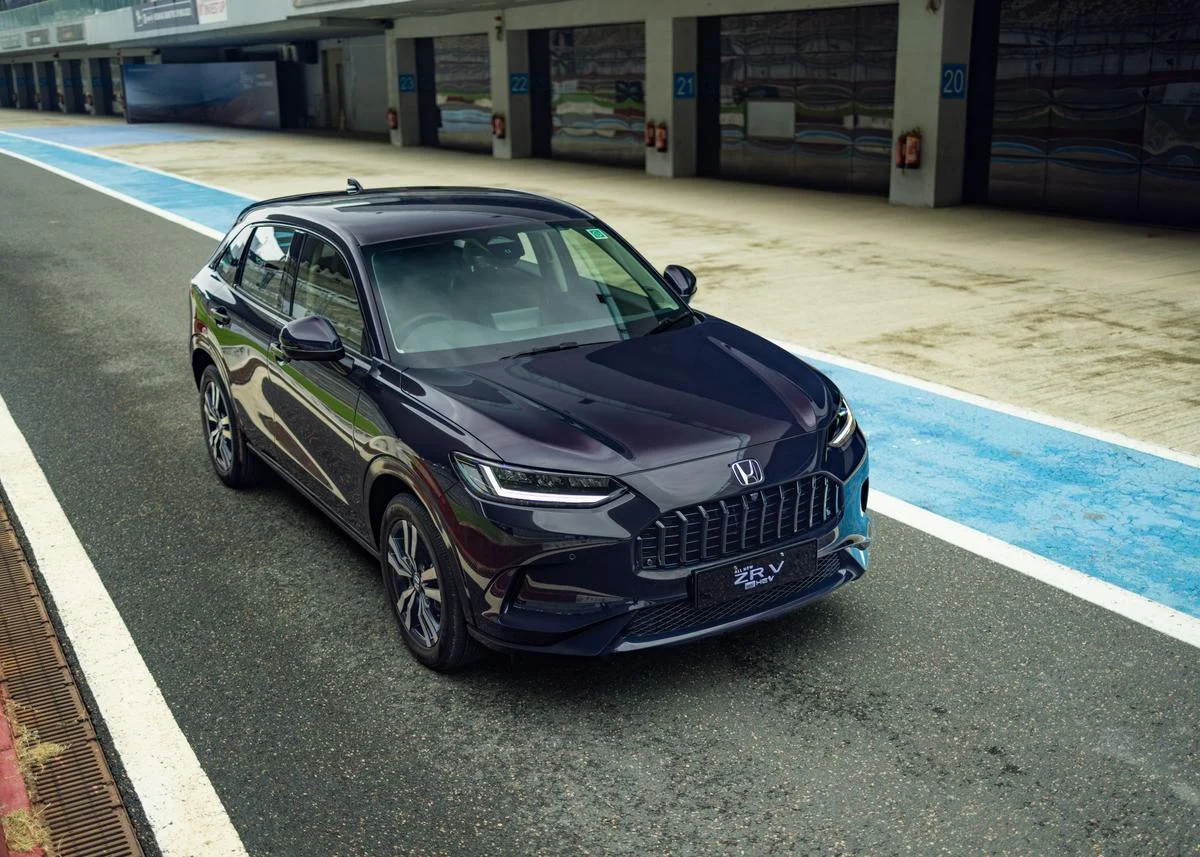
In an era where the Indian automotive landscape is increasingly defined by "digital excess"—a race for the largest panoramic sunroofs, the most expansive touchscreens, and the most aggressive LED signatures—Honda has made a calculated, almost contrarian move. The introduction of the Honda ZR-V to the Indian market marks a significant shift in strategy for the Japanese automaker. Rather than engaging in a feature-for-feature arms race with established rivals, Honda has doubled down on its historical strengths: tactile quality, mechanical refinement, and sophisticated hybrid engineering.
The Honda ZR-V enters the premium SUV segment not as a populist crowd-pleaser, but as a niche, precision-engineered tool. Priced at ₹47.99 lakh (ex-showroom), it arrives as a Completely Built Unit (CBU), carrying with it the high-quality fit and finish expected of a global product, while simultaneously facing the uphill battle of a price tag that rivals larger, seven-seater alternatives.
Main Facts: The ZR-V at a Glance
The Honda ZR-V is positioned between the HR-V and the CR-V in Honda’s global lineup, though in India, it serves as the brand’s flagship offering. Its primary identity is forged around the "e:HEV" strong hybrid powertrain, a system that Honda believes is the perfect bridge between internal combustion and full electrification for the Indian context.
Key Specifications:

- Powertrain: 2.0-litre Atkinson-cycle petrol engine paired with two electric motors.
- Output: Combined 181 bhp and 315 Nm of peak torque.
- Transmission: e-CVT (Electronic Continuously Variable Transmission).
- Performance: 0-100 km/h in 7.9 seconds.
- Fuel Efficiency: Claimed 22 kmpl (tested); 17-18 kmpl (real-world estimated).
- Safety: 8 Airbags, Honda SENSING (ADAS), 4-star Euro NCAP rating.
- Price: ₹47.99 Lakh (Ex-showroom).
Chronology: From Global Launch to Indian Shores
The ZR-V’s journey to India is part of a broader global rollout that began in 2022. Originally designed to capture the "Z-Generation" (hence the name) in markets like North America (where it is sold as the HR-V) and Europe, the vehicle was engineered on the same platform as the 11th-generation Honda Civic. This lineage is crucial, as it explains the SUV’s car-like handling characteristics and low center of gravity.
Honda’s decision to bring the ZR-V to India as a CBU reflects a "test-the-waters" approach. Following the discontinuation of the CR-V and the Civic in India a few years ago, the brand lacked a premium halo product. The ZR-V fills this vacuum, arriving at a time when Indian consumers are showing an increased appetite for strong hybrids over diesel powerplants in the premium segment. By opting for the CBU route, Honda ensures that Indian buyers receive the exact same specification and build quality as buyers in London or Tokyo, though it subjects the vehicle to India’s stringent import duties.
Supporting Data: The Sophistication of e:HEV Technology
The heart of the ZR-V is the latest iteration of Honda’s dual-motor hybrid system. Unlike "mild hybrids" that merely assist the engine, or "parallel hybrids" that often feel unrefined during transitions, the ZR-V’s e:HEV system operates primarily as an electric vehicle in urban environments.
The Three Pillars of Drive
- EV Drive Mode: At low speeds and during initial acceleration, the lithium-ion battery powers the electric propulsion motor directly. The petrol engine remains off, providing a silent, torque-rich experience typical of an EV.
- Hybrid Drive Mode: When more power is required, the 2.0-litre engine fires up, but it does not drive the wheels. Instead, it acts as a generator, supplying electricity to the electric motor, which in turn drives the front wheels. This allows the engine to operate at its most efficient RPM regardless of road speed.
- Engine Drive Mode: At sustained highway speeds (typically 80-120 km/h), a lock-up clutch connects the engine directly to the front wheels via a single-speed transmission. This is the most efficient way to maintain high-speed cruising, bypassing the energy conversion losses of the hybrid system.
The data supports the efficiency of this approach. While competitors with similar performance figures often struggle to exceed 10-12 kmpl in stop-and-go traffic, the ZR-V consistently delivers figures north of 18 kmpl, making it one of the most efficient premium SUVs in its class.

Driving Dynamics: Testing at the Buddh International Circuit
To demonstrate that the ZR-V is more than just an efficiency-focused commuter, Honda chose the Buddh International Circuit (BIC)—India’s only Formula 1-spec track—for its maiden drive. While an unlikely venue for a family SUV, the track highlighted the ZR-V’s chassis balance.
During high-speed stability tests, the ZR-V reached an indicated 150 km/h with a level of composure that belied its SUV stature. The Civic-derived suspension (MacPherson struts at the front and a multi-link setup at the rear) ensures that the vehicle remains planted. In the slalom course, taken at roughly 80 km/h, the ZR-V displayed minimal body roll. The steering, which is light and effortless in the city, weights up predictably as lateral G-forces increase, providing the driver with a genuine sense of connection to the road.
Interior Craftsmanship and "Invisible" Engineering
The interior of the ZR-V is a masterclass in "Quiet Luxury." Honda has avoided the temptation to replace every physical button with a sub-menu on a screen. The climate control knobs, for instance, operate with a mechanical "click" that feels expensive and tactile.
However, it is the "invisible" engineering that truly sets the ZR-V apart. Two specific features highlight Honda’s attention to detail:

- Integrated Washer Jets: Instead of nozzles on the hood that spray fluid haphazardly, the ZR-V features jets integrated directly into the wiper arms. This ensures the fluid is applied exactly where the blade meets the glass, improving visibility instantly while using 50% less fluid.
- Proximity-Based Tailgate: The powered tailgate features a "Walk Away Close" function. Unlike systems that close immediately—forcing the user to scramble away—the ZR-V pauses, senses the user’s movement, and only completes the closing cycle once the person has stepped a safe distance away.
Official Responses and Market Positioning
Honda’s official stance on the ZR-V focuses on "long-term ownership satisfaction." Company representatives emphasize that while the feature list might appear shorter than some rivals (missing items like ventilated seats or a panoramic sunroof), the focus has been placed on safety and longevity.
The ZR-V boasts a 4-star Euro NCAP rating and comes equipped with the full Honda SENSING suite. This includes Collision Mitigation Braking (CMBS), Lane Keeping Assist (LKAS), and Adaptive Cruise Control with Low-Speed Follow. By providing eight airbags as standard and focusing on structural integrity, Honda is positioning the ZR-V as the "sensible" choice for the discerning professional who prioritizes safety and engineering over flamboyant styling.
Implications: The ZR-V’s Place in the Indian Market
The arrival of the ZR-V has significant implications for the Indian premium SUV segment. At nearly ₹48 lakh, it competes directly with the Hyundai Tucson, the Volkswagen Tiguan, and the Jeep Meridian.
The Competitive Trade-off:

- The Tucson/Meridian Buyer: Will likely find the ZR-V lacking in "theatre"—the absence of a massive sunroof or ventilated seats is a notable omission at this price point.
- The ZR-V Buyer: Is likely someone moving up from a City or a Civic who values the "Honda-ness"—the reliability, the ease of use, and the sophisticated hybrid tech that promises low running costs without the range anxiety of a full EV.
The ZR-V’s CBU status means it will remain a low-volume, high-prestige product for Honda India. It serves as a brand-builder, proving that Honda can still engineer vehicles that are "genuinely good to drive" rather than just "good for the brochure."
Conclusion: Substance Over Spectacle
The Honda ZR-V is a reminder of what premium motoring used to be about before it was swallowed by the gadgetry of the smartphone era. It is a vehicle that doesn’t scream for attention but earns it through the precision of its steering, the smoothness of its hybrid transitions, and the solidity of its build.
While the ₹47.99 lakh price tag makes it an expensive proposition on paper, the value of the ZR-V reveals itself over miles, not minutes. For the buyer who intends to keep their vehicle for a decade, the ZR-V’s combination of Honda’s legendary reliability and cutting-edge hybrid efficiency makes it a compelling, if niche, addition to the Indian market. It is an SUV for the pragmatist who appreciates the art of engineering over the art of marketing.
This review was produced in association with Motorscribes and The Hindu. For more updates on the latest automotive launches, follow @motorscribes on Instagram.
