

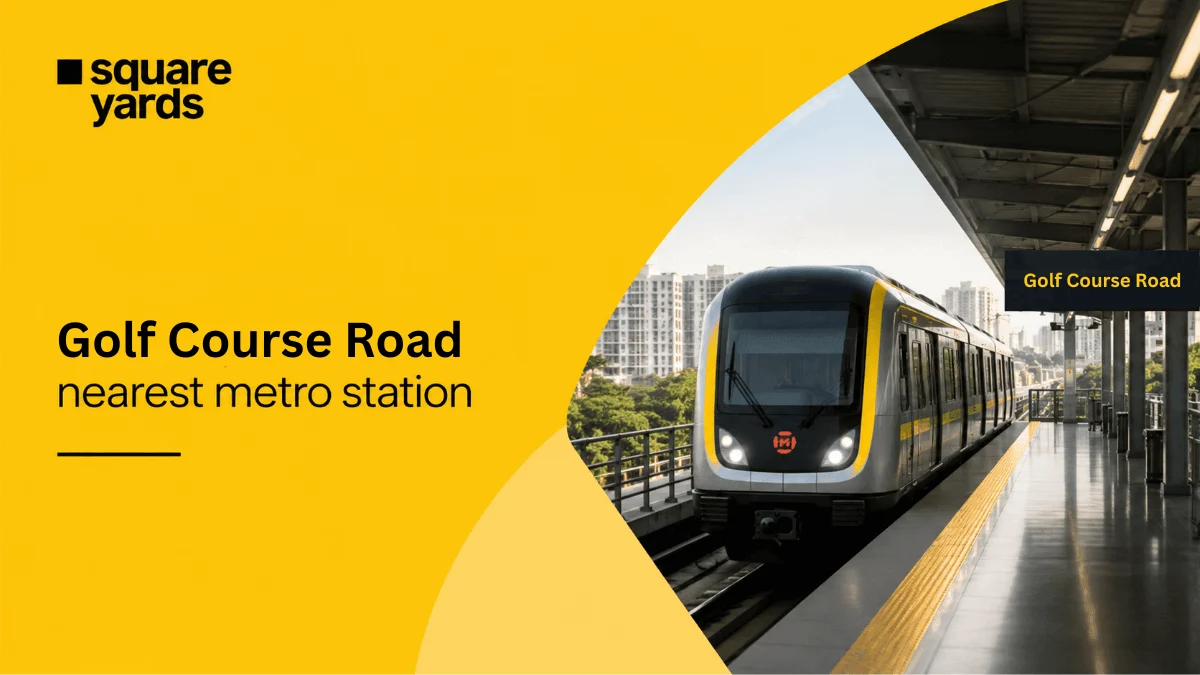
GURGAON – In the landscape of Indian real estate, few stretches of asphalt carry as much economic weight or social prestige as Gurgaon’s Golf Course Road. Stretching approximately nine kilometers through the heart of the city’s most affluent sectors, this corridor has evolved from a mere transit route into a self-contained "Peripheral Business District" (PBD). Central to this evolution is a complex, multi-layered metro infrastructure that—despite a turbulent operational history—has fundamentally redefined how the city’s elite commute and how investors value property.
While often spoken of as a single destination, Golf Course Road is a variegated ecosystem where connectivity changes block by block. From the high-traffic interchange at Sikanderpur to the quiet terminal at Sector 56, the road’s relationship with the Delhi Metro and the Rapid Metro systems offers a masterclass in transit-oriented development.
1. Main Facts: A Dual-System Transit Corridor
Golf Course Road’s connectivity is unique because it is served by two distinct but interconnected metro systems: the Delhi Metro Rail Corporation’s (DMRC) Yellow Line and the Gurgaon Rapid Metro.
The Northern Gateway
At its northern terminus, near the bustling MG Road junction and Galleria Market, the corridor connects to the Delhi Metro Yellow Line via Sikanderpur Station. This is the most critical node for the road, acting as the bridge between Gurgaon’s local loop and the wider National Capital Region (NCR). Commuters from Central Delhi, Huda City Centre, or North Delhi use this interchange to penetrate the Golf Course Road stretch.
The Rapid Metro Spine
As the road moves southward from Sector 42, it is serviced exclusively by the Rapid Metro’s Phase 2 expansion. Unlike the Delhi Metro, which was designed for mass inter-city transit, the Rapid Metro was envisioned as a "feeder" or "neighborhood" system. Five specific stations were constructed to serve this corridor:
- Sector 42-43
- Sector 53-54
- Sector 54 Chowk
- Sector 55-56
- DLF Phase 1 (Connecting the northern tip to the southern stretch)
Road Infrastructure Synergy
A defining feature of this corridor is that metro connectivity does not exist in a vacuum. It is complemented by a massive engineering feat: a series of 25 signal-free underpasses. This allows for a rare urban phenomenon where high-speed road travel and elevated rail transit operate in parallel, significantly reducing the "last-mile" friction that plagues other parts of Gurgaon.
2. Chronology: From Private Ambition to Public Management
The story of Golf Course Road’s connectivity is marked by three distinct eras of development.
Era 1: The Emergence of the Yellow Line (Pre-2013)
Before the Rapid Metro, Golf Course Road was largely car-dependent. The arrival of the Delhi Metro’s Yellow Line at Sikanderpur and MG Road provided the first "umbilical cord" to Delhi. However, residents living in the deeper sectors (54, 55, 56) still faced a grueling 15-to-20-minute drive just to reach the metro, often hampered by the heavy traffic of a then-developing road.
Era 2: The Rapid Metro Expansion (2013–2017)
The Rapid Metro was India’s first fully privately funded metro system, built by IL&FS. Phase 1 (opened in 2013) served the Cyber City loop. However, the game-changer for real estate was Phase 2, which opened in March 2017. This 6.6-kilometer extension ran directly alongside Golf Course Road. For the first time, premium residential towers like DLF The Aralias or The Magnolias were within walking distance of a metro station.
Era 3: The DMRC Takeover (2019–Present)
The "complicated history" alluded to by urban planners refers to the financial collapse of the original operator, IL&FS. Amidst legal battles and debt crises, the Haryana Government intervened. In October 2019, the DMRC took over the operations and maintenance of the Rapid Metro. This transition brought much-needed professional stability and safety standards to the line, though the system continues to operate on a slightly different schedule than the main Yellow Line.
3. Supporting Data: The Economics of the Corridor
The impact of the metro on property values along Golf Course Road is quantifiable. The road hosts some of the highest capital values in Northern India.
Real Estate Valuation Matrix
| Metric | Range (Average) |
|---|---|
| Residential Sale Price | Rs 18,800 – Rs 30,400 per sq. ft. |
| Premium Penthouse Prices | Rs 50 Crore – Rs 75+ Crore |
| Monthly Rental Yields | Rs 32 – Rs 54 per sq. ft. |
| Small Unit Entry Point | Approx. Rs 35 Lakh (Studio/Old constructions) |
Comparative Analysis of Nearby Localities
The "Metro Premium" is evident when comparing Golf Course Road to its neighbor, the Golf Course Extension Road.
- Golf Course Road: Rs 18,800–30,400/sq.ft. (Direct Metro Access)
- Golf Course Extension Road: Rs 12,000–19,000/sq.ft. (No Direct Metro Access currently)
- DLF Phase 1: Rs 20,000–35,000/sq.ft. (Established, Rapid Metro Phase 1)
- Sushant Lok: Rs 14,000–22,000/sq.ft. (Near Yellow Line)
Corporate Footprint
The road serves as a corporate hub for Fortune 500 companies, which drives the rental demand. Key tenants include:
- Financial Services: American Express, Ernst & Young (EY).
- Technology: Oracle, Dell.
- Social Infrastructure: Schools like Shri Ram Aravali and Lancers International; Hospitals like Paras and Artemis.
4. Official Responses and Infrastructure Governance
The management of Golf Course Road is a collaborative effort between the Gurgaon Metropolitan Development Authority (GMDA) and the DMRC.
Operational Discrepancies
Officials acknowledge that while the Rapid Metro is now stable, it operates on a "feeder" logic. The first train starts at 6:05 AM and the last at 10:00 PM. In contrast, the Delhi Metro Yellow Line runs until 11:00 PM. This one-hour gap is a frequent point of contention for corporate employees working late shifts in Cyber City or Delhi, forcing a reliance on app-based cabs for the final leg of the journey.
Last-Mile Connectivity
The GMDA has focused on enhancing the "Last Mile" experience. While the road is signal-free for cars, pedestrian access to metro stations has been a historic challenge. Recent efforts have focused on:
- Auto-Rickshaw Stands: Regulated zones at station exits with fares ranging from Rs 30 to Rs 100.
- Corporate Shuttles: Major office parks along the corridor now run private shuttle loops between Sikanderpur and their respective campuses.
- Safety: Given the premium nature of the residents, 24×7 Ola/Uber availability is higher here than in any other part of Gurgaon.
5. Implications: Is This the Gold Standard for Investment?
The convergence of the Rapid Metro and the signal-free corridor has created a unique "Transit-Oriented Development" (TOD) zone. But for investors and residents, the implications are nuanced.
For Residents: Lifestyle vs. Utility
For the ultra-wealthy living in the road’s signature gated communities, the metro is often viewed as a "secondary amenity"—something used by visiting staff or for quick trips to Cyber Hub to avoid weekend parking. However, for the mid-level corporate workforce, the metro is a lifeline. The ability to live in Sector 56 and reach Central Delhi in under 60 minutes without touching a steering wheel is a massive draw.
For Investors: Resilience and Growth
The primary implication for investors is price resilience. During market downturns, "corridor properties" with multi-modal transport links tend to hold their value better than isolated luxury pockets.
- The "Extension" Threat: While the Golf Course Extension Road offers newer stock at lower prices, the lack of a metro line remains its "Achilles’ heel." Until the metro is extended further south, the original Golf Course Road will likely maintain its 30-40% price premium.
- The Stability Factor: The takeover of Rapid Metro by DMRC has removed the "operator risk" that previously shadowed the corridor. A government-backed transit system ensures that the infrastructure will not be abandoned, securing long-term capital appreciation.
Future Outlook
As Gurgaon continues to expand toward Sohna and the Dwarka Expressway, Golf Course Road’s role is shifting from a "new frontier" to the "established core." The metro connectivity has effectively "future-proofed" the road. Even as traffic volume increases, the elevated rail provides a bypass that guarantees a predictable commute—a luxury that is becoming increasingly rare in India’s rapidly urbanizing landscape.
Frequently Asked Questions
1. What is the most efficient way to reach Golf Course Road from IGI Airport?
There is no direct metro link from the airport to Golf Course Road. The most efficient route is a 30-minute drive (18 km). If using the metro, one would have to take the Airport Express to New Delhi Station, change to the Yellow Line to Sikanderpur, and then switch to the Rapid Metro—a journey that would take significantly longer than a taxi.
2. Can I use the same Smart Card for Delhi Metro and Rapid Metro?
Yes, the DMRC Smart Card is fully integrated and works across both the Yellow Line and the Rapid Metro stations along Golf Course Road.
3. Which station is closest to the high-end residential towers like The Magnolias?
The Sector 53-54 and Sector 54 Chowk stations are the closest to the most premium residential stretch of the road.
4. Is the area safe for late-night travel?
Golf Course Road is one of the most well-lit and patrolled areas in Gurgaon. However, because the Rapid Metro closes at 10:00 PM, those traveling later should plan to use app-based aggregators (Uber/Ola) which have a very high density of vehicles in this corridor.
