

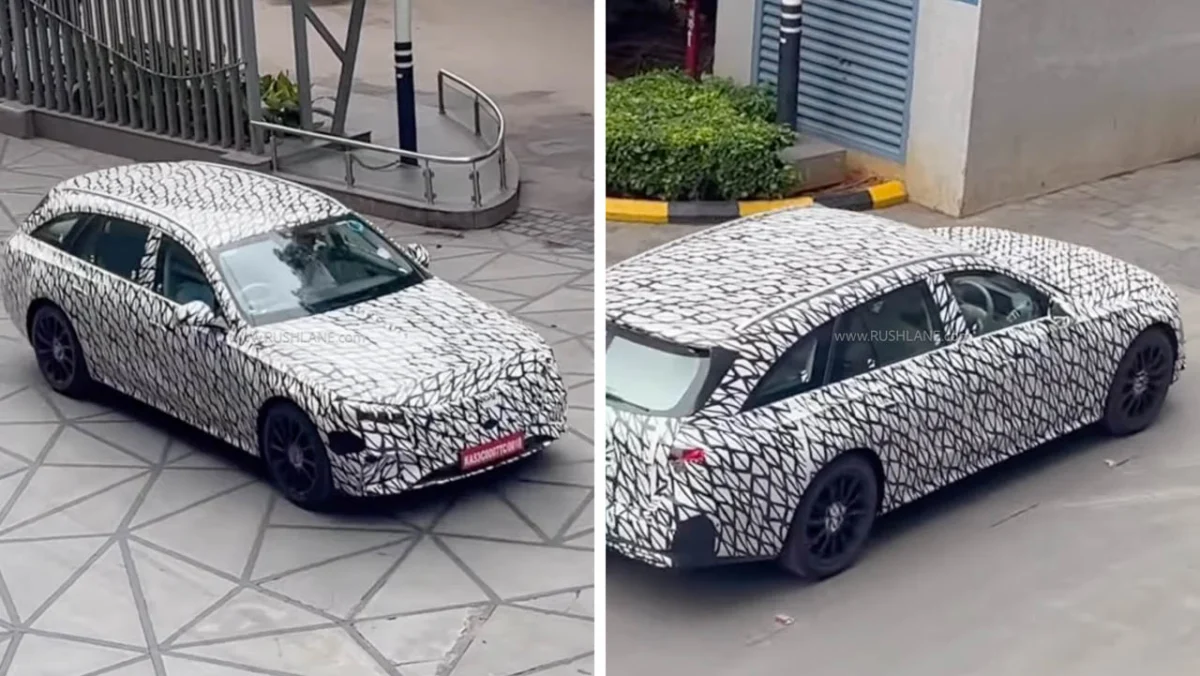
The Indian automotive landscape has long been a fortress for the Sport Utility Vehicle (SUV). From compact crossovers to full-sized luxury behemoths, the "high-riding" stance has dominated consumer preference for over a decade. However, a recent sighting in the tech corridors of Bengaluru suggests that Mercedes-Benz might be preparing to challenge this status quo once again. A heavily camouflaged test mule of the latest-generation Mercedes-Benz E-Class Estate—often referred to in its more stylish iterations as a "Shooting Brake"—was recently captured undergoing rigorous road testing.
This sighting, occurring near the Mercedes-Benz Research and Development India (MBRDI) facility, has sent ripples through the automotive community. It raises a pivotal question: Is the German luxury titan preparing to re-introduce the practical yet sophisticated estate body style to the Indian market, or is this merely a cog in the wheel of Mercedes’ global R&D efforts?
Main Facts: The Bengaluru Sighting
The latest images, captured by automotive enthusiast Dhee Raj Jathan, show a vehicle that, despite its heavy camouflage, is unmistakably the S214-generation E-Class Estate. The vehicle was spotted navigating the traffic near the Brigade Tech Garden in Bengaluru, a stone’s throw from MBRDI.
Key Observations from the Spy Shots:
- The Silhouette: Unlike the standard E-Class sedan, which features a traditional three-box design, the test mule displays the elongated roofline and steep tailgate characteristic of a station wagon.
- Camouflage Detail: The vehicle is wrapped in a comprehensive "dazzle" camouflage pattern, intended to hide specific body lines and lighting signatures. However, the proportions suggest this is the standard Estate rather than the rugged "All-Terrain" variant, though the latter remains a possibility for the Indian market.
- Lighting and Wheels: Even through the wrap, the distinct "star" pattern in the LED tail lamps—a hallmark of the new E-Class generation—is visible. The alloy wheel design appears to be a mid-range aerodynamic set, likely used for durability testing.
- The MBRDI Connection: The proximity to the MBRDI facility is crucial. This center is Mercedes-Benz’s largest R&D hub outside of Germany, specializing in everything from embedded software to mechanical simulation. The presence of the car here could imply "Component Testing" rather than a guaranteed "Market Launch."
Chronology: Mercedes-Benz’s Tryst with Estates in India
To understand the significance of this sighting, one must look at the historical context of the estate body style in India. While globally popular—particularly in Europe—estates have struggled to find a foothold in the Indian subcontinent.
- The Early Years: In the late 1990s and early 2000s, various manufacturers attempted to sell estates (station wagons) in India. Models like the Maruti Baleno Altura, the Skoda Octavia Combi, and the Tata Indigo Marina were launched to lukewarm responses. Consumers largely viewed them as "glorified vans" rather than lifestyle vehicles.
- 2018 – The E-Class All-Terrain: Mercedes-Benz India took a bold step in 2018 by launching the E-Class All-Terrain. It was a ruggedized version of the E-Class Estate, featuring increased ground clearance and 4MATIC all-wheel drive. It was positioned as a niche alternative for those who wanted the luxury of an E-Class but required more cargo space and light off-road capability without moving to a full-sized SUV like the GLE.
- December 2025: Initial reports and spy shots of the new-generation E-Class Estate began surfacing in India. These early sightings suggested that Mercedes was beginning a long-term evaluation process for the S214 platform on Indian soil.
- August 2026: The most recent sightings in Bengaluru confirm that the testing phase is ongoing. The persistence of these tests over several months indicates that the vehicle is undergoing more than just a cursory evaluation.
Supporting Data: Specifications and Features
The S214 E-Class Estate is a technological tour de force, sharing much of its DNA with the recently launched E-Class sedan but offering significantly enhanced utility.

Exterior Aesthetics and Dimensions
The E-Class Estate is designed to be aerodynamic and elegant. In international markets, Mercedes offers several "lines" or trims:
- Avantgarde/Urban Edition: Features a modern grille with a central star and blacked-out accents.
- Exclusive Line: Retains the classic Mercedes-Benz radiator grille with the iconic standing hood ornament—a favorite among traditionalists in India.
- AMG Line: Offers aggressive bumpers, larger air intakes, and sportier wheel designs.
The Estate is approximately 4,949 mm long, but its real advantage lies in its cargo capacity. While the sedan offers respectable trunk space, the Estate provides between 615 and 1,830 liters of luggage room (depending on rear seat configuration), making it an ideal "lifestyle" vehicle for golf trips, long-distance touring, or hauling luxury equipment.
Interior Technology: The MBUX Superscreen
The interior of the test mule is expected to house the "MBUX Superscreen." This massive glass panel stretches across the dashboard, incorporating:
- 12.3-inch Driver Display: A high-resolution TFT cluster for navigation and telemetry.
- 14.4-inch Central Display: The primary interface for media, climate, and vehicle settings.
- 12.3-inch Passenger Display: Allowing the front passenger to stream content or assist with navigation without distracting the driver.
The cabin is further elevated by active ambient lighting, which can pulse in sync with the Burmester 4D surround sound system, and the "Energizing Comfort" programs that coordinate climate control, fragrance, and seat massage functions.
Potential Powertrains for India
While the global lineup includes everything from plug-in hybrids (PHEVs) to the monstrous AMG E53, the Indian spec (if launched) would likely focus on proven efficiency:

- The 2.0L Petrol (E200): A turbocharged four-cylinder engine with a 48V mild-hybrid system, producing roughly 204 hp and 320 Nm of torque.
- The 2.0L Diesel (E220d): The workhorse of the Indian luxury segment, offering around 197 hp and 440 Nm of torque, prized for its effortless highway cruising.
- The 3.0L Straight-Six (E450): If Mercedes positions the Estate as a high-end "boutique" offering, they might opt for the 375 hp six-cylinder engine to appeal to driving enthusiasts.
Official Responses and Market Speculation
As of August 2026, Mercedes-Benz India has remained tight-lipped regarding a formal launch date for the E-Class Estate. When queried about spy shots in the past, the official stance typically emphasizes the role of MBRDI.
"India is a global hub for Mercedes-Benz research, development, and data science," a spokesperson might typically state. "Vehicles seen on Indian roads are often part of global testing programs for software validation, ADAS (Advanced Driver Assistance Systems) calibration, and powertrain endurance under extreme tropical conditions."
However, industry insiders suggest a different possibility. Mercedes-Benz India has a strategy of "Top-End Vehicle" (TEV) focus. By bringing in the Estate as a CBU (Completely Built Unit) or in limited numbers, they could cater to a growing demographic of ultra-high-net-worth individuals who find SUVs too common and sedans too restrictive.
Implications: The Return of the Station Wagon?
The sighting of the E-Class Estate in Bengaluru carries several implications for the Indian automotive market and the luxury segment at large.
1. Challenging the SUV Hegemony
The primary reason estates failed in India previously was a lack of "road presence." However, the modern E-Class Estate, with its "Shooting Brake" inspired silhouette, is a genuine head-turner. It offers a "low-slung" sporty aesthetic that SUVs cannot replicate. If Mercedes can market this as a "lifestyle statement" rather than a "family wagon," they may find success where others failed.

2. The Practicality Factor
India’s luxury buyers are increasingly traveling by road between major cities (e.g., Delhi to Jaipur, Mumbai to Goa). The Estate offers the plush ride quality and high-speed stability of a sedan—which is inherently superior to an SUV due to a lower center of gravity—while providing the luggage space of a crossover. This "best of both worlds" approach is the Estate’s strongest selling point.
3. Testing for Global Markets
It is highly probable that the Bengaluru tests are focused on ADAS. India’s chaotic traffic provides the perfect "stress test" for autonomous emergency braking, steering assist, and sensor fusion. Data gathered by this E-Class Estate in Bengaluru will likely help refine the software for Mercedes-Benz vehicles sold in London, New York, and Berlin.
4. Competitive Landscape
Currently, the E-Class Estate has no direct rivals in India. Audi does not sell the A6 Avant here, and BMW has kept the 5 Series Touring away from Indian shores. By launching the Estate, Mercedes would enjoy a "monopoly of one" in a niche but profitable sub-segment.
Conclusion
The appearance of the Mercedes-Benz E-Class Estate on the streets of Bengaluru is more than just a fleeting glimpse of a rare car; it is a testament to India’s growing importance in the global automotive R&D ecosystem and a hint at a diversifying luxury market.
Whether this culminates in a showroom launch or remains a dedicated test bed for MBRDI engineers, the S214 Estate represents the pinnacle of Mercedes-Benz’s "functional luxury." For the Indian enthusiast, the hope remains that the "Three-Pointed Star" will once again give the station wagon a chance to shine on the subcontinent’s highways. If the E-Class Estate does arrive, it won’t just be a car with a bigger boot—it will be a bold declaration that there is more to luxury than just a high seating position.
