

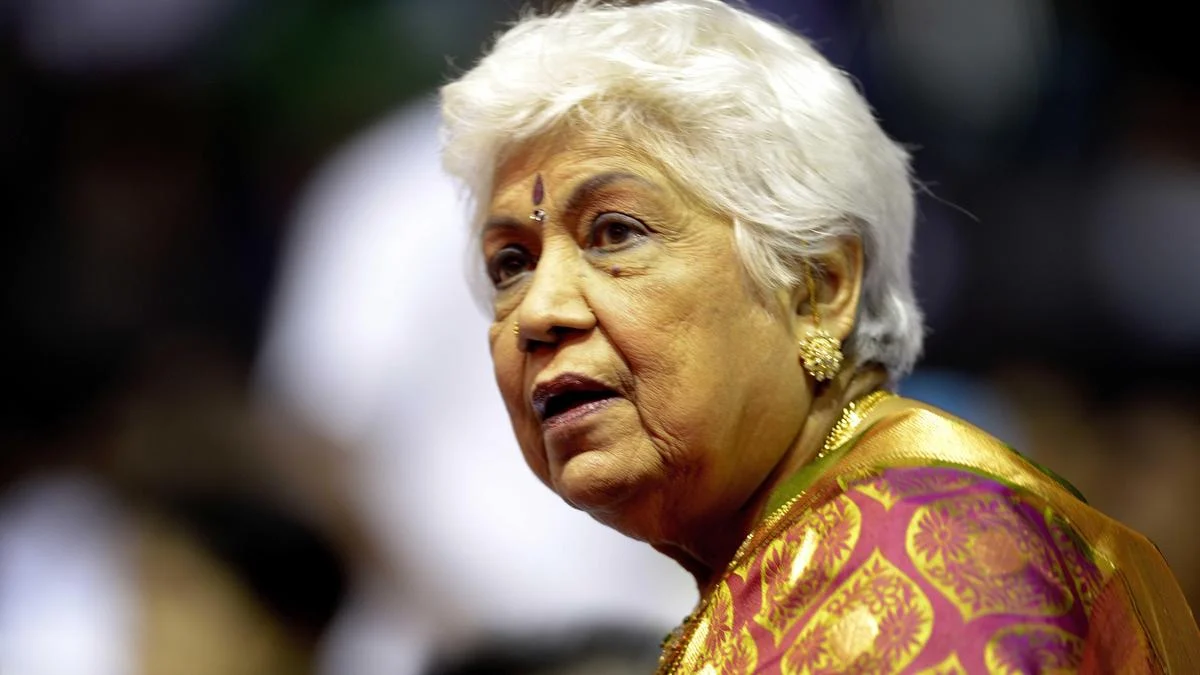
Chennai, India – The South Indian film industry is in mourning following the passing of the legendary actress ‘Sowcar’ Janaki, who passed away at the remarkable age of 94. Until her demise, she stood as arguably the oldest surviving luminary of South Indian cinema, a testament to a career that spanned decades and left an indelible mark on Tamil, Telugu, and Kannada cinema. Known for her breathtaking versatility and ability to embody a vast spectrum of characters, Janaki was more than just an actress; she was a cultural icon whose performances continue to resonate with audiences. Her journey from a young woman with a passion for radio dramas to a celebrated Padma Shri awardee is a compelling narrative of talent, resilience, and an unwavering dedication to her craft.

The Genesis of a Star: From Radio Waves to the Silver Screen
Born in 1931 in Rajahmundry, Andhra Pradesh, into a conservative Brahmin family, Janaki’s early life was steeped in intellectual pursuits. Her father, a proponent of education who had studied paper-making technology in England, fostered an environment where English was the primary language at home. In stark contrast to the burgeoning film culture of the era, watching movies was considered taboo within her household. However, this restrictive environment did little to dampen her spirit. Instead, it nurtured a deep love for the auditory arts, with listening to the radio becoming her cherished pastime. It was through All India Radio that Janaki’s natural talent for performance began to blossom. She actively participated in radio dramas, her robust voice and innate dramatic flair quickly earning her recognition. Her consistent excellence led to her being recognized as an A-grade artist, a significant achievement that foreshadowed her eventual ascent to cinematic stardom.

The moniker "Sowcar" became intrinsically linked to her identity following her debut in the Telugu film Shavukaru (meaning "moneylender" or "financier"). Directed by the eminent L.V. Prasad, the film’s title resonated so strongly with her performance that it became an inseparable part of her name, a permanent badge of her early success. This marked the beginning of a cinematic journey that would see her become a household name across South India.

A Versatile Reign: Tamil Cinema’s Enduring Darling
Janaki’s foray into Tamil cinema commenced with the film Valayapathi in 1952. From this point onwards, she embarked on a remarkable trajectory, consistently delivering performances that showcased an extraordinary range of emotions and a profound understanding of character. Her association with some of the most melodious songs and impactful roles in Tamil cinema cemented her status as a leading actress. She was celebrated for her inherent style, the finesse with which she delivered her lines, a regal presence, and an unparalleled ability to convey a myriad of expressions. This mastery of emotional portrayal even earned her the poignant title of the "weeping face," a descriptor that, while acknowledging her skill in evoking pathos, perhaps understated the sheer breadth of her acting prowess. Despite such accolades, Janaki herself identified as a feminist, a sentiment that likely informed her strong portrayals of women navigating societal expectations and personal challenges.

Her career was marked by collaborations with some of the most influential figures in Tamil Nadu’s political and cinematic landscape. She had the distinction of acting alongside three Chief Ministers of Tamil Nadu: the legendary M.G. Ramachandran, the prolific screenwriter and politician M. Karunanidhi, and the iconic actress-turned-politician J. Jayalalithaa. In Telugu cinema, she shared the screen with the formidable N.T. Rama Rao, further highlighting the pan-Indian appeal and respect she commanded.

Director K. Balachander, a filmmaker renowned for his astute character studies and launching pad for many a star, considered Janaki one of his favourite actors. Her performance as the feigning mother of Rajinikanth in Balachander’s Thillu Mullu remains a classic example of her comedic timing and ability to portray complex, albeit humorous, deception. The scene where she dramatically exclaims, "Enakku konjam bayama irukku" ("I am a little scared") followed by "Pressure konjam jasthiya irukku" ("The pressure is a bit too much") elicited widespread laughter and showcased her adeptness in lighter roles.

The legacy of ‘Sowcar’ Janaki is also intrinsically linked to the musical landscape of South Indian cinema. The haunting melody "Maalaipozhuthin Mayakkathile Naan Kanavu Kanden Thozhi" from the film Bhagyalakshmi, though composed by the legendary duo Viswanathan-Ramamoorthy, holds a special place in the heart of maestro Ilaiyaraaja. This song invariably evokes the image of Janaki, who portrayed a poignant widow in the film, a role that further underscored her ability to convey profound emotional depth. Her presence in Babu, a film starring the legendary Sivaji Ganesan, was equally significant. In this cinematic outing, she played the pivotal role of Sridevi’s mother, a character that demanded both strength and vulnerability.

A Life of Contrasts: From Privilege to Poverty and Back
In a poignant parallel, Janaki’s own life journey mirrored the narrative of the impoverished mother she portrayed in Babu, a woman born into wealth but later facing abject poverty. Her early life, while rooted in a relatively privileged and intellectually stimulating environment, was also marked by a strict conservative upbringing that prohibited pursuits considered frivolous, such as filmmaking. This familial resistance was so strong that she was married at the tender age of 15, and became a mother at 17, seemingly curtailing any aspirations beyond domesticity.

However, fate, as it often does, had different plans. Janaki herself recounted in an interview with the esteemed actress Suhasini Maniratnam, how an unexpected door opened for her in the world of cinema. Nagi Reddi, a prominent Telugu film producer, was reportedly captivated by her voice and offered her a role in one of his films. Despite her family’s staunch opposition, which led to her early marriage, an opportunity eventually presented itself. The stark reality of her initial years in the film industry was one of significant hardship. Janaki spoke candidly about the abject poverty she endured as a mother of two children when she first ventured into cinema, a testament to her early struggles and the sheer determination required to establish herself.

The Thespian’s Counterpart: Holding Her Own Against Legends
While many actresses graced the screen opposite the iconic Sivaji Ganesan, ‘Sowcar’ Janaki’s performances in films like Puthiya Paravai, Uyarntha Manithan, and Mahakavi Kalidas consistently stood their ground, matching the brilliance of the thespian himself. Her captivating songs, evocative body language, and impeccable dialogue delivery commanded the audience’s attention, ensuring that her performances were always noteworthy.

Her first film with Sivaji Ganesan was Paavai Vilakku. Although Padikkatha Medhai was released prior to Paavai Vilakku, it was in Paavai Vilakku that the legendary pairing first appeared on screen. In Puthiya Paravai, Janaki’s entrance, characterized by her extraordinary hairstyle and a stylish Singapore-inspired costume, humming to the rhythm of bongos while Sivaji Ganesan lit a cigarette, is etched in cinematic memory. Her expression in the song "Paartha Gnaabagam Illaiyo" was nothing short of stunning, a visual masterpiece that complemented the song’s melancholic undertones. Her role in subtly tormenting Sivaji Ganesan throughout the film, particularly in the evocative song "Enge Nimmathi, Enge Nimmathi," remains another significant highlight of her career.

The breadth of her talent was further illuminated when her roles were juxtaposed. Her portrayal of the princess in Mahakavi Kalidoss, who was compelled into marriage with Kalidoss, showcased a different facet of her acting prowess. This was in contrast to her role as the spirited housewife in Ethir Neechal, where she delivered the memorable song "Aduthathu Ambujatha Paarthela." These diverse characters offered profound glimpses into her innate ability to inhabit the skin of her characters, transforming them into believable and captivating individuals. Furthermore, her role as Sivaji Ganesan’s imperious wife in Uyarntha Manithan solidified her reputation for portraying strong, complex female characters. Another film where her talent shone brightly was Kaviya Thalaivi.

Veteran actor Sivakumar, who shared the screen with her in films such as Uyarndha Manithan and Motor Sundaram Pillai, estimated that Janaki had acted in approximately 450 films. This staggering number is a testament to her prolific career and her enduring appeal across generations of filmmakers and audiences.

A Cherished Collaborator and a Feminist Icon
‘Sowcar’ Janaki held the distinction of being the first film actress to grace the stage in K. Balachander’s play Mezhuguvarthi. This collaboration led to her featuring in numerous films directed by Balachander, a director known for his keen eye for performance and his ability to extract nuanced portrayals from his actors. In a heartfelt letter to Balachander, she expressed that her most significant and memorable cinematic experiences were predominantly with him, underscoring the profound impact their professional relationship had on her career.

Beyond her cinematic achievements, Janaki was also recognized for her contributions with prestigious accolades, including the Padma Shri and the Kalaimamani awards. These honours are a fitting tribute to a career that not only entertained but also enriched the cultural tapestry of South India. Her preference to identify as a feminist speaks volumes about her personal convictions and her approach to portraying women on screen – as individuals with agency, strength, and complexity.

The passing of ‘Sowcar’ Janaki leaves a void in the film industry, but her legacy is immortalized in the countless films she graced. Her performances, her voice, and her enduring spirit will continue to inspire and captivate audiences for generations to come. She was not merely an actress; she was a force of nature, a woman who defied conventions and carved her own unique path in the annals of Indian cinema.
