

VISAKHAPATNAM — In a significant move to bridge the gap between urban economic ecosystems and grassroots leadership, Visakhapatnam played host to a landmark conference titled "Celebrating Women Entrepreneurs: Urban Ecosystem and Grassroots Leadership" on Tuesday, June 16, 2026. The event, which transformed the city’s entrepreneurial landscape into a vibrant forum of innovation and advocacy, brought together a diverse cohort of stakeholders, including policymakers, industry titans, and micro-entrepreneurs from the hinterlands of Andhra Pradesh.
The summit was jointly organized by the Global Alliance for Mass Entrepreneurship (GAME) and Aspire For Her (AFH), in strategic partnership with the Women’s Wing of the Visakhapatnam Chamber of Commerce and Industry (VCCI). The day-long event served as both a celebration of existing successes and a rigorous workshop aimed at dismantling the systemic barriers that prevent women-led enterprises from scaling.
Main Facts: A Convergence of Vision and Venture
The core objective of the conference was to create a roadmap for women entrepreneurs to transition from "subsistence-level" businesses to "growth-oriented" enterprises. Central to the discussions were four pillars of modern business: market access, institutional finance, digital literacy, and the power of collaborative networking.
Visakhapatnam, often hailed as the executive capital of Andhra Pradesh, provided the ideal backdrop. As the city evolves into a logistics and technology hub, the inclusion of women in its economic fabric is seen as vital for sustainable regional growth. The presence of high-ranking officials, including Member of Parliament M. Sribharat and VMRDA (Visakhapatnam Metropolitan Region Development Authority) Commissioner N. Tej Bharath, signaled a strong political and administrative commitment to this cause.
The event featured:
- The Exhibition Zone: A curated space where traditional crafts met modern commerce.
- The Spotlight Sessions: Personal narratives from women who have navigated the "missing middle" of the Indian economy.
- The Hamsafal Programme Launch: A specialized initiative by AFH and GAME designed to provide end-to-end support for women-led ventures.
Chronology of the Event: From Policy to Practice
The proceedings commenced on Tuesday morning with an inaugural ceremony that set a tone of pragmatic optimism.
Morning Session: Policy and Infrastructure
The early hours were dominated by keynote addresses from MP M. Sribharat and Commissioner N. Tej Bharath. Unlike traditional ribbon-cutting ceremonies, this session transitioned quickly into a town-hall-style discussion. The leaders engaged directly with entrepreneurs, discussing how urban infrastructure—such as the VMRDA’s development projects—can better accommodate women-led trade hubs and local markets.
Mid-Day: The Panel Deliberations
By noon, the focus shifted to the "Urban Ecosystem" panel. Experts from the banking sector, digital marketing agencies, and the VCCI Women’s Wing debated the challenges of financial inclusion. A recurring theme was the "collateral crunch," where women entrepreneurs often struggle to secure loans due to a lack of property ownership.
Simultaneously, the "Grassroots Leadership" session highlighted the success of Farmer Producer Organizations (FPOs) and cooperatives. The highlight was the presentation by the Visakhapatnam Town Fisherwomen Dry Fish Cooperative Society, which demonstrated how collective bargaining and organized processing have sustained their community since the 1980s.
Afternoon: The Exhibition and Networking
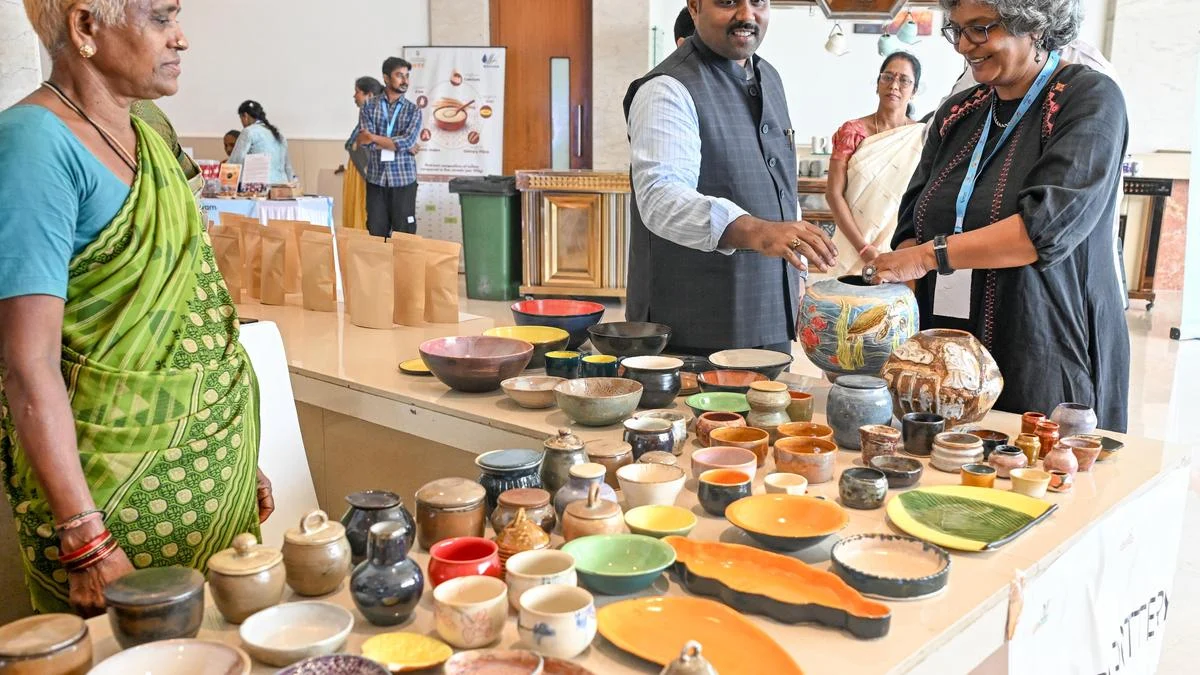
The post-lunch period saw the Exhibition Zone come alive. VMRDA Commissioner N. Tej Bharath conducted a detailed walkthrough of the stalls, spending significant time at the Arra Pottery display. The commissioner lauded the blend of traditional ceramic techniques with contemporary aesthetic appeal, noting that such products have high potential in both domestic and international lifestyle markets.
Evening: The Roadmap for Tomorrow
The conference concluded with the "Buyer-Seller Interaction" session. This was a tactical segment where entrepreneurs were introduced to potential corporate buyers and e-commerce aggregators. The day ended with a commitment from the organizers to turn the conference’s recommendations into a white paper for the state government.
Supporting Data: The Economic Reality of Women Entrepreneurs
The necessity of such a conference is underscored by the current economic data regarding women’s participation in the Indian workforce and entrepreneurship. While India has seen a rise in women-led startups, the majority remain in the "micro" category of the MSME (Micro, Small, and Medium Enterprises) sector.

- The Cooperative Legacy: The Visakhapatnam Town Fisherwomen Dry Fish Cooperative Society serves as a statistical outlier and a model of success. Registered in 1987, it boasts 164 active members. In a sector (fisheries) often dominated by male middlemen, this cooperative has managed to maintain a 39-year legacy of financial independence through processing and direct marketing.
- The Scale of Impact: Aspire For Her (AFH) revealed that their community now exceeds 1.2 million women nationwide. However, data shared during the summit suggested that less than 20% of these women have formal access to institutional credit, relying instead on personal savings or informal lenders.
- The Hamsafal Initiative: The newly discussed Hamsafal programme aims to address these gaps. By partnering with GAME, the program intends to mentor 50,000 women entrepreneurs in the next two years, focusing specifically on digital onboarding and "export-ready" certification.
Official Responses: Voices from the Leadership
The rhetoric from the summit reflected a shift from "empowerment" as a social cause to "empowerment" as an economic necessity.
MP M. Sribharat emphasized the role of Visakhapatnam as a catalyst for the state’s GDP. "We are not just looking at small-scale support; we are looking at how women-led businesses can become integral parts of our global supply chains. The spirit of entrepreneurship in Vizag is high, and our role is to ensure that the ‘Ease of Doing Business’ applies to the woman at the grassroots level just as much as it does to the tech giant," he stated.
VMRDA Commissioner N. Tej Bharath, while inspecting the handcrafted ceramic stalls, highlighted the importance of "Place-making" in urban development. "The VMRDA is committed to creating spaces where these entrepreneurs can showcase their talent. Whether it is through dedicated weekend markets or permanent kiosks in our parks and urban spaces, we want to ensure that ‘Arra Pottery’ and similar ventures have a visible, prestigious platform," Bharath said.
Subhash Kiran, Programme Director at GAME, provided the strategic context for the collaboration. "Entrepreneurship flourishes when local ecosystems work together. Our goal is to move beyond ‘subsistence livelihoods.’ We want to see these women become employers. Through our collaborations with community organizations and market partners, we are building the scaffolding they need to scale," Kiran explained to The Hindu on the sidelines of the event.
Divya Sampath of Aspire For Her focused on the power of the network. "With a community of 1.2 million, we have the data to understand exactly where the bottlenecks are. The Hamsafal programme is our answer to those bottlenecks. It’s about creating a ‘Hamsafar’ (a companion) for every woman on her business journey."
Implications: A New Paradigm for Regional Growth
The Visakhapatnam conference has several long-term implications for the regional and national economy:
1. The Formalization of the Informal Sector
By bringing groups like the Fisherwomen’s Cooperative to the same table as VMRDA officials, the event facilitates the formalization of informal trade. This leads to better data collection, which in turn allows for more targeted government subsidies and insurance schemes.
2. Bridging the Digital Divide
A significant portion of the summit was dedicated to digital opportunities. For entrepreneurs like those at Sankalpa Art Village, digital literacy means moving from local exhibitions to global platforms like Etsy or Instagram. The implication is a massive increase in the "Geographic Reach" of Andhra’s traditional crafts.
3. Strengthening the "Missing Middle"
Most women-led businesses in India are either very small (micro) or very large (corporate). There is a vacuum in the middle—the small and medium enterprises that drive employment. The focus on "scaling" at this conference suggests a concerted effort to fill this gap, which could lead to thousands of new local jobs.
4. Urban-Rural Synergy
The title of the conference itself—Urban Ecosystem and Grassroots Leadership—highlights a crucial realization: the products of the grassroots need the markets of the urban ecosystem. Visakhapatnam, as a consumption center, is now being officially linked to the production centers of the surrounding rural districts.
Conclusion
The "Celebrating Women Entrepreneurs" conference was more than a celebratory event; it was a strategic alignment of intent and action. By focusing on the tangible—market access, finance, and digital tools—rather than just the abstract concept of empowerment, the organizers and the city of Visakhapatnam have set a benchmark.
As the handcrafted ceramics of Arra Pottery and the processed goods of the Fisherwomen’s Cooperative find their way into larger markets, the success of this summit will be measured not by the speeches made, but by the growth charts of the women who attended. In the evolving economic narrative of Andhra Pradesh, the message from Visakhapatnam is clear: the future of the economy is not just urban and digital, but inclusive and female-led.
