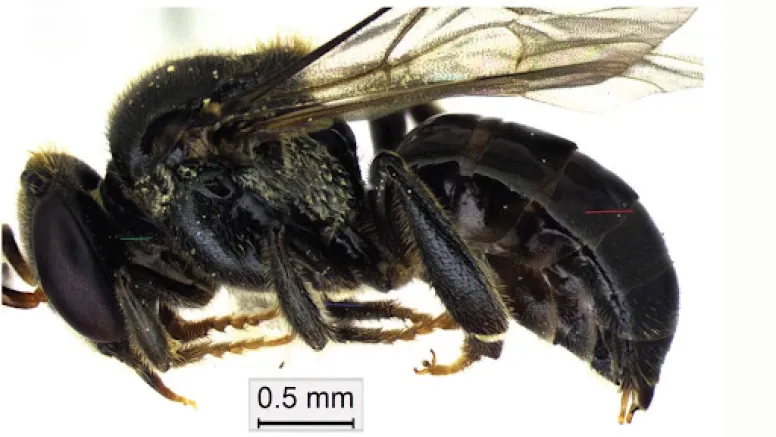
MEDZIPHEMA, NAGALAND — In the dense, moisture-laden forests of Northeast India, a region long celebrated as a global biodiversity hotspot, scientists have unearthed a secret hidden nearly a meter beneath the earth’s surface. A collaborative team of entomologists has officially identified a new species of stingless honey bee, Tetragonula nagalandensis, marking a significant milestone in the documentation of India’s avian and insect wealth.
The discovery, published by researchers from the University of Agricultural Sciences (UAS) Bengaluru, Nagaland University, and the Central Agricultural University (Imphal), brings the total number of recorded stingless bee species in India to 19. Living in subterranean colonies nearly 80 centimeters deep, this tiny pollinator challenges conventional understandings of bee habitats and highlights the urgent need for expanded taxonomic surveys in the Indo-Burma biological corridor.
I. Main Facts: The Discovery of Tetragonula nagalandensis
The newly identified species, Tetragonula nagalandensis, is a member of the Meliponini tribe—commonly known as stingless bees. While they possess a stinger, it is highly reduced and evolutionarily non-functional for defense, leading these bees to employ alternative strategies for survival.
Key Characteristics at a Glance:
- Scientific Name: Tetragonula nagalandensis
- Type Locality: Medziphema region, Nagaland, India.
- Habitat: Subterranean; feral colonies found in moist soil at depths of 70 to 80 centimeters.
- Physical Size: Approximately 5 millimeters in length.
- Identifying Features: A distinct C-shaped notch on the male’s fifth sternite (underside) and a sharply curved penis valve.
- Nesting Structure: Compact clusters of brood cells protected by multiple thin layers of wax and organic resins (propolis).
The discovery is particularly notable because it underscores the "cryptic diversity" of the Tetragonula genus. To the naked eye, many stingless bee species appear identical. It is only through high-resolution microscopy and the study of male reproductive anatomy that scientists can distinguish one species from another.
II. Chronology: From the Forest Floor to the Laboratory
The journey to identifying T. nagalandensis was a multi-year endeavor that required equal parts traditional field craft and modern forensic entomology.
Phase 1: The Field Expedition (2023–2024)
The research team began an intensive survey of the Nagaland hills, focusing on the Medziphema region. Unlike standard honey bees (Apis mellifera or Apis cerana) that build exposed or cavity-based hives in trees, stingless bees are notoriously difficult to spot. The researchers looked for "entrance tubes"—small, waxy pipes protruding from the soil surface that serve as the only gateway to the underground city.

Phase 2: The Excavation
Upon locating a feral colony, the team undertook a delicate excavation process. They followed the entrance tubes through moist, compact soil, digging down nearly a meter. At a depth of 80 centimeters, they discovered the heart of the colony. The nest was not arranged in the traditional vertical combs seen in honeybees but in a "brood cluster" formation, where individual cells are bunched together like grapes.
Phase 3: The Search for the Male
In the world of bee taxonomy, females (workers) are often morphologically indistinguishable between species. To confirm a new species, scientists must find the male. The team utilized "pan trapping"—placing bowls of water near the nest sites—to capture male specimens. The males of T. nagalandensis were eventually secured, providing the "biological fingerprint" necessary for a formal description.
Phase 4: Comparative Analysis
The specimens were transported to laboratories at UAS Bengaluru. Here, researchers compared the Nagaland specimens with existing holotypes of related species, such as T. kyrdemkulaiensis (found in Meghalaya) and T. iridipennis. By late 2025, the team concluded that the Nagaland bee was a distinct, previously unrecorded species.
III. Supporting Data: Anatomical Precision and Nesting Architecture
The formal classification of T. nagalandensis relies on minute anatomical differences that separate it from its closest relatives.
Morphological Divergence
While T. nagalandensis shares a superficial resemblance to T. kyrdemkulaiensis, it is significantly smaller. The primary diagnostic tool used by the researchers was the male genitalia and the structure of the abdominal segments.
- The Fifth Sternite: In T. nagalandensis, the fifth abdominal segment of the male features a deep, C-shaped notch.
- The Penis Valve: The reproductive organ (penis valve) is sharply curved and robust, a feature not seen in other Indian Tetragonula species.
Subterranean Engineering
The nesting habits of this species represent an evolutionary adaptation to the climate of Northeast India. By nesting 80 centimeters underground, the bees are insulated from the extreme temperature fluctuations of the Nagaland hills.

- The Involucrum: The nest is encased in an involucrum—a multilayered sheath of wax and propolis. This structure acts as a waterproof barrier, preventing the moist soil from flooding the brood chamber.
- Storage Pots: Surrounding the brood cells are larger "pots" made of dark cerumen (a mix of wax and plant resin) used to store honey and pollen.
IV. The "Hanging Bee" Breakthrough: T. srikantanathi
During the same survey that yielded the new species, the researchers achieved a second scientific "first." They captured the first-ever male specimen of Tetragonula srikantanathi.
Previously, T. srikantanathi was known only from worker bees. This species is famous for its "hanging nests," where the brood combs are arranged in single-cell-thick layers that dangle horizontally within tree cavities or rock overhangs. By capturing the male of this species, the researchers have completed the taxonomic profile for T. srikantanathi, allowing for more accurate DNA barcoding and comparative studies in the future.
V. Official Responses and Academic Perspectives
The discovery has been met with enthusiasm from the Indian scientific community, highlighting the role of regional universities in global conservation efforts.
Dr. S. Ramani, a veteran entomologist (formerly of UAS Bengaluru) and a lead contributor to the study, emphasized the importance of male-based taxonomy:
"In stingless bees, the workers are ‘evolutionary mimics’ of one another. If we only look at the workers, we miss the true diversity of the genus. Finding the male of T. nagalandensis was the ‘Eureka’ moment that allowed us to say with certainty that this is a species new to science."
Representatives from Nagaland University noted that the discovery is a point of pride for the state:

"Naming the species nagalandensis is a tribute to the rich natural heritage of our land. It reminds us that even in areas we think we know well, there are wonders waiting just beneath our feet. This discovery underscores the importance of protecting Nagaland’s primary forests from deforestation."
VI. Implications: Why a Small Bee Matters for a Big Planet
The discovery of Tetragonula nagalandensis carries weight far beyond the world of academic entomology. It has profound implications for agriculture, conservation, and climate resilience.
1. The Pollination Powerhouse
Stingless bees are among the most efficient pollinators of tropical flora. Because of their small size, they can access flowers that larger honeybees cannot. In Northeast India, these bees are vital for the pollination of high-value crops like cardamom, litchi, and various citrus fruits, as well as the wild vegetation that maintains the forest canopy.
2. The Pollinator Crisis
Globally, bee populations are in decline due to pesticide use, habitat loss, and climate change. Most conservation efforts focus on the European Honeybee (Apis mellifera), but native species like T. nagalandensis are often better adapted to local environments. Identifying these species is the first step toward creating "native-first" conservation strategies.
3. Traditional Medicine and Meliponiculture
In many parts of India, the honey produced by stingless bees (often called "Putka" or "Dammar" honey) is prized for its medicinal properties. It is higher in acidity and antioxidant content than regular honey. By identifying and understanding the nesting habits of subterranean bees, researchers can help local communities develop sustainable "meliponiculture" (stingless bee farming) techniques that do not require destroying wild colonies.
4. Biodiversity Mapping in the Northeast
The discovery suggests that the Himalayan foothills and the Northeast states likely harbor dozens of other undiscovered insect species. The researchers argue that a systematic, well-funded survey of India’s soil-dwelling insects is necessary to map the country’s true biological wealth before it is lost to urban expansion.

Conclusion: The Unseen Guardians of the Soil
The discovery of Tetragonula nagalandensis serves as a humbling reminder of the complexity of the natural world. While human activity often focuses on the visible landscape, a vital part of the Earth’s life-support system operates in the darkness of the soil.
As the team from Bengaluru, Nagaland, and Imphal continues their work, the focus now shifts to protecting the habitat of this 5-millimeter marvel. The "Bee of Nagaland" is more than just a new name in a taxonomic ledger; it is a sentinel for the health of the subterranean ecosystem, a master engineer of the earth, and a tiny but mighty contributor to the food security of the region.
Scientists hope that this breakthrough will inspire a new generation of Indian entomologists to look closer at the ground they walk on, for as T. nagalandensis proves, the next great discovery may be less than a meter away.