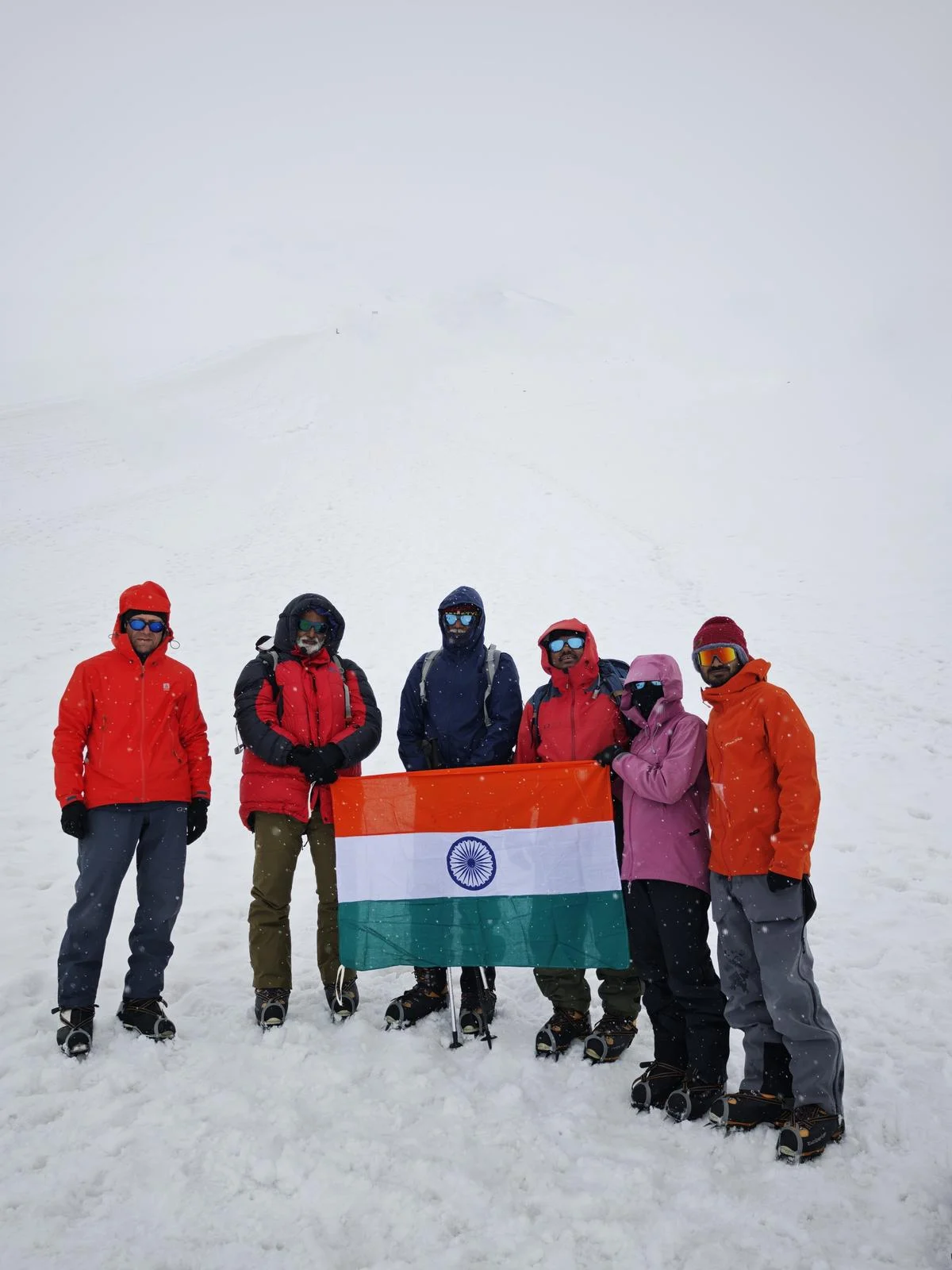
WAYANAD, KERALA — At an age when most individuals are settling into the quiet rhythms of post-retirement life, T.J. Marce, a 74-year-old retired employee of the Kerala State Road Transport Corporation (KSRTC), is busy rewriting the narrative of human endurance. On August 15, 2026, as India celebrated its 80th Independence Day, Marce stood atop the 5,642-metre (18,510 ft) summit of Mount Elbrus in Russia. In doing so, he not only hoisted the tricolour on Europe’s highest peak but also etched his name into the annals of Indian mountaineering as potentially the oldest Indian to achieve this feat.
The expedition, which saw a five-member team from Kerala navigate the treacherous slopes of the Caucasus range, serves as a testament to the fact that the spirit of adventure knows no chronological boundaries. For Marce, this was more than a climb; it was the second chapter of a late-blooming odyssey to conquer the "Seven Summits"—the highest peaks of each of the seven continents.
The Ascent: Defying the Elements on India’s 80th Independence Day
The final push for the summit of Mount Elbrus is notorious for its psychological and physical toll. Located in the Kabardino-Balkaria region of Russia, Elbrus is a dormant volcano with two summits. The Western summit, standing at 5,642 metres, is the objective of elite climbers worldwide.
The Kerala-based team, led by seasoned mountaineer S. Seshadri, began their eight-day expedition in early August. By the time they reached the "saddle point"—the high-altitude pass between the mountain’s twin peaks—they were greeted by the raw fury of the Caucasus. Reports from the team indicate they faced biting cold and gale-force winds reaching speeds of 65 km/h.
On the morning of August 15, the team braved these extreme conditions to reach the peak. Joining Marce at the summit were S. Seshadri (Lead), G.J. Aghina Soorya (Co-lead and the team’s sole female member), M.P. Muraleedharan (66), and P. Athif. The timing was symbolic, aimed at marking eight decades of Indian independence from one of the highest vantage points in the Northern Hemisphere.
Chronology of a Late-Life Mountaineering Career
T.J. Marce’s journey to the top of the world did not begin in his youth, but rather in the golden years following his service with the KSRTC. His trajectory over the last few years highlights a rapid progression from local trekking enthusiast to international high-altitude climber.
1. The Foundation: Everest Base Camp
Before tackling the Seven Summits, Marce and his long-time climbing partner, 66-year-old M.P. Muraleedharan, tested their mettle on the rugged trails of the Himalayas. They successfully completed the Everest Base Camp (EBC) trek in Nepal, a journey that takes hikers to an altitude of 5,364 metres. While not a summit, the EBC trek is a grueling test of cardiovascular health and acclimatization, proving to Marce that his body could handle the thin air of the "Death Zone" periphery.

2. September 2025: Mount Kilimanjaro
In September 2025, Marce and Muraleedharan took their ambitions to the African continent. They summited Mount Kilimanjaro (5,895 metres) in Tanzania. Kilimanjaro, the highest free-standing mountain in the world, served as Marce’s first official entry into the Seven Summits club. This success provided the confidence and the logistical blueprint for the Elbrus expedition.
3. August 2026: Mount Elbrus
Less than a year after his African triumph, Marce focused on Europe. Mount Elbrus, while lower in absolute elevation than Kilimanjaro, presents a different set of challenges, including permanent snowfields, glacial crevasses, and volatile Arctic-adjacent weather patterns. At the age of 74 years, six months, and 26 days, Marce’s successful summit on August 15 marked his second continental peak in 11 months.
Supporting Data: The Logistics of an Over-70 Expedition
Mountaineering at 74 requires more than just willpower; it necessitates a sophisticated approach to physiology and logistics. The team’s success was underpinned by several critical factors:
- Acclimatization Schedule: The eight-day window for the Elbrus climb included multiple "climb high, sleep low" rotations. This is vital for older climbers to prevent High-Altitude Pulmonary Edema (HAPE) and High-Altitude Cerebral Edema (HACE).
- The Team Composition: The expedition drew talent from across Northern Kerala. Marce, Seshadri, and Muraleedharan represented Wayanad, a region known for its hilly terrain which served as their primary training ground. Aghina Soorya brought expertise from Kozhikode, and P. Athif joined from Malappuram.
- Weather Windows: The team encountered the strongest winds after the saddle point. Navigating 65 km/h winds at sub-zero temperatures requires specialized gear and a high level of physical stability, which the team maintained despite the age of its senior members.
According to online records and mountaineering databases currently available, Marce is believed to be the oldest Indian national to reach the Elbrus summit. While official verification from national mountaineering federations is often a multi-month process, the team’s documentation of the ascent remains robust.
Official Responses and Personal Reflections
Speaking from the perspective of the expedition leadership, S. Seshadri emphasized that the journey was about more than just reaching a geographical point.
"The summit is only one part of the journey," Seshadri remarked. "The preparation, the people, the challenges, and the safe return are equally important. The journey to the mountains on foot is transformational, and we want more people to experience that. From the first trail to the highest mountains, we believe everyone must trek."
For Marce, a native of Kavumannam in the Thariode grama panchayat, the motivation is deeply personal and rooted in a lifelong love for the wilderness.

"From a young age, I have been interested in trekking and sightseeing. I have always been fascinated by the wild and wanted to experience it more," Marce said. "When I summit a mountain and look down, it gives me a different kind of satisfaction. The expedition itself gives me a lot of energy. I want to summit more mountains, but that requires a lot of planning and preparation. Maybe I will undertake my next big trek next year."
Implications: Redefining Retirement and Senior Fitness
The achievements of T.J. Marce and M.P. Muraleedharan (66) carry significant implications for the discourse on ageing in India. Their success challenges the stereotypical view of retirement as a period of physical decline.
1. The "Active Ageing" Movement
Marce’s feat serves as a high-profile example of the "Active Ageing" movement. By maintaining a rigorous fitness regimen in the hills of Wayanad, he has demonstrated that the physiological capacity for high-altitude endurance can be preserved well into the eighth decade of life. This has inspired a burgeoning community of senior trekkers in Kerala, a state that already boasts high life expectancy and a growing interest in wellness tourism.
2. Kerala’s Growing Mountaineering Culture
Traditionally, Indian mountaineering has been dominated by residents of the Himalayan states. However, the success of this five-member team from Wayanad, Kozhikode, and Malappuram signals a shift. The Western Ghats are increasingly being used as a training ground for international expeditions, and the Kerala mountaineering community is becoming more organized and ambitious.
3. The Seven Summits Ambition
With two peaks (Kilimanjaro and Elbrus) and the Everest Base Camp already under his belt, Marce is now a serious contender in the global community of senior mountaineers. His progress raises the possibility of an Indian septuagenarian completing the Seven Summits, a feat that would gain international recognition.
Conclusion: The Path Ahead
As T.J. Marce returns to the mist-covered valleys of Wayanad, he does not speak of resting. His eyes are already set on 2027. While the specific mountain for his next expedition remains under wraps—dependent on "planning and preparation"—the momentum he has built over the last year suggests that the world has not seen the last of the "Mountain Man of Kavumannam."
His story remains a powerful reminder that while the body may age, the horizon remains infinite for those with the courage to keep walking. In the thin air of the Caucasus, Marce found more than just a view; he found a new dimension to life, proving that for some, the summit is just the beginning.