

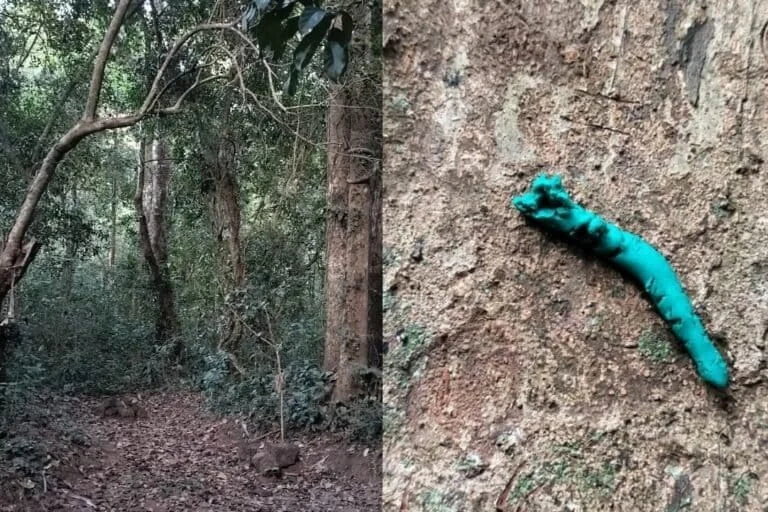
Across the verdant landscape of Kerala, nestled between sprawling coconut plantations and bustling rural settlements, lie ancient pockets of biodiversity known as sacred groves. These "islands" of primary forest, preserved for centuries through religious taboo and community reverence, have long been viewed as cultural relics. However, a groundbreaking new study from the Ecology Lab at the Central University of Kerala reveals that these groves are far more than just spiritual sanctuaries; they are high-functioning ecological engines.
The research, recently published in the journal Applied Ecology, demonstrates that sacred groves maintain significantly higher rates of predation—a critical ecological process—compared to the multi-storied home gardens that characterize the region. By examining the interactions between predators and caterpillars, researchers have provided empirical evidence that these small, isolated forest patches are essential for regulating insect populations and maintaining the stability of the broader environment.
Main Facts: The Functional Superiority of Sacred Groves
The core of the study revolves around "trophic interactions"—the way energy moves through an ecosystem via the food chain. Specifically, the researchers focused on the predation of caterpillars, which are primary herbivores. In a healthy ecosystem, predators such as birds, ants, and spiders keep caterpillar populations in check, preventing them from over-consuming vegetation.
The study’s findings are definitive: predation rates were consistently and significantly higher in sacred groves than in nearby home gardens. This suggests that the "ecological health" of a sacred grove—measured by its ability to facilitate natural pest control—is superior to that of human-managed agricultural spaces, even those as complex as Kerala’s famous multi-storied home gardens.
"Species richness or abundance studies capture only the structure of ecosystems, not how they function," explains Gopika Viswan, a researcher at the Ecology Lab and the study’s co-author. "Ecosystems are sustained not merely by the presence of species, but by interactions among them. Predation is a fundamental ecological process that shapes community structure and ecosystem functioning."
Key findings from the data include:
- Dominant Predators: Arthropods, particularly ants, were the primary drivers of predation, accounting for 57-61% of all recorded attacks.
- Avian Influence: Insectivorous birds were the second most active group, contributing to 22-35% of predation events.
- Habitat Complexity: The structural density of sacred groves—comprising ancient trees, thick leaf litter, and undisturbed undergrowth—provided a more effective hunting ground than the more "ordered" environment of a home garden.
Chronology: Two Years of Fieldwork in the Malabar Mosaic
The study was conducted in the northern Malabar region of Kerala’s Kasaragod district. This area is a unique geographical mosaic, where at least 117 sacred groves are scattered across a landscape dominated by human activity, stretching from the foothills of the Western Ghats to the shores of the Arabian Sea.

Phase 1: Site Selection and Setup (2023)
The research team selected 12 distinct sites located at varying distances (between 8 km and 44 km) from the Western Ghats. The Western Ghats, a UNESCO World Heritage site and a global biodiversity hotspot, served as the "source pool" for species in this experiment. To ensure a fair comparison, the researchers utilized a "paired site" approach: each selected sacred grove was matched with a multi-storied home garden located just 1 to 2 kilometers away.
Phase 2: Winter Fieldwork (January – February 2024)
The first round of intensive fieldwork took place during the peak of the dry season. This period was chosen strategically, as it coincides with the highest activity levels of insectivorous birds and arthropods in the region. During this window, the team deployed the first massive wave of artificial "sentinel" prey.
Phase 3: Secondary Testing and Data Refinement (January – February 2025)
In the second year, the researchers expanded their methodology. In addition to the artificial models used in the first year, they introduced freeze-killed mealworms to gain a more granular understanding of which specific insect predators were involved in the attacks. By the end of this period, the team had collected enough data to run complex generalized linear mixed-effects models (GLMMs) to account for variables like caterpillar color, placement, and distance from the forest source.
Supporting Data: The Plasticine Caterpillar Method
To measure predation without spending thousands of hours in direct observation, the researchers turned to a widely accepted ecological "detective" tool: plasticine caterpillars.
The team deployed 1,296 artificial caterpillars made from non-toxic, non-hardening, and non-drying plasticine. These models were designed to mimic the most common larvae found in the region, appearing in two colors: green (mimicry for camouflage) and reddish-brown (mimicry for bark/stems).
Why Plasticine?
The soft nature of plasticine is crucial because it acts as a "recording device" for predator behavior. When a bird pecks at the model, it leaves a V-shaped mark; when an ant or a wasp bites it, it leaves tiny serrated indentations; and when a small mammal gnaws on it, it leaves distinct tooth marks.
The results of this "clay-model" census revealed several layers of ecological data:

- Color Preference: Brown caterpillars were attacked more frequently than green ones. This suggests that in the shaded, complex light of a grove, camouflage is a highly effective survival strategy, and predators are more likely to target prey that stands out against the green foliage.
- Micro-Habitat Variation: Caterpillars placed on branches and stems experienced higher predation rates than those placed on leaves. This highlights the importance of the "woody" structure of the forest in facilitating predator movement.
- The "Ant" Factor: The overwhelming dominance of arthropod predation (over 60% in some areas) underscores the role of ants as the "invisible police" of the forest, providing a level of pest control that is often overlooked in favor of larger animals like birds.
Official Responses: Challenging Ecological Theories
The study’s findings have sparked significant interest in the scientific community because they challenge "Island Biogeography Theory"—a cornerstone of conservation biology. Usually, this theory suggests that the further a "habitat island" (like a sacred grove) is from a "mainland" (like the Western Ghats), the lower its biodiversity and ecological function will be.
However, the Kerala study produced a surprising anomaly.
"One of the most surprising outcomes was that predation did not follow a simple, uniform decline with increasing distance from the Western Ghats," says Palatty Allesh Sinu, Associate Professor at the Ecology Lab and the study’s corresponding author. "While predation did decline with distance within the sacred groves—as expected—the opposite happened in home gardens. In those managed spaces, both overall and bird predation actually increased the further they were from the Western Ghats."
This "Paradox of the Home Garden" suggests that when forest-dwelling predators are absent, other opportunistic species in human-dominated landscapes might step in to fill the vacuum, though they do so less consistently than the specialized predators found in the sacred groves.
Bhavya Lakshmi, a co-author of the study, emphasizes that the quality of the habitat is more important than the size. "Grove size did not explain the observed patterns. This indicates that habitat quality and structural complexity—the layers of plants, the age of the trees, the lack of human interference—buffer the negative effects of being isolated and small."
Implications: A New Paradigm for Conservation
The findings of this study have profound implications for environmental policy and conservation strategy in India and beyond.
1. Beyond "Big Forest" Conservation
For decades, conservation efforts have focused on protecting large, continuous tracts of forest (such as National Parks). While these are vital, the Kerala study proves that small, "fragmented" patches like sacred groves are not ecological "dead ends." Instead, they are high-performing refugia that maintain essential services like natural pest control.

2. Valuing Cultural Conservation
Sacred groves (Kavu in Malayalam) are often protected because of their association with deities like Naga (serpents) or Bhagavathi (the Mother Goddess). This study provides a "secular" and scientific justification for these religious traditions. It suggests that traditional knowledge and cultural taboos have inadvertently created a network of highly efficient ecological "service stations" across the landscape.
3. Improving Agricultural Resilience
By maintaining sacred groves near agricultural lands and home gardens, farmers benefit from "spillover" effects. The predators harbored in the groves—the ants and birds—likely move into the surrounding gardens, providing free, non-toxic pest management for crops like black pepper, areca nut, and coconut.
4. Climate and Ecosystem Stability
As climate change disrupts insect breeding cycles, the "buffering" effect of sacred groves becomes even more critical. "Changes in predation can trigger strong ecological consequences, including trophic cascades," warns Gopika Viswan. By preserving these groves, Kerala is essentially maintaining a "safety net" for its regional ecosystem stability.
Conclusion
The research from the Central University of Kerala serves as a powerful reminder that in the world of ecology, size isn’t everything. These small, ancient fragments of the Western Ghats, preserved by the faith of local communities, are performing a Herculean task in silence.
As India continues to urbanize and agricultural landscapes become more homogenous, the protection of sacred groves must transition from a matter of local tradition to a priority of national environmental policy. To lose a sacred grove is not just to lose a place of worship or a patch of trees; it is to lose a vital link in the chain of life that keeps the entire landscape healthy.
