

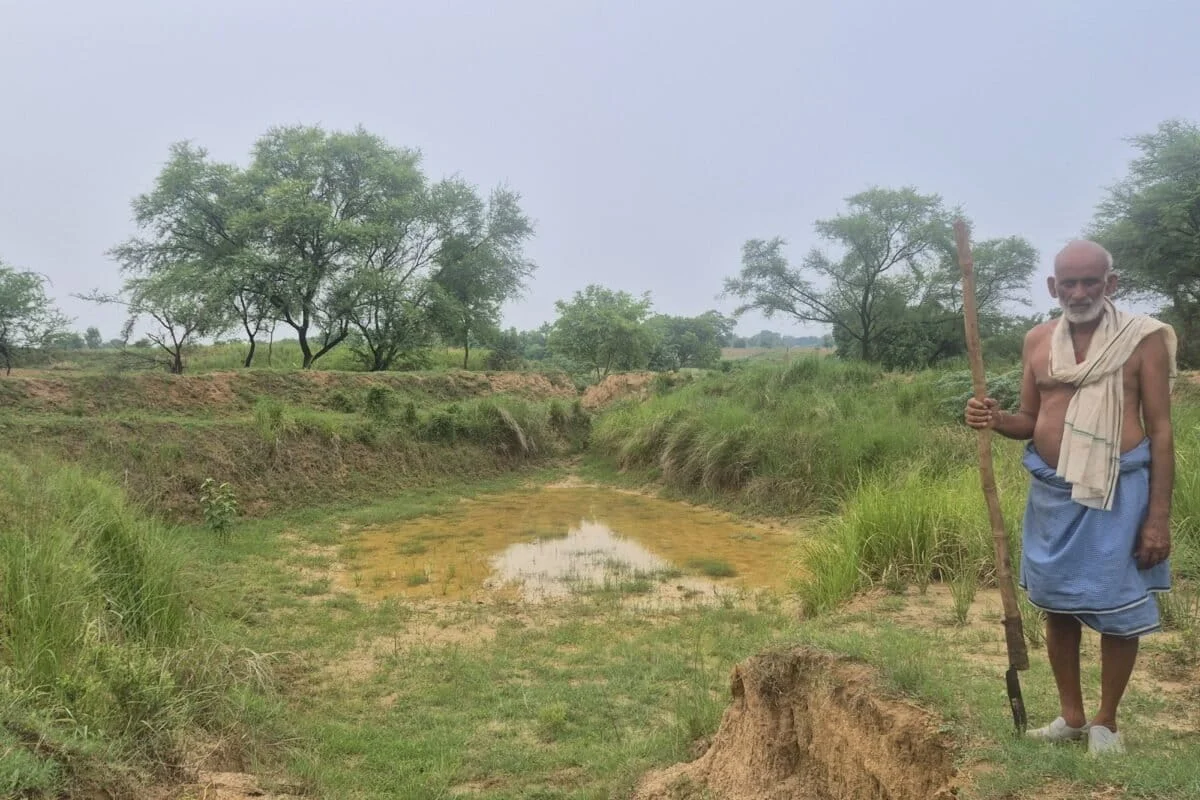
BUNDELKHAND, INDIA — In the parched expanses of Uttar Pradesh’s Banda district, 35-year-old Vipin Kumar Yadav stands at the edge of a ten-foot-deep excavation on his land. Known locally as a khet talab (farm pond), this structure was designed to be his insurance policy against the region’s notorious droughts. But this July, as the searing heat of Bundelkhand lingered and the monsoon remained elusive, the pond offered little comfort.
“Very low rain this year; only one rain in this season till now,” Yadav lamented. Last year, his pond was a reservoir of prosperity, brimming with water that allowed him to more than double his wheat yield. This year, the water level hasn’t even reached the five-foot mark. “I am worried: how will the wheat and mustard crops get water this year?”
Yadav’s anxiety is shared by thousands of farmers across the Bundelkhand region, a semi-arid territory straddling the states of Uttar Pradesh and Madhya Pradesh. While the Indian government has aggressively promoted farm ponds as a decentralized solution to climate vulnerability, a combination of erratic rainfall, poor scientific planning, and a lack of maintenance infrastructure is threatening to turn these "reservoirs of hope" into empty pits of debt.

Main Facts: A Region on the Edge
Bundelkhand is one of India’s most climate-vulnerable regions. Traditionally dependent on rainfall for its two primary cropping seasons—Kharif (monsoon) and Rabi (winter)—the area has seen a dramatic shift in weather patterns. According to the Uttar Pradesh Agriculture Statistics 2022-23, irrigation coverage remains low: only 47% in Chitrakoot, 54% in Mahoba, and 61% in Banda.
The current crisis is exacerbated by a significant rainfall deficit. By August 1, 2024, rainfall in Banda was 26% below normal, while Mahoba faced a staggering 43% deficit. This meteorological drought coincides with global climate warnings. The Union Ministry of Earth Sciences and the US National Oceanic and Atmospheric Administration (NOAA) have both flagged a strengthening El Niño, with a 90% chance of it becoming "very strong" in the coming months. For a region where 13 droughts were recorded in a recent 15-year span, the strengthening El Niño is a harbinger of potential agricultural catastrophe.
Chronology: From Ancient Wisdom to Modern Schemes
The concept of water harvesting is not new to Bundelkhand. The region’s history is inextricably linked to sophisticated water management.
- The Medieval Era: The Chandela and Bundela rulers developed interconnected systems of ponds, tanks, and lakes that managed scarce resources for centuries. These systems relied on the natural slope of the plateau to move water through a series of catchment areas.
- 1968–1992: Studies indicate that the frequency of major droughts tripled during this period compared to the 18th and 19th centuries, signaling the onset of modern climate instability.
- 2009: Following a series of devastating crop losses, the Union Cabinet approved a ₹72.66 billion "Bundelkhand Package." This included a target to construct 30,000 farm ponds and 20,000 dug wells across the region.
- 2016–17: Uttar Pradesh launched the Khet-Talab Yojana under the Pradhan Mantri Krishi Sinchayee Yojana (PMKSY). In its first phase, 2,000 ponds were dug across seven districts.
- 2024: The scheme now operates under the Rashtriya Krishi Vikas Yojana, providing a 50% subsidy (approximately ₹52,500) for a standard 22×20×3-metre pond.
Despite these decades of investment, the transition from community-managed traditional systems to individual, subsidy-driven farm ponds has met with mixed results.
Supporting Data: The High Cost of Structural Failure
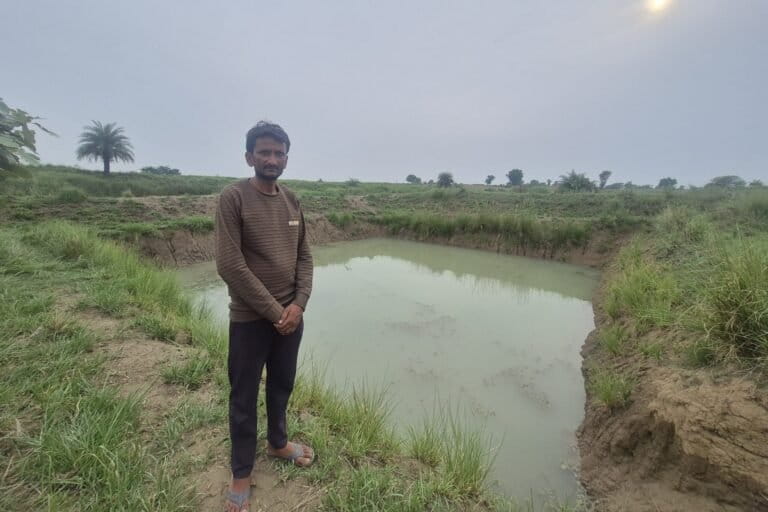
The promise of the khet talab is rooted in productivity. In a successful year, like Vipin Kumar Yadav’s 2023 season, the pond allowed for two rounds of irrigation for four acres of wheat. This boosted his yield from a meager 3.5–4.5 quintals per acre to an impressive 9–10 quintals.
However, the "ground experience" of other farmers reveals a pattern of systemic failure:

1. The Seepage Crisis
In Doda Mafi village, 65-year-old Sunder Kol represents the "losers" of the scheme. His land consists of sandy soil, which acts like a sieve. Despite the rains, his pond cannot retain water. "I haven’t received any benefit," Kol said. He not only lost the yield of his mustard crop but also lost 0.25 acres of cultivable land to the physical footprint of the pond.
2. Siltation and Depth Loss
Mullu Kol of Mangawan panchayat saw his pond’s capacity halved in just over a decade. Originally six feet deep, siltation has reduced it to three feet. Because wheat requires three rounds of irrigation, he has been forced to switch to mustard, which is less water-intensive but also less profitable. This shift has created a local shortage of grain and fodder for his livestock.
3. Abandoned and Half-Finished Projects
The case of Bulli Mawasi in Bambiya gram panchayat highlights the bureaucratic and financial hurdles. His pond, started in 2009 under the MGNREGA scheme, was meant to be 10 feet deep. Work stopped at five feet due to a lack of funds. For 15 years, the pond has remained a dry pit. Mawasi now pays ₹250 an hour to rent irrigation equipment and ₹1,000 for diesel—costs he must borrow at high interest rates.

Official Responses: Budgetary Constraints vs. Strategic Needs
Government officials acknowledge the hurdles but point to a lack of comprehensive funding for maintenance. Baljeet Bahadur, the Soil Conservation Officer for Chitrakoot, noted that while seepage is a known issue in sandy areas, "there is no budget for seepage control, desiltation, or maintenance."
The current subsidy model covers only 50% of the construction cost (₹52,500 out of an estimated ₹1.05 lakh). Officials observe that many farmers limit their excavation to whatever the government subsidy covers, leading to shallow, poor-quality ponds that are more susceptible to evaporation and siltation.
In response to the El Niño forecast, Union Agriculture Minister Shivraj Singh Chouhan recently directed that water-conservation structures be repaired and strengthened under the Viksit Bharat-Guarantee for Rozgar and Ajeevika Mission (Gramin) Act (VB-G RAM G). However, the implementation of these directives at the village level remains slow.

Implications: A Science-Led Path Forward
Experts argue that the khet talab scheme needs a radical overhaul to move from a "target-driven" approach to a "science-led" one.
The Need for Hydrogeological Mapping
Shashikant Tripathi, a hydrogeology expert and retired professor, argues that poor site selection is the primary reason for failure. "The failure to choose the right site is a major reason why the ponds fail," he said. He emphasizes that site selection must consider the underlying rock, slope, drainage density, and soil type. A scientifically placed pond can retain water for four to five months, even in semi-arid conditions.
Maintenance and Ownership
A 2023 case study by Erasmus University Rotterdam noted that when the government adopted the pond scheme, the focus shifted to "visible physical structures," sidelining local knowledge and community participation. Kaushal Garg, a senior hydrology scientist at ICRISAT, suggests that Gram Panchayats must take responsibility for maintenance, utilizing employment schemes like MGNREGA for annual desiltation and bunding repairs.

Technical Innovations
To combat seepage, Gaya Prasad Gopal of the Akhil Bhartiya Samaj Seva Sansthan suggests lining pond beds with black polythene and covering them with black clay soil. Furthermore, experts recommend integrating farm ponds with drip or sprinkler irrigation systems to maximize the "crop per drop" efficiency.
Conclusion: Beyond the Pit
For farmers like Vipin and Keshav Yadav, the farm pond is not just a hole in the ground; it is a vital organ of their farm’s ecosystem. When it fails, the economic ripple effects are profound—leading to debt, migration, and food insecurity.
As Bundelkhand braces for a potentially historic El Niño, the lesson is clear: building a pond is only the first step. Without a dedicated budget for maintenance, scientific site selection, and a focus on soil integrity, the khet talab remains a precarious gamble against a changing climate. For the farmers of Uttar Pradesh, the difference between a bumper harvest and a dry field now depends as much on government policy as it does on the clouds above.
