

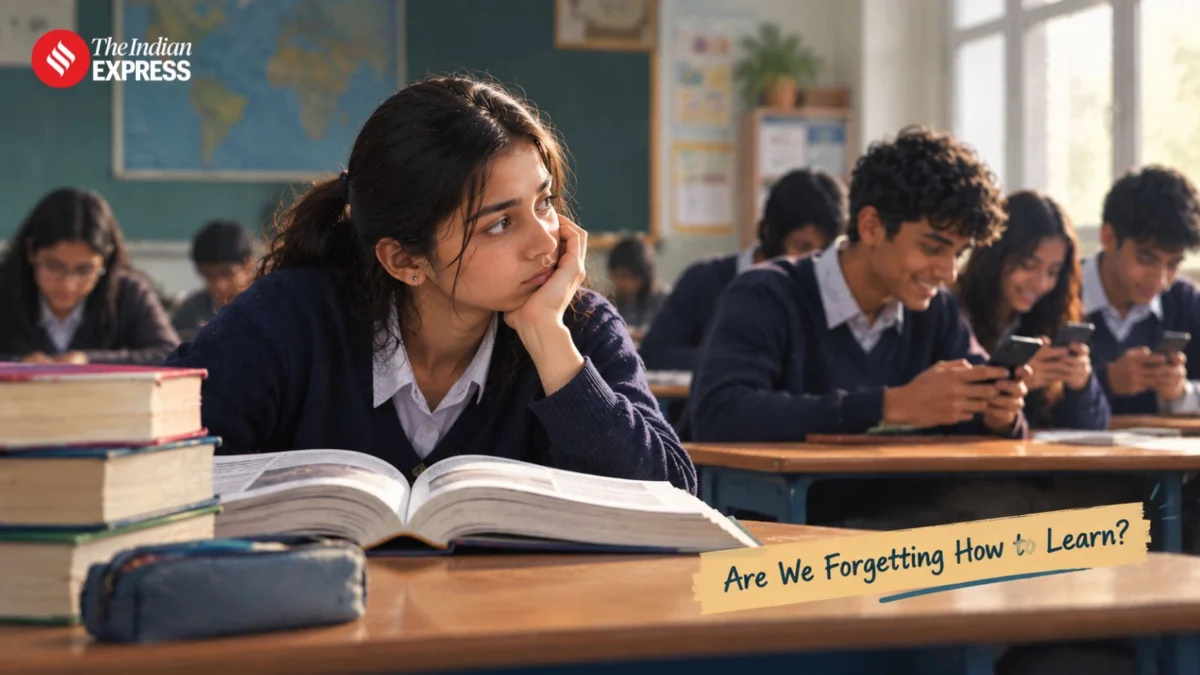
New Delhi, September 12, 2026 – A comprehensive new report from the Organisation for Economic Co-operation and Development (OECD) paints a stark picture of declining academic performance among 15-year-old students worldwide. The Programme for International Student Assessment (PISA) 2025 findings reveal a significant and sustained drop in reading and mathematics scores across many of the world’s major education systems over the past decade, raising urgent questions about the future of global literacy and numeracy.
The PISA 2025 cycle, the largest edition to date encompassing over 760,000 students from 91 countries and economies, has identified a worrying trend: learning levels are falling. Average reading scores among OECD countries have plummeted by 28 points since 2015, a decline the OECD equates to approximately one-and-a-half years of learning. Similarly, mathematics scores have fallen by 22 points, a drop equivalent to just over one year of schooling. This erosion of foundational skills has led to a concerning increase in the proportion of students performing at low achievement levels across science, mathematics, and reading, now standing at one in five, up from 16% in the 2022 PISA cycle.
While science performance has remained broadly stable between 2022 and 2025, it too has seen a decline since 2009. The average scores for OECD countries in PISA 2025 stand at 482 points in science, 463 in mathematics, and 461 in reading. These figures underscore a critical juncture for global education, demanding immediate attention and strategic intervention.
The Unfolding Crisis: A Decade of Decline
The PISA 2025 results confirm that the current learning slump is not a recent phenomenon exacerbated by the COVID-19 pandemic. The report indicates that reading performance had been weakening prior to the global health crisis, and mathematics scores experienced a sharp decline after 2018. This long-term downward trajectory is a significant cause for concern, suggesting systemic issues within educational frameworks that predate recent disruptions.
"The PISA 2025 results are a wake-up call," stated a senior OECD education analyst during a press briefing. "We are witnessing a worrying erosion of fundamental skills in reading and mathematics across many of our member countries. This decline, which has been unfolding over the past decade, has profound implications for individual students’ future opportunities and for the overall economic and social well-being of our nations."
The PISA assessment, renowned for its rigorous methodology, goes beyond rote memorization. It evaluates how well 15-year-old students can apply their knowledge and skills in science, mathematics, and reading to real-world situations, assess information, solve problems, and engage effectively as citizens. The scale of the decline observed in reading and mathematics is particularly troubling, as these are considered the bedrock upon which higher-level learning and critical thinking are built.
PISA 2015-2025 Performance Trends (OECD Countries vs. Non-OECD Participants)
| Subject | OECD Countries | Non-OECD Participants |
|---|---|---|
| Reading | -28 points | -16 points |
| Mathematics | -22 points | -8 points |
| Science | Modest decline | Broadly stable |
Source: PISA 2025 Results (Volume I)
The data highlights that the decline in reading and mathematics is more pronounced in OECD countries compared to participating non-OECD economies, which have seen more modest drops or relative stability in some areas. This divergence suggests that while challenges are global, the impact and potential underlying causes may differ across various economic and educational contexts.
Resilience and Exception: Asian Nations Lead the Way
Amidst the widespread decline, the PISA 2025 report identifies pockets of resilience and exceptional performance, particularly among several Asian nations. While the overall trend points downwards, these systems demonstrate that sustained high performance is achievable through focused educational policies and robust implementation.
The Chinese provinces of Beijing, Shanghai, Jiangsu, and Zhejiang, collectively reported as B-S-J-Z in PISA data, alongside Singapore, emerged as the strongest performers across all three core subjects. Their consistent top rankings underscore the effectiveness of their educational approaches in fostering deep understanding and application of knowledge.
Other high-achieving systems that featured among the top 10 globally include Estonia, Japan, Korea, Macao (China), Chinese Taipei, and the United Kingdom. These nations have consistently prioritized educational quality and have shown an ability to adapt and innovate in response to evolving global challenges.
Furthermore, the report acknowledges a number of countries that have shown significant improvement in science performance over the longer term. These include Lithuania, the Slovak Republic, Turkey, the Dominican Republic, Georgia, Montenegro, Qatar, Thailand, and the United Arab Emirates. Their progress serves as an encouraging example of how targeted interventions and strategic investments can yield positive educational outcomes.
"The successes observed in countries like Singapore and the B-S-J-Z region are not accidental," commented an education expert. "They are the result of long-term, sustained commitment to teacher training, curriculum development, equitable resource allocation, and a societal emphasis on the value of education. Their experiences offer valuable lessons for other nations grappling with declining performance."
The Persistent Shadow of Socio-Economic Disparities
The PISA 2025 findings also cast a spotlight on the enduring influence of socio-economic background on student achievement. Across OECD countries, students from more advantaged backgrounds continue to outperform their disadvantaged peers by a significant margin. In science, for instance, advantaged students scored an average of 85 points higher than disadvantaged students.
Crucially, the report clarifies that the observed narrowing of this gap in some instances is not due to real gains for disadvantaged students, but rather a consequence of weaker performance among their more advantaged counterparts. This suggests that the socio-economic divide remains a formidable barrier to equitable educational outcomes, impacting not only access to resources but also the quality of learning experiences.
"The widening gap between advantaged and disadvantaged students is a societal failing that education systems must address," stated a spokesperson for a global education advocacy group. "It is imperative that we move beyond simply acknowledging this disparity and implement concrete policies to ensure that every child, regardless of their background, has the opportunity to reach their full potential."
The report emphasizes that factors such as parental education, occupation, and home resources continue to play a pivotal role in shaping a student’s academic trajectory. While schools strive to be equalizers, the pervasive influence of socio-economic factors outside the classroom cannot be ignored.
The Double-Edged Sword of Digital Technology and AI
In an era increasingly defined by digital transformation, the PISA 2025 assessment delves into the complex relationship between technology, artificial intelligence (AI), and student learning. The findings reveal that digital devices are now ubiquitous in the learning environment, but their impact is a mixed bag, presenting both opportunities and significant challenges.
Alarmingly, 46% of OECD students reported using AI chatbots weekly or more frequently to assist them with their learning. Concurrently, a substantial 28% of students indicated that their classmates were distracted by digital devices during most or every science lesson. The PISA analysis strongly correlates excessive or leisure-oriented device use with weaker academic performance, suggesting that the pervasive presence of digital distractions is actively hindering learning.
However, the report offers a nuanced perspective on AI. It found that AI use was not uniformly detrimental. Students who utilized AI for learning and were equipped with the skills to critically evaluate AI-generated information tended to perform better than those who were frequent users without such guidance. This critical distinction underscores the importance of digital literacy education.
"The key takeaway regarding AI is not whether students use it, but how they use it and whether they are taught to use it critically," explained a lead researcher on the PISA project. "Simply providing access to AI tools is insufficient. We must focus on developing students’ ability to discern reliable information, understand the limitations of AI, and integrate these tools as aids rather than replacements for genuine learning and critical thinking."
The PISA 2025 also introduced a new assessment of computational problem-solving skills. While nearly two-thirds of OECD students achieved proficiency in this area, only about half did so while also demonstrating basic proficiency in science, reading, and mathematics. This finding highlights a crucial point: digital skills cannot easily compensate for fundamental weaknesses in core academic subjects. A strong foundation in reading, writing, and arithmetic remains paramount, even in a technologically advanced world.
Looking Ahead: Implications and the Path Forward
The PISA 2025 results serve as a stark warning, demanding a comprehensive and urgent response from policymakers, educators, parents, and students worldwide. The observed declines in reading and mathematics are not merely statistics; they represent a generation of young people potentially ill-equipped to navigate an increasingly complex global landscape.
The implications of this learning crisis are far-reaching. A decline in foundational literacy and numeracy skills can lead to reduced educational attainment, limited career opportunities, and decreased civic engagement. Economically, it could result in a less skilled workforce, diminished innovation, and a slower pace of economic growth.
Addressing this challenge will require a multi-pronged approach:
- Curriculum Reform and Pedagogical Innovation: Educational systems must re-evaluate their curricula to ensure they are relevant, engaging, and effective in fostering deep learning. This includes a renewed focus on foundational skills and the integration of critical thinking, problem-solving, and digital literacy.
- Teacher Professional Development: Investing in high-quality teacher training and ongoing professional development is crucial. Educators need to be equipped with the latest pedagogical strategies, effective classroom management techniques, and the skills to integrate technology meaningfully into their teaching.
- Equitable Resource Allocation: Addressing the socio-economic disparities in education requires targeted interventions to support disadvantaged students. This includes providing additional resources, tutoring, and early childhood education programs to level the playing field.
- Responsible Technology Integration: Schools and governments must develop clear guidelines and strategies for the responsible integration of digital technologies and AI. This involves not only providing access but also equipping students and teachers with the skills to use these tools effectively and ethically.
- Parental and Community Engagement: Fostering a societal appreciation for education and encouraging parental involvement in a child’s learning journey is vital. Strong partnerships between schools, families, and communities can create a supportive ecosystem for academic success.
The OECD has committed to working closely with its member countries to analyze the PISA 2025 findings in greater detail and to develop evidence-based policy recommendations. The organization emphasizes that the future prosperity and well-being of nations depend on their ability to equip their young people with the knowledge and skills they need to thrive in the 21st century. The PISA 2025 report is not just a snapshot of current performance; it is a call to action to reverse the tide of declining learning and build a more robust and equitable future for all.
