

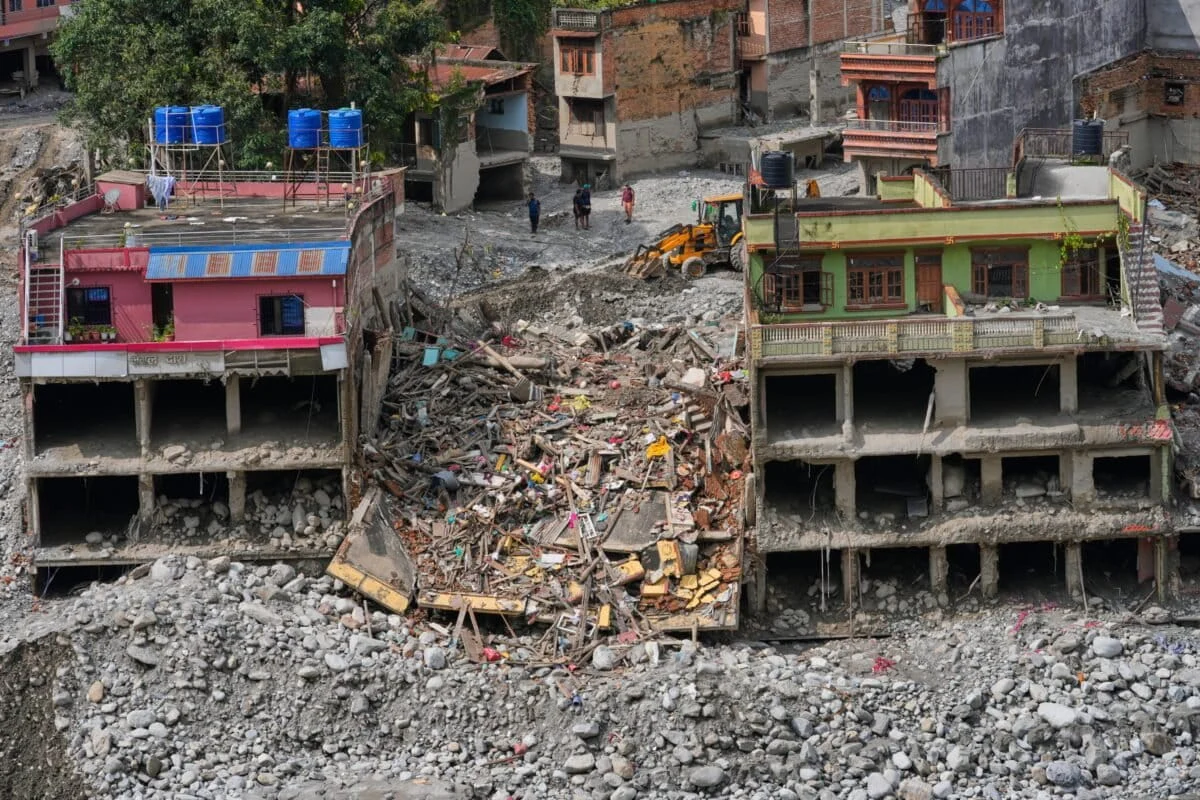
KATHMANDU — The wreckage along the Bhote Koshi river is more than a trail of twisted metal and silted remains; it is a graveyard of unresolved questions. As of September 12, 2026, the death toll from the August 26 floods in Nepal has climbed to 1,386, with over 5,130 individuals still missing. In the wake of this unprecedented cryospheric collapse, the Himalayan nation has become the flashpoint for a global debate: Can the nascent Fund for Responding to Loss and Damage (FRLD) actually protect the world’s most vulnerable, or is it merely a symbolic gesture in an era of escalating climate chaos?
Nepal, a country responsible for a mere 0.027% of global greenhouse gas emissions, now finds itself at the center of an existential struggle. On August 31, the Government of Nepal took the extraordinary step of petitioning the Board of the FRLD, a financial mechanism established under the United Nations Framework Convention on Climate Change (UNFCCC). The letter, signed by Finance Minister Swarnim Wagle and Minister for Agriculture, Forest and Environment Gita Chaudhary, was not just a request for aid; it was a challenge to the international community to translate "solidarity into timely support."
Main Facts: The Human and Economic Toll
The disaster of August 26 was not a typical monsoon event. It was a "cascading" disaster—a complex chain reaction that began in the high-altitude cryosphere and ended in the destruction of downstream communities. According to assessments by the International Centre for Integrated Mountain Development (ICIMOD), the direct damage from this single event is estimated at a staggering $2.6 billion.
However, the financial burden does not end with immediate losses. Sravan Shrestha, a remote sensing and geoinformation specialist at ICIMOD, warns that the true cost of reconstruction and recovery could exceed $5 billion. For a nation classified by the UN as a "Least Developed Country" (LDC), such a figure represents a significant portion of its annual GDP, threatening to reverse decades of developmental progress.
The tragedy has left thousands of families in a state of perpetual mourning and uncertainty. In districts like Nuwakot and along the Trishuli and Tadi rivers, entire villages have been replaced by thick layers of sludge and debris. The scale of the missing—over 5,000 people—suggests that the final death toll may be among the highest in Nepal’s recent history of natural disasters.

Chronology of a Cascading Disaster
The catastrophe began on the morning of August 26, 2026, at an altitude of approximately 5,200 meters on the north face of the Langtang Himal.
The Trigger (06:00 AM – 08:00 AM)
A bedrock slope beneath a "hanging glacier" failed, sending a massive volume of rock and ice plummeting 1,200 meters. This was not a simple avalanche; the sheer friction generated during the fall melted vast quantities of ice, transforming the mass into a hyper-concentrated debris flow. This surge roared into the Lhende Khola, a primary tributary of the Bhote Koshi river.
The Surge (08:00 AM – 10:00 AM)
By the time the flow reached the Lhende Khola at 2,900 meters, it had gained enough momentum and volume to overwhelm existing riverbeds. The water, already swollen by seasonal monsoon rains, became a wall of mud, boulders, and timber.
The Impact (10:00 AM – 12:00 PM)
The flood crossed the border into Nepal and reached the settlement of Syabrubesi within ten minutes. Automated river gauges, designed to provide early warnings for rising water levels, were instantly swept away. The velocity of the debris flow rendered traditional early warning systems (EWS) useless; the disaster arrived before the alerts could be processed.
The Diplomatic Response (August 31)
Five days after the disaster, the Nepalese government dispatched its formal appeal to the FRLD Board. The letter emphasized that the Bhote Koshi disaster is a textbook example of how climate-driven events in the cryosphere compound and cascade, affecting everything from water and food security to health and infrastructure.

Supporting Data: The Science of Himalayan Warming
The tension surrounding the Nepal floods is rooted in the "attribution" debate. While scientists hesitate to link a single slope failure directly to climate change without exhaustive study, the broader data points to an undeniable trend.
The "Third Pole" is Melting
The Hindu Kush Himalaya (HKH) region is warming at approximately 0.3°C per decade—roughly twice the global average. A comprehensive 2026 glacier assessment, utilizing 30 years of Landsat satellite data, revealed that the region has lost 12% of its glacier area since 1990. More alarmingly, the rate of loss in the last decade was 50% higher than in the 1990s.
The Frequency of Extremes
Historically, glacial-origin floods in the HKH were expected once every 5 to 10 years. "In 2025 alone, three such events hit the region, and now this in 2026," says Shrestha. As glaciers retreat, they remove the physical pressure that once held bedrock slopes in place, making catastrophic failures more likely.
The Preparedness Gap
Nepal currently monitors 47 "potentially dangerous" glacial lakes, with sophisticated early warning systems at Tsho Rolpa and Imja Tsho. However, the August 26 event did not originate from a lake. It came from a bedrock slope failure—a hazard that no regional inventory currently tracks. This "blind spot" in monitoring highlights the need for a total overhaul of disaster risk reduction (DRR) infrastructure in mountain regions.
Official Responses and the "Loss and Damage" Dilemma
Nepal’s request to the Fund for Responding to Loss and Damage has placed the international community in a difficult position. The FRLD was operationalized at COP28 in Dubai with great fanfare, but its actual capacity remains questionable.

The Financial Shortfall
Pledges to the fund currently stand at approximately $820 million. While this sounds substantial, it is dwarfed by the demand. As of the July 2026 board meeting, 119 countries had submitted 176 funding requests totaling $2.8 billion. Nepal’s $2.6 billion damage estimate for a single event nearly equals the total requests from the rest of the world combined.
"The resources currently available are orders of magnitude below the scale of actual loss and damage needs," says Vera Künzel, Senior Advisor at Germanwatch. She notes that while the fund was welcomed with enthusiasm, it is currently "far from being able to meet expectations."
The Rapid Response Machinery
The FRLD was designed to provide "rapid response" support, distinguishing it from other climate funds that focus on long-term adaptation. However, experts like Emily Wilkinson of the ODI’s Global Risks and Resilience Programme point out a technical hurdle: the "Barbados Implementation Modalities" (the pilot phase rules) currently lack the specific provisions to trigger immediate cash disbursements for emergencies.
The "Polluter Pays" Principle
Raju Pandit Chhetri, Executive Director of the Prakriti Resource Centre, argues that the burden of proof should not rest on Nepal. "If they say these are not the kind of events that climate change is going to bring, then those questioning it are just shying away from their own responsibility. They should prove the incident was not because of climate change," Chhetri asserts. He maintains that support for Nepal is an obligation rooted in fairness, not charity.
Implications: A System on Trial
The outcome of Nepal’s request, expected to be discussed at the FRLD board meeting in Manila in December 2026, will serve as a litmus test for the Paris Agreement’s effectiveness.

1. The Trust Gap
If the FRLD fails to respond to a disaster of this magnitude, it may permanently damage the trust between the Global South and the Global North. The Least Developed Countries (LDC) Group has already expressed solidarity with Nepal, calling for clearer guidance on how to mobilize additional funding.
2. Redefining Disaster Monitoring
The Bhote Koshi disaster proves that monitoring glacial lakes is no longer enough. Future climate adaptation must include satellite-based monitoring of bedrock stability and "hanging" glaciers. This requires a level of technological investment that most vulnerable nations cannot afford without international aid.
3. Geopolitical and Social Vulnerability
The impact of the flood was worsened by "uneven development" and social marginalization. Many of those killed lived in high-risk zones because they had no other economic options. Future climate finance must address these underlying social vulnerabilities rather than just rebuilding physical infrastructure.
4. The Moral Imperative
As the "polluter pays" principle gains traction in international law, the Nepal floods provide a clear case for climate reparations. With a negligible carbon footprint, Nepal is paying the ultimate price for a crisis it did not create.
The disaster in the Langtang Himal is a warning to the world. As the mountains crumble and the rivers rise, the time for "pilot phases" and "comprehensive assessments" is running out. For the 5,130 missing in the mud of the Bhote Koshi, the international community’s response—or lack thereof—will be the final word on the promise of global climate justice.
