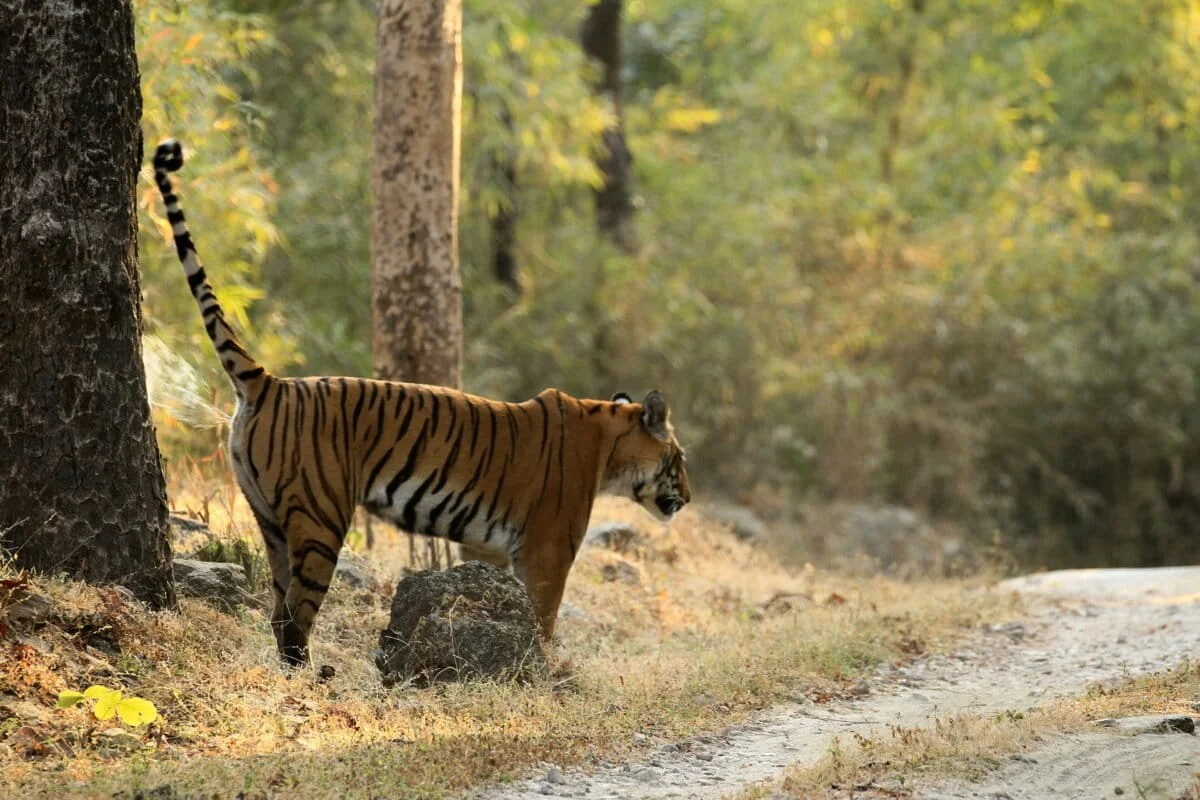
In the dense undergrowth of India’s deciduous forests, the presence of a Bengal tiger or an Indian leopard is often a whispered secret, revealed only by a fleeting shadow or a distant alarm call. For decades, conservationists have relied on the "eyes" of the forest—camera traps—and the "blueprints" of life—DNA from hair and scat—to monitor these elusive predators. However, while these methods can tell us who is there and how many of them exist, they often remain silent on the most intimate details of an animal’s life: its health, its age, and its reproductive journey.
A groundbreaking study led by researchers from the National Centre for Biological Sciences (NCBS), Ahmedabad University, and the Danish Academy of Technical Sciences is changing that narrative. By analyzing Volatile Organic Compounds (VOCs) found in urine and scat, scientists have unlocked a "chemical diary" that allows them to read the physiological state of big cats without ever making physical contact. This non-invasive approach marks a significant leap forward in the field of chemical ecology, providing a new lens through which to view the health and population dynamics of India’s most iconic predators.
Main Facts: Decoding the Chemical Signature
The core of the research lies in the premise that every animal leaves behind a trail of airborne chemicals. These VOCs are the primary language of the animal kingdom, used for marking territory, attracting mates, and signaling social status. Until now, capturing and interpreting these signals in the wild was considered a monumental challenge due to environmental interference.
The study’s primary breakthrough is the successful identification of species, sex, and reproductive status through the analysis of these odors. Key findings include:
Species Identification: Researchers could distinguish between Bengal tigers and Indian leopards with an accuracy rate of 79% using urine samples and 75% using scat.
Reproductive Monitoring: A specific compound, nonanol, was found in significantly higher concentrations in the urine of pregnant or lactating female tigers, offering a potential "chemical pregnancy test" for wild populations.
Physiological Insights: The study successfully classified age and sex with varying degrees of accuracy (between 55% and 71%), overcoming the limitations of traditional visual monitoring.
Health Indicators: In a notable case study, elevated levels of dimethyl tetrasulphide were found in the scat of a captive tiger suffering from epilepsy, suggesting that metabolic changes caused by illness are reflected in an animal’s scent.
Chronology: From the Zoo to the Wild
The journey of this research followed a rigorous path from controlled environments to the unpredictable landscapes of the Ranthambore Tiger Reserve.
Phase 1: Controlled Environments (The Baseline)
The study began in the controlled settings of three major Indian zoos: Bannerghatta Biological Park (Bengaluru), Kamala Nehru Zoological Park (Ahmedabad), and Sayajibaug Zoo (Vadodara). Here, researchers had access to nine captive tigers and 15 captive leopards. Because the age, sex, and medical history of these animals were documented, the team could create a reliable chemical "baseline." They supervised the collection of urine and scat directly from enclosure floors, ensuring that the samples were fresh and untainted.
Phase 2: The Transition to the Wild
To prove the method’s viability in the real world, the team moved to Rajasthan’s Ranthambore Tiger Reserve. Ranthambore provided a unique "living laboratory" because its tiger population is among the most well-monitored in the world. Forest guards and researchers can identify individual tigers by their stripe patterns, allowing the team to tie chemical samples back to known individuals.
The researchers collected 144 urine samples from 28 individually identified wild tigers. The process required immense patience; teams waited for tigers to "spray" (scent-mark) trees or rocks and then moved in to collect the sample once the animal had departed. To ensure the accuracy of their findings, they also collected "control" samples of soil, grass, leaf litter, and bark to distinguish the animal’s scent from the surrounding environment.
Phase 3: Laboratory Analysis and Machine Learning
Back in the lab, the team used thermal desorption-gas chromatography-mass spectrometry (TD-GC-MS) to isolate and identify the specific chemical compounds. Given the complexity of the data, they employed a Random Forest machine-learning algorithm. This AI-driven approach looked for patterns across hundreds of different compounds to determine which combinations were most indicative of species, age, or sex.
Supporting Data: The Accuracy of the "Whiff"
The data revealed that while urine and scat both carry vital information, they serve different diagnostic purposes.
Urine vs. Scat
Urine proved to be a more consistent medium for monitoring. It produced stable chemical signals regardless of the season. In contrast, scat samples were highly susceptible to environmental degradation. During the intense heat of the Indian summer, scat dried quickly, losing its volatile components, while the monsoon rains frequently washed away samples before they could be collected.
Demographic Accuracy
The Random Forest models showed that:
Tiger Sex Identification: Urine yielded 55% accuracy, while scat was more reliable at 71%.
Tiger Age Identification: Both urine and scat hovered around 63-64% accuracy.
The "Male" Problem: Interestingly, the model more frequently misclassified older tigers and males. Researchers hypothesize that the chemical profiles of dominant males may be more complex or subject to more frequent fluctuations due to territorial stress.
The Nonanol Breakthrough
Perhaps the most significant data point was the discovery of nonanol. In the wild tiger population at Ranthambore, four females were either pregnant or lactating during the study. Their urine samples showed a massive spike in nonanol compared to non-reproductive females. This provides conservationists with a tool to monitor the "recruitment" (birth rate) of a population without having to wait for cubs to emerge from dens months later.
Official Responses: Insights from the Research Team
The researchers emphasize that this is not just a laboratory success but a practical tool for the future of conservation.
B.V. Aditi Prasad, the study’s corresponding author and a postdoctoral fellow at the Max Planck Institute, highlighted the non-invasive nature of the work:
"The goal was to see whether you could ‘read’ biologically meaningful information directly from the odors the animals leave behind, without ever having to catch, dart, or physically handle the animal. It’s striking that so much—its sex, age, reproductive status, even signs of illness—can be read from a single whiff."
Shannon B. Olsson, supervising author from the Danish Academy of Technical Sciences, pointed to the medical and forensic potential:
"Detecting chemicals in urine and fecal matter has been widely used in nutrition, medicine, and forensics. Applying such techniques to conservation offers researchers and managers the opportunity to directly monitor individual statuses for population health and safety."
Uma Ramakrishnan, a renowned molecular ecologist from NCBS and co-author, stressed the importance of an integrated approach:
"The novel chemical ecology tools showcased here, when integrated with other approaches, are sure to help us understand and conserve these amazing animals better."
Implications: The Future of Forest Management
The introduction of VOC analysis into the conservationist’s toolkit has several profound implications for the management of tiger reserves and human-wildlife conflict zones.
1. Resolving Species Ambiguity
In many parts of India, tigers and leopards share the same habitat. Their physical signs, such as territorial "scrapes" in the dirt or scat, can look remarkably similar to the untrained eye. Chemical analysis can provide a definitive identification, helping forest departments understand how these two predators partition their habitat and compete for resources.
2. Identifying "Problem" Animals
In cases of human-wildlife conflict, it is often difficult to identify which specific animal is involved in cattle lifting or attacks on humans. If a "problem" animal leaves behind a scent mark or scat, VOC analysis could potentially help managers identify its sex, age, and health status (such as an injury or illness that might be driving it toward easier prey), allowing for more targeted and humane interventions.
3. A Complement to Camera Trapping
The researchers are careful to note that this method will not replace camera traps. Camera traps remain the gold standard for population counts and for detecting cubs, who do not yet mark territory with urine. Instead, odour analysis acts as a "deep dive" into the data that cameras cannot provide. While a camera shows a tiger is present, the scent tells you if that tiger is healthy or pregnant.
4. Overcoming Environmental Challenges
The study acknowledges that this method is in its infancy. Factors such as diet, humidity, and temperature can all alter the chemical "bouquet" of an animal. Future research will need to involve larger sample sizes and broader validation across different Indian landscapes—from the humid mangroves of the Sundarbans to the cold forests of the foothills.
Conclusion: A New Era of Non-Invasive Science
The ability to "read" the forest through its scents represents a paradigm shift in wildlife biology. As tiger populations in India continue to spill over the boundaries of protected reserves into human-dominated landscapes, the need for sophisticated, non-invasive monitoring has never been more urgent.
By combining the ancient instincts of the animal kingdom with the cutting-edge capabilities of gas chromatography and machine learning, scientists have opened a new dialogue with nature. This "whiff of science" may well be the key to ensuring that the roar of the tiger and the silent tread of the leopard continue to echo through India’s wilderness for generations to come.