

The Indian electric vehicle (EV) landscape is witnessing a significant shift as performance-oriented manufacturers move beyond basic commuting solutions toward specialized, high-performance machinery. Ultraviolette Automotive, a frontrunner in this space, has officially recalibrated the launch trajectory for its highly anticipated electric enduro motorcycle, the Shockwave.
Originally slated for a 2026 release, the Shockwave is now scheduled for a market debut in the first quarter of 2027. This delay is not merely a scheduling setback but a strategic overhaul, as the company has confirmed that the motorcycle will transition to a newly developed 100V battery and drivetrain architecture. This move aligns the Shockwave with the updated Tesseract electric scooter, signaling a unified high-voltage roadmap for Ultraviolette’s next generation of products.
I. Main Facts: The Evolution of the "Funduro" Concept
The Ultraviolette Shockwave represents a departure from the sleek, aerodynamic silhouettes of the F77 Mach 2. Positioned as a "Funduro"—a portmanteau of "Fun" and "Enduro"—the motorcycle aims to capture the raw, mechanical spirit of classic two-stroke dirt bikes while leveraging the instantaneous torque of electric propulsion.
The 100V Architectural Shift
The most critical update in the recent announcement is the migration to a 100V system. In the world of electric motorcycles, higher voltage systems are often synonymous with greater efficiency and sustained performance. By moving to 100V, Ultraviolette aims to achieve:

- Enhanced Thermal Management: Higher voltage allows for lower current flow for the same power output, reducing heat buildup in the battery and motor during high-load off-road riding.
- Improved Power Density: The architecture supports more aggressive power delivery, essential for the "snap" required in enduro riding.
- Faster Charging Capabilities: Higher voltage platforms typically facilitate quicker energy replenishment, a vital factor for riders taking the bike on trail excursions.
Versatile Ergonomics
Recognizing the diverse needs of the modern rider, Ultraviolette has confirmed that the production version of the Shockwave will be available in both single-seat and dual-seat configurations. The single-seat setup caters to hardcore off-road enthusiasts looking for maximum mobility, while the dual-seat version offers utility for urban environments and occasional pillion use.
II. Chronology: From Concept to Refinement
The journey of the Shockwave has been one of rapid prototyping followed by calculated technical pivots. Understanding the timeline provides insight into Ultraviolette’s "fail-fast, refine-faster" engineering philosophy.
- March 2025: The "Fast Forward India" Unveiling
Ultraviolette hosted a landmark event where it showcased two future-leaning concepts: the Tesseract (a high-performance scooter) and the Shockwave (the enduro motorcycle). At this stage, the Shockwave was presented as a near-production-ready prototype with a launch window set for late 2025 or early 2026. - Mid-2025 to Early 2026: Testing and Feedback
Following the unveiling, the company engaged in extensive testing. Feedback from these sessions, combined with advancements in their internal R&D regarding battery chemistry and motor controllers, led to the realization that a higher-voltage platform would be necessary to meet the ambitious performance targets set for the "Funduro" category. - May 2026: The Tesseract Precedent
Ultraviolette announced that the Tesseract scooter would be delayed to January 2027 to accommodate the shift to the 100V architecture. This set the stage for a similar update for the Shockwave. - March 2027 (Projected): Commercial Launch
The Shockwave is now expected to hit the showroom floors between January and March 2027. This timeline allows the company to synchronize the production lines for both the Tesseract and the Shockwave, utilizing shared components of the 100V ecosystem.
III. Supporting Data: Technical Specifications and Benchmarks
While the shift to 100V architecture means final production figures may vary, the specifications released during the March 2025 unveiling provide a baseline for what enthusiasts can expect. Ultraviolette has hinted that the 100V update will likely meet or exceed these "reference" figures.
Performance Metrics (Reference Prototype)
- Peak Power: 14.5 bhp (approx. 11 kW).
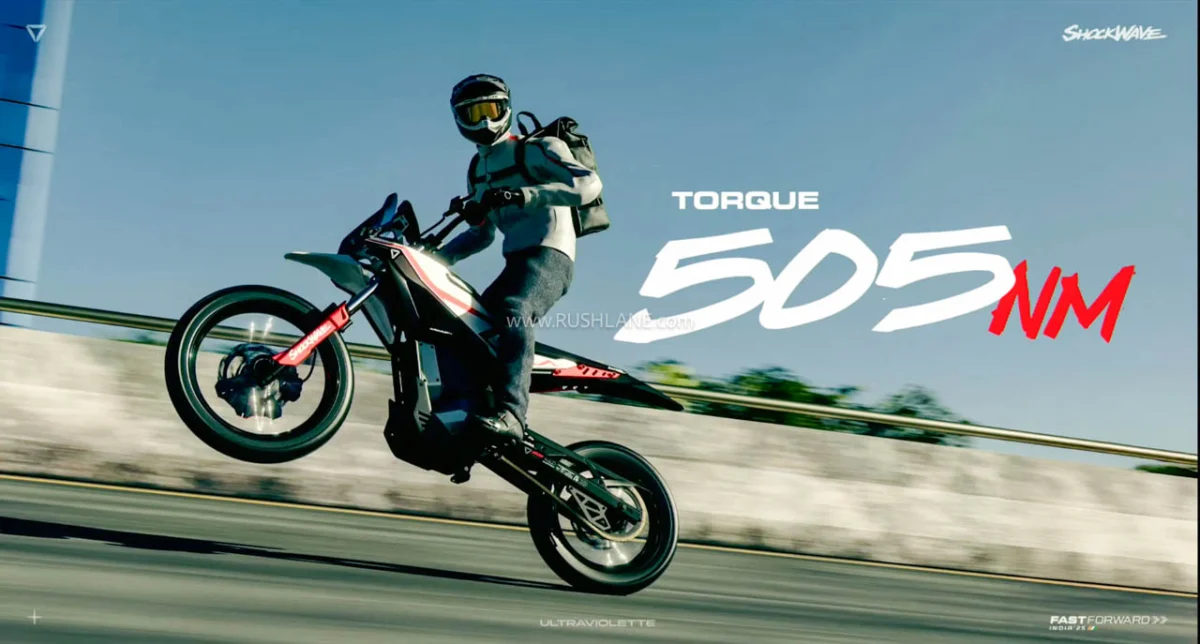
- Wheel Torque: A staggering 505 Nm. This figure highlights the massive reduction gearing typical of electric off-roaders, designed to provide "stump-pulling" low-end grunt.
- Acceleration: 0 to 60 km/h in 2.9 seconds.
- Top Speed: 120 km/h, sufficient for both trail transitions and urban highway stretches.
- Curb Weight: 120 kg. To put this in perspective, this is significantly lighter than most 150cc–200cc internal combustion engine (ICE) dual-sport motorcycles.
Range and Charging
- IDC Range: 165 km on a single charge.
- Battery Tech: While specific kWh figures for the 100V pack are pending, the focus remains on high discharge rates to support the bike’s "spirited" riding character.
Cycle Parts and Hardware
The Shockwave is built to withstand the rigors of off-road abuse:

- Suspension: Long-travel telescopic front forks (200 mm travel) and a rear monoshock (180 mm travel).
- Wheels/Tires: A classic 19-inch front and 17-inch rear combination, likely shod with dual-purpose or knobby tires.
- Braking: Disc brakes at both ends, featuring dual-channel ABS with a "Supermoto" mode that allows the rider to switch off the rear ABS for controlled slides.
IV. Official Responses: Leadership Vision
The leadership at Ultraviolette has been transparent about the decision to push back the launch in favor of technical superiority. Narayan Subramaniam, Co-founder and CEO of Ultraviolette, has emphasized that the Shockwave is more than just a product; it is a statement of intent for the brand.
Speaking on the parallel development of the Shockwave and Tesseract, Subramaniam noted:
"The move to a 100V architecture is a pivotal step in our evolution. It allows us to deliver the kind of visceral, engaging riding experience that we originally envisioned for the Shockwave. We aren’t just building an electric motorcycle; we are recreating the soul of the ‘Funduro’ for a new generation. By aligning our upcoming platforms on this high-voltage architecture, we ensure that our products remain at the cutting edge of thermal efficiency and power delivery."
The company also confirmed that the setup of the dedicated production line for the Shockwave has already commenced within its existing manufacturing facility in Bengaluru. This suggests that while the launch is a year away, the industrialization phase is well underway.

V. Implications: The Broader Market Impact
The delay and subsequent upgrade of the Shockwave carry several implications for Ultraviolette, its competitors, and the Indian EV ecosystem at large.
1. Financial Fortification
The timing of this announcement coincides with a major financial milestone for the company. Ultraviolette recently secured an $85 million funding round. Notably, Lip-Bu Tan, the Executive Chairman of Walden International and CEO of Intel, participated as an investor and joined the company as an advisor. This influx of capital and Silicon Valley expertise provides Ultraviolette with the "runway" needed to invest in complex 100V R&D without the immediate pressure of rushed product launches.
2. Defining a New Niche
The Indian market currently lacks a dedicated, performance-oriented electric enduro. While there are electric commuters and high-end sportbikes like the F77, the middle-ground "lifestyle" off-road segment is largely vacant. By the time the Shockwave launches in 2027, it will likely face competition from Hero MotoCorp’s EV wing (Vida) or specialized startups, but its high-voltage architecture may give it a significant performance edge.
3. Pricing Strategy Challenges
At the March 2025 unveiling, an introductory price of Rs 1.5 lakh was teased for the first 1,000 buyers, with a standard price of Rs 1.75 lakh thereafter. However, with the transition to 100V architecture and the inflationary pressures of the next two years, market analysts speculate that the final production price may see an upward revision. Ultraviolette will need to balance its "premium-tech" positioning with the price sensitivity of the Indian enthusiast market.

4. Infrastructure Synergy
The move to 100V is also a nod toward future-proofing. As India’s DC fast-charging infrastructure matures, vehicles with higher-voltage architectures will be better positioned to take advantage of high-speed charging stations, reducing downtime for riders who use their Shockwaves for weekend adventures far from home.
Conclusion: A Calculated Leap Forward
The Ultraviolette Shockwave is representative of a new era in Indian motorcycling—one where electric power is not just a "green" alternative but a performance upgrade. By opting to delay the launch to integrate 100V architecture, Ultraviolette is prioritizing long-term brand equity over short-term sales cycles.
As the company prepares its Bengaluru facility for the 2027 rollout, the industry will be watching closely. If the Shockwave can deliver on its promise of 505 Nm torque in a 120 kg package with the reliability of a high-voltage system, it may very well become the "gold standard" for electric off-roading in the subcontinent. For now, enthusiasts must wait, but the promise of a truly uncompromising "Funduro" suggests that the wait may be well worth it.
